AWS Announces Enhanced Custom Event Bus for Amazon EventBridge to Streamline Enterprise Event-Driven Architectures

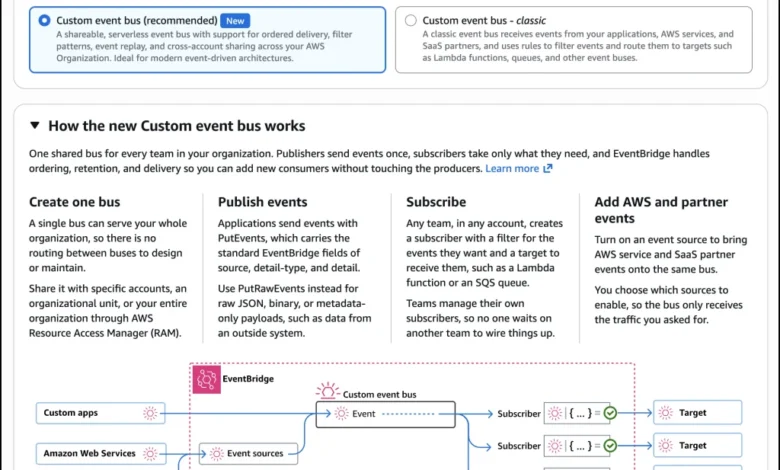
Organizations building event-driven applications on Amazon EventBridge have historically faced significant operational friction as they scaled from single-team prototypes to multi-account enterprise architectures. To address these challenges, Amazon Web Services (AWS) has announced the launch of an enhanced custom event bus for Amazon EventBridge, a transformative update designed to provide a centralized event backbone that eliminates the architectural complexity of traditional multi-bus, cross-account configurations.
The Evolution of Event-Driven Scaling
For years, the standard practice for AWS developers was to deploy a single custom event bus within a single account. While this model is highly effective for localized workloads, it becomes increasingly difficult to manage as organizations adopt multi-account strategies to enforce security boundaries and team autonomy. Previously, connecting these accounts required a complex web of cross-account rules and bus-to-bus configurations. This workaround often introduced "architectural bloat," where platform teams struggled to maintain visibility into event subscriptions, and costs compounded unpredictably due to the nature of inter-bus routing.
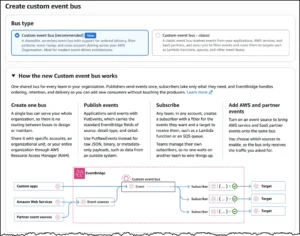
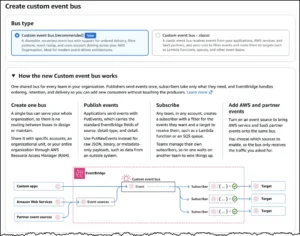
The new enhanced custom event bus seeks to reverse this trend by offering a unified infrastructure layer. By allowing a single bus to be shared across an entire AWS organization, AWS is effectively shifting the burden of routing and discovery from the developer to the managed service provider. This development reflects a broader industry shift toward simplifying serverless operations, where the goal is to minimize the "plumbing" required to maintain a functional distributed system.

Chronology of Amazon EventBridge Development
Since its inception, Amazon EventBridge has evolved from a simple event routing service into the primary nervous system for many AWS-native applications.
- 2019: AWS rebranded Amazon CloudWatch Events as Amazon EventBridge, signaling a pivot toward a serverless event bus capable of connecting SaaS applications and custom microservices.
- 2020–2022: The service expanded to include features like Schema Registry, Event Replay, and Pipes, which enabled easier data integration. However, the multi-account management remained a manual, permission-heavy process.
- 2023–2024: As organizations reached the limits of traditional EventBridge throughput, developers began requesting more granular controls over ordering and delivery guarantees.
- September 2026: AWS introduces the enhanced custom event bus, marking a significant milestone in the service’s maturity by introducing native organizational sharing and strict ordering capabilities.
Architectural Improvements and Technical Specifications
The enhanced custom event bus introduces several critical features that address long-standing gaps in serverless architecture. Foremost among these is the support for ordered event delivery. In previous iterations, EventBridge followed an asynchronous, non-deterministic delivery model, which was suitable for most microservices but problematic for logistics or financial systems requiring strict sequential processing. By utilizing an EventGroupId, developers can now ensure that related events are processed in order, effectively removing the need to introduce additional queuing services like Amazon Simple Queue Service (SQS) as a buffer for Lambda functions.
Furthermore, the introduction of the "Subscriber" resource represents a consolidation of what were previously disparate settings. By merging event filtering, target configuration, retry policies, and dead-letter queue (DLQ) management into a single resource, AWS is reducing the configuration surface area. This change is expected to lower the risk of "configuration drift," where different parts of a system become desynchronized due to conflicting rules across various AWS resources.
Supporting Data and Economic Implications
A primary driver for this update is the optimization of cloud expenditure. Under the previous architecture, companies frequently saw ballooning costs resulting from redundant cross-account routing. The new pricing model shifts the cost basis toward a clear ingress/egress throughput structure. Publishers pay for the ingestion of events, and subscribers pay for the delivery. This transparency allows finance and platform engineering teams to perform precise cost allocation, identifying which business units are driving the most traffic across the organization’s event backbone.

Additionally, the increased capacity—a default quota of 10,000 subscribers per bus—is a major performance upgrade. Previously, strict limits on the number of targets per rule or rules per bus forced teams to implement "fan-out" patterns that added latency and management overhead. By scaling the capacity of a single bus, AWS is allowing for flatter, more efficient architectures that can handle high-throughput scenarios without fragmentation.
Data Integrity and Reliability Features
Reliability remains a cornerstone of the update. The inclusion of content-based deduplication is a significant advancement for high-scale environments. In scenarios where network timeouts occur, publishers often retry events, potentially leading to duplicate processing. With the new enhanced bus, EventBridge automatically hashes incoming payloads to detect and suppress duplicate events within a five-minute window. This provides "exactly-once" delivery semantics for those scenarios where idempotency is difficult to implement at the application level.
For enterprises dealing with legacy data formats, the integration of JSONata for real-time event transformation and support for deserializing Apache Avro or Protocol Buffers directly on the bus eliminates the need for intermediate "transformation microservices." This reduces the total number of moving parts in a data pipeline, thereby decreasing the potential points of failure.
Industry Impact and Analyst Perspective
Industry analysts have noted that this move aligns with the "Platform Engineering" trend, where centralized teams are responsible for providing self-service infrastructure to product teams. By enabling AWS Resource Access Manager (AWS RAM) integration, the enhanced bus allows platform teams to delegate the ability to publish or subscribe to events without granting broad administrative permissions. This balance between centralized governance and decentralized execution is considered the "gold standard" for large-scale enterprise cloud adoption.
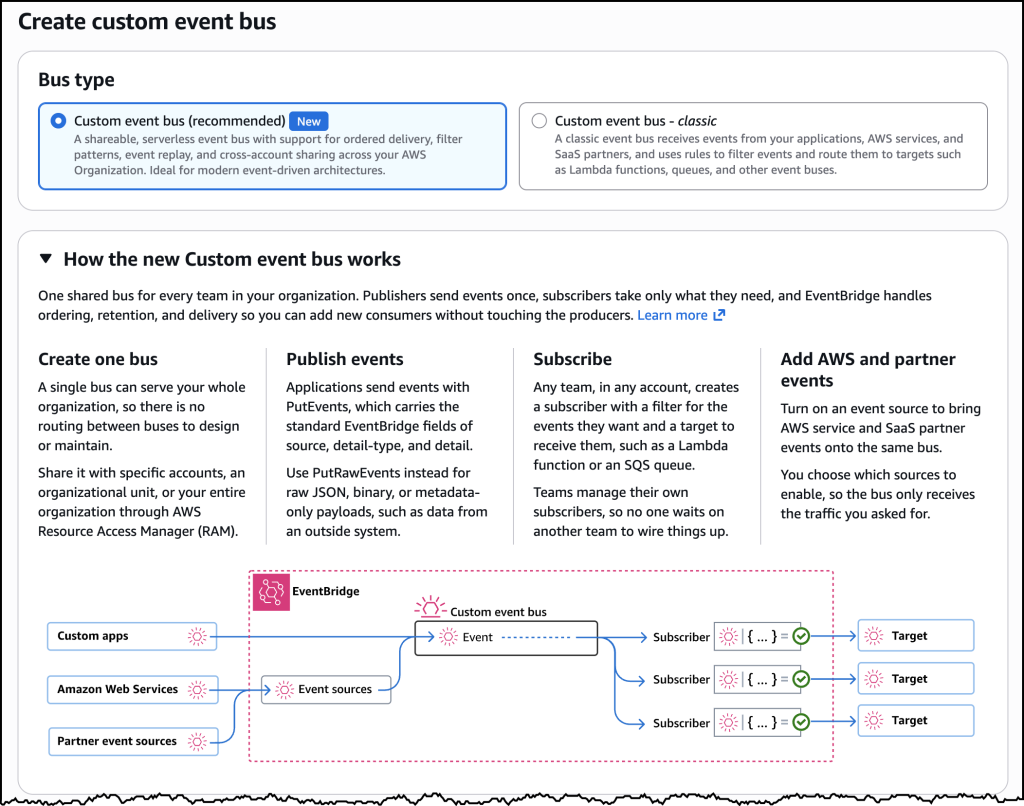
While the "classic" event bus will remain supported for legacy workloads, the introduction of the enhanced bus is expected to become the default for all new serverless projects within the next fiscal year. The transition is non-disruptive, as the new bus is presented as a separate, opt-in resource in the AWS Management Console.
Availability and Next Steps
The enhanced custom event bus is now available in major regions, including US East (N. Virginia, Ohio), US West (Oregon), and key locations across Europe and the Asia Pacific. Organizations are encouraged to review the updated AWS documentation regarding migration paths if they intend to transition existing workloads to the enhanced model.
For teams currently struggling with the "bus-to-bus" bottleneck, the new architecture offers a clear path toward simplification. By centralizing the event backbone, AWS is enabling organizations to focus on business logic rather than the intricate networking and permission configurations that previously dominated event-driven development. This update represents a significant step forward in making complex, multi-account event-driven architectures not only possible but sustainable at scale.
Related posts: