Amazon EventBridge Launches Enhanced Custom Event Bus to Simplify Enterprise Multi-Account Architectures

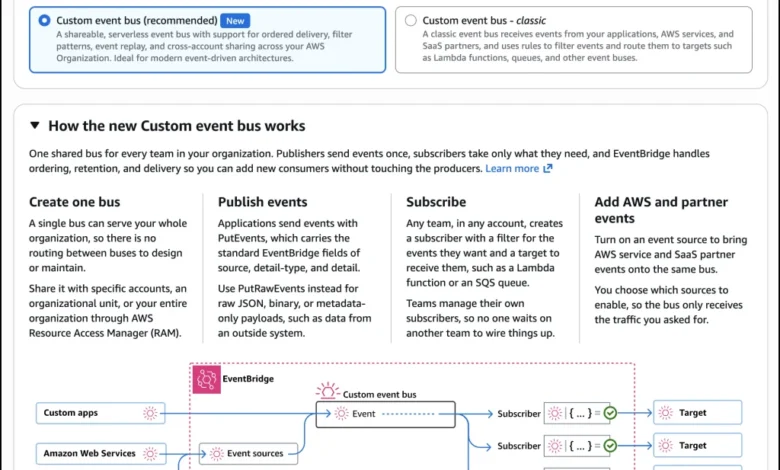
Organizations building event-driven applications on Amazon EventBridge have long operated within a paradigm of complexity as their architectures scale. Historically, these systems began as single, custom event buses contained within a solitary AWS account. While efficient for small, centralized teams, this model often fractured as enterprise adoption matured. AWS best practices advocate for a multi-account structure to isolate workloads, yet the mechanics of routing events between these isolated silos—via cross-account rules or intricate bus-to-bus configurations—frequently reintroduced the very operational friction that serverless architectures were designed to eliminate.
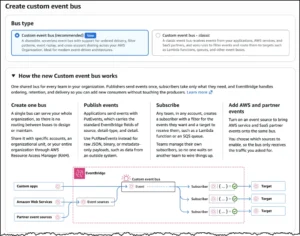
The release of the enhanced custom event bus for Amazon EventBridge represents a fundamental shift in how large-scale organizations manage asynchronous event flows. By providing a centralized, shared event backbone that spans multiple AWS accounts, this new iteration addresses the visibility gaps, routing costs, and ordering limitations that have challenged platform engineers for years.
The Evolution of Event-Driven Infrastructure
The trajectory of serverless adoption has been marked by a transition from monolithic applications to highly distributed microservices. In the early stages, developers relied on standard event bus configurations, which functioned as the connective tissue for internal application logic. However, as organizations expanded to include dozens or hundreds of accounts, the "bus-to-bus" routing pattern became a liability.
Under the previous model, platform teams faced significant hurdles. First, visibility into event subscribers became opaque, making it difficult to audit which services were consuming sensitive data. Second, the cost structure—driven by repeated cross-account and inter-bus routing charges—began to scale non-linearly with the number of participants. Finally, the inherent asynchronous nature of EventBridge meant that developers requiring strict event ordering were forced to implement "shim" layers, such as Amazon SQS or custom logic, to maintain sequence, thereby increasing latency and maintenance overhead.

This new offering arrives as a direct response to these architectural bottlenecks. By deploying a single, centralized event bus that natively supports cross-account sharing, AWS is effectively moving the "plumbing" of the network into the managed service layer, allowing developers to focus exclusively on event schemas and business logic.
Technical Breakthroughs and Feature Enhancements
The enhanced custom event bus introduces four critical pillars of improvement: centralized sharing, guaranteed ordering, consolidated subscriber management, and a modernized pricing architecture.
1. Streamlined Organization-Wide Sharing
The integration with AWS Resource Access Manager (AWS RAM) is perhaps the most significant operational improvement. Rather than manually configuring complex IAM policies for every cross-account connection, platform teams can now share a single bus across an entire AWS Organization, an Organizational Unit (OU), or specific IAM principals. This eliminates the need for redundant infrastructure provisioning and centralizes governance, allowing platform teams to maintain strict oversight of who can publish to or subscribe from the backbone.
2. Native Event Ordering and Synchronous Delivery
The industry-standard model for event-driven systems is "at-least-once" delivery, where event sequence is often sacrificed for speed and availability. However, critical business domains—such as financial transaction processing, logistics, and inventory management—require strict adherence to event sequence. The enhanced bus solves this by allowing developers to assign an EventGroupId to payloads. When this ID is present, EventBridge ensures that events are delivered in sequence to consumers. Furthermore, the inclusion of synchronous invocation for targets like AWS Lambda removes the need for intermediary queueing services, simplifying the stack and reducing end-to-end latency.
3. The Subscriber Resource Model
The introduction of the "Subscriber" resource represents a paradigm shift in how consumers interact with the bus. Previously, developers had to manage a collection of rules, targets, and retry configurations independently. The new Subscriber resource aggregates these components into a single, cohesive unit. This includes integrated retry policies, dead-letter queue (DLQ) configurations, and start-time flexibility, which is particularly useful for replaying historical events during a system recovery or when onboarding a new consumer service that requires a full data hydration.

4. Advanced Content Manipulation and Deduplication
Data integrity is addressed through optional content-based deduplication. By hashing the payload, EventBridge can identify and discard duplicate events that arrive within a five-minute window, effectively moving from "at-least-once" to "exactly-once" delivery semantics for those specific use cases. Additionally, the native support for JSONata allows for real-time transformation of events, while built-in deserialization for formats like Apache Avro and Protocol Buffers allows teams to filter and route events without custom parsing code.
Economic Implications and Cost Structure
The transition to an ingress/egress throughput-based pricing model signals a shift toward predictability. In the legacy model, charges were calculated on a per-event basis, which became prohibitively expensive as routing complexity grew. By shifting to a model where publishers pay for ingestion and subscribers pay for delivery, AWS has aligned costs more closely with actual value consumption. This change is expected to lower the total cost of ownership (TCO) for large-scale enterprise deployments, as it removes the "routing tax" associated with moving data between buses.
Industry analysts observe that this pricing update is designed to encourage organizations to move away from fragmented, multi-bus architectures toward a more efficient, unified event fabric. For firms with high-volume, cross-account traffic, this shift represents a potential reduction in operational expenditure, though the exact impact will vary depending on the specific distribution of publishers and subscribers within the organization.
Chronology of Development
- Initial Adoption Phase (2019–2021): Amazon EventBridge gains traction as the primary service for serverless event-driven architectures.
- The Complexity Ceiling (2022–2024): Large-scale enterprises encounter the limitations of multi-account bus-to-bus routing, leading to requests for centralized, ordered messaging.
- Announcement and Beta (September 2026): AWS unveils the enhanced custom event bus, addressing core issues of visibility, ordering, and cost.
- General Availability: The feature is rolled out across major global regions, including US East, US West, Europe, and Asia Pacific, signaling immediate readiness for enterprise production workloads.
Broader Industry Impact and Future Outlook
The release of the enhanced custom event bus reflects a broader trend in cloud computing: the migration from "managed services" to "architectural frameworks." By baking best practices—such as organization-wide sharing, ordered delivery, and unified subscriber management—directly into the service, AWS is effectively setting a new standard for how event-driven systems should be structured in the cloud.
For platform teams, the implications are profound. They no longer need to act as "gatekeepers" of the event bus, manually approving cross-account permissions for every new service deployment. Instead, they can provide a self-service, governed backbone that application teams can consume securely.
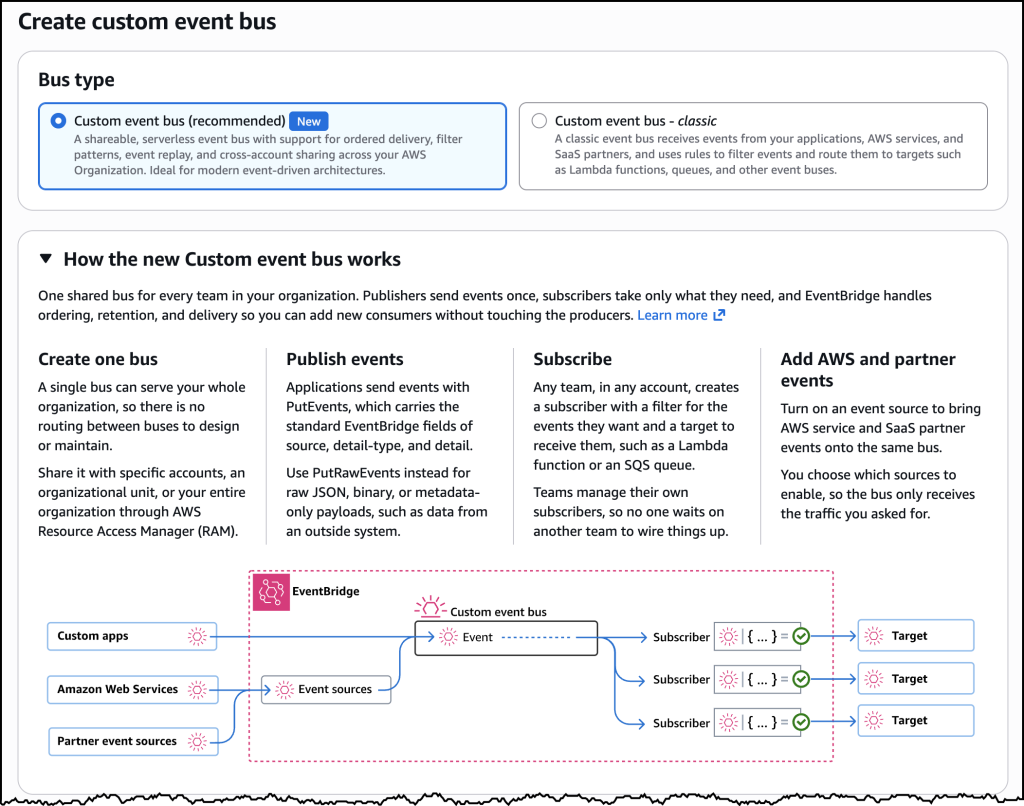
However, the shift to a centralized bus also necessitates a new approach to governance. Because all teams are sharing the same infrastructure, the blast radius of a misconfigured subscriber or a malformed event is potentially wider. AWS has mitigated this through robust quota management—defaulting to 10,000 subscribers per bus—but organizations will still need to implement clear schema registries and CI/CD validation to ensure that the central backbone remains performant and reliable.
As organizations continue to decentralize their application teams while simultaneously centralizing their data infrastructure, the enhanced custom event bus will likely become the cornerstone of enterprise event-driven strategy. The combination of native ordering, simplified subscriber management, and transparent pricing positions this tool to become the default choice for any new, high-scale architecture on AWS. For existing workloads, the "classic" bus remains a stable, reliable option, ensuring that organizations can migrate to the enhanced architecture at their own pace, following their own internal release cycles and risk tolerance.