React Native 0.86 Official Release Brings Edge-to-Edge Android Support and Transitions to the React Foundation

The release of React Native 0.86 marks a significant milestone in the evolution of the cross-platform development framework, delivering substantial improvements to Android compatibility and developer tooling while simultaneously cementing a major structural change in the project’s governance. As of this release, the framework has transitioned from the Meta-managed GitHub organization to the independent React Foundation, signaling a long-term commitment to decentralized stewardship and open-source stability. This update continues the project’s recent trend of prioritizing developer experience and stability, notably featuring zero user-facing breaking changes for the second consecutive major release cycle.
A Structural Shift: The React Foundation
The migration of the React Native repository, along with core dependencies including React, Metro, and Yoga, from the Facebook GitHub organization to the newly established React Foundation represents more than a mere change in URL paths. For years, the React ecosystem—which serves as the backbone for millions of mobile and web applications worldwide—operated under the direct oversight of Meta. The move to the React Foundation is designed to foster a more sustainable, community-governed environment.
This transition reflects the growing maturity of the React ecosystem. By separating the codebase from a single corporate entity, the Foundation aims to ensure that the framework remains resilient against internal corporate strategic shifts, providing developers with the security of an independent, neutral home for the project. For the end user and the developer, this change is largely invisible; GitHub’s infrastructure has been configured to automatically redirect all existing pull requests, issues, and documentation links to their new repository destinations, ensuring no interruption in project workflows.
Enhancing the Android Development Experience
One of the most technical challenges in mobile development involves maintaining UI consistency across varying OS versions, particularly on the Android platform, which has seen aggressive changes in system UI handling in recent iterations. React Native 0.86 introduces comprehensive support for "edge-to-edge" display modes on Android 15 and beyond.
In previous versions, developers often struggled with system UI overlaps, where status bars or navigation gestures would inadvertently obscure content or leave awkward dead space at the edges of the screen. With this release, the framework provides a more robust, native-level implementation of edge-to-edge rendering. Crucially, this update addresses scenarios where the operating system enforces these UI constraints even if the developer has not explicitly toggled the edgeToEdgeEnabled Gradle property. By automating these fixes, React Native reduces the cognitive load on developers, allowing them to build immersive, full-screen mobile experiences without the need for manual configuration or complex custom workarounds.
Advancements in React Native DevTools
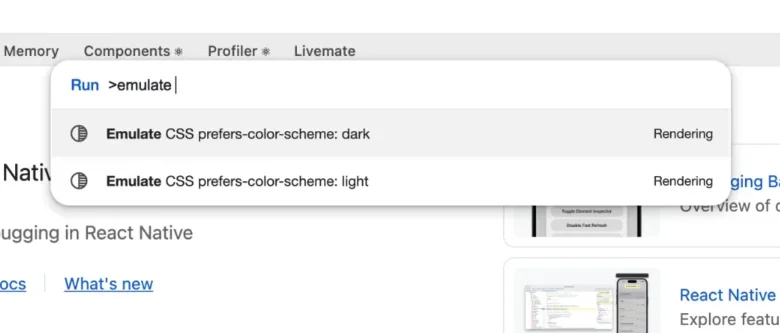
Modern software engineering is heavily reliant on effective debugging and diagnostic tools. Version 0.86 brings a highly requested feature to React Native DevTools: integrated light and dark mode emulation. Previously, testing an application’s appearance settings necessitated physical changes to the host device or emulator settings—a tedious process that often disrupted the flow of development.
Through the implementation of the Emulation.setEmulatedMedia API, developers can now toggle theme states directly from the DevTools interface. By pressing cmd + shift + P to access the Command Palette, engineers can instantly switch between light and dark modes. This functionality, modeled after established standards in web browser development tools, provides a temporary, non-destructive override. Once the debugging session is disconnected, the application reverts to its default system-defined state, ensuring that the test environment does not accidentally overwrite production-level configuration files.
The Commitment to Stability and Incremental Upgrades
Perhaps the most notable characteristic of the React Native 0.86 release is the absence of breaking changes. In the early years of React Native, frequent breaking changes were a common point of friction for development teams, often leading to "upgrade fatigue" and technical debt. Since the release of version 0.83, the engineering team has prioritized a strategy of non-breaking, incremental updates.

This approach serves a dual purpose: it encourages teams to adopt the latest version of the framework promptly, and it allows for the integration of modern architectural improvements—such as the transition to the New Architecture (TurboModules and Fabric)—without forcing developers to rewrite existing business logic. For teams currently operating on version 0.85, the upgrade to 0.86 is designed to be a seamless, "drop-in" experience. This predictable release cycle is vital for large-scale enterprise applications where the cost of a breaking change can run into hundreds of hours of development and QA testing time.
Technical Deep Dive: Infrastructure and Performance
Beyond the visible improvements to Android and DevTools, version 0.86 is underpinned by significant behind-the-scenes work. With over 596 commits contributed by 97 individuals, the release is a testament to the scale of the React Native community. Key performance and infrastructure updates include:
- JSI (Native Interface) Enhancements: The JavaScript Interface (JSI), which acts as the bridge between the JS engine and native C++ code, has received several new APIs. These additions allow for more efficient communication between native modules and the JavaScript runtime, facilitating faster data exchange and reduced latency in complex modules.
- Runtime Alignment: The release continues the effort to align the React Native runtime more closely with web standards. By narrowing the gap between browser-based JavaScript execution and mobile-native execution, the framework makes it easier for developers to reuse logic between web and mobile platforms.
- Layout and Rendering: Minor optimizations in the Yoga layout engine and the rendering pipeline have been implemented to ensure that complex UI trees are calculated with lower CPU overhead. These improvements are particularly beneficial for applications with high-frequency animation requirements.
Broader Implications and Future Outlook
The release of 0.86 provides a snapshot of the current state of mobile development: a shift toward stability, platform consistency, and community-driven governance. As Android and iOS continue to evolve their design languages, the burden of ensuring that cross-platform frameworks keep pace falls on the shoulders of open-source maintainers. The proactive support for Android 15’s edge-to-edge requirements demonstrates that React Native remains a first-class citizen in the mobile ecosystem, capable of adapting to new OS paradigms rapidly.
Furthermore, the successful transition to the React Foundation serves as a model for other large-scale open-source projects. By de-risking the project’s ownership structure, the framework has positioned itself for long-term survival in an industry where corporate priorities are prone to change. For the developer, this means a more stable, predictable platform that is less likely to be impacted by sudden shifts in organizational strategy.
Getting Started with Version 0.86
For teams looking to adopt the latest version, the upgrade process is straightforward. Developers are encouraged to utilize the "React Native Upgrade Helper," a community-maintained tool that provides a side-by-side comparison of the changes required when moving between versions. This tool is particularly useful for identifying the specific delta in configuration files, which is where most of the work in an upgrade usually resides.
New projects can be initialized using the standard CLI command:
npx @react-native-community/cli@latest init MyProject --version latest
For those within the Expo ecosystem, the latest version will be available via the expo@canary release channel. As 0.86 becomes the stable benchmark, previous versions—specifically the 0.83.x series—will move to an unsupported status, emphasizing the importance of keeping dependencies updated to ensure security and compatibility.
Acknowledgments
The scale of this release reflects the collaborative nature of the React Native project. With nearly 100 contributors, the community has shown a significant capacity for self-regulation and technical innovation. The efforts of these contributors, ranging from bug fixes and documentation improvements to architectural overhauls, are what keep the framework competitive against native-only development options. As the project looks toward future releases, the focus remains clear: prioritize the developer experience, ensure backward compatibility, and foster a robust, independent ecosystem for cross-platform mobile development.
Related posts: