Navigating the Great Divide: How Artificial Intelligence is Reshaping Enterprise Software Development and Industry Identity

The artificial intelligence landscape is currently defined by a profound and widening chasm in how different segments of society perceive and interact with large language models (LLMs). According to observations highlighted by AI researcher Andrej Karpathy, this perceptual divide separates the general public, mainstream professionals, and the bleeding-edge vanguard into distinct experiential realities occurring simultaneously. While everyday users largely encounter AI through consumer-facing chatbots characterized by occasional unreliability and limited utility, a small fraction of technology professionals are experiencing exponential capability curves that fundamentally alter their daily workflows.
This dichotomy sets the stage for a broader reckoning across the global technology sector. As enterprises grapple with integration, economists debate productivity metrics reminiscent of the 1990s dot-com boom, and software engineers redefine their professional identities, the industry is transitioning from manual coding to supervisory control models. Understanding this multifaceted transformation requires examining the intersection of enterprise adoption hurdles, emerging educational frameworks, and strategic financial management regarding operational costs.
The Perception Gap: From Derpy Chatbots to Exponential Vertigo
To understand the current state of artificial intelligence adoption, industry analysts point to Karpathy’s tripartite model of user experience. At the base of the spectrum, the general public interacts sparingly with generative AI, frequently dismissing the technology due to superficial errors or conversational friction. In the middle tier, the majority of working professionals utilize AI tools for modest productivity gains—such as drafting emails or summarizing documents—yet remain anchored to traditional methodologies.
Conversely, a small sliver of engineers and researchers operate within an entirely different paradigm. For these specialists, AI agents handle complex, multi-step engineering tasks, creating a sensation of professional vertigo where capabilities scale vertically week over week. Bridging this gap remains a significant challenge for software organizations, as the unreliability of entry-level interfaces often masks the immense power available in frontier-grade systems.
Enterprise Adoption: The Swiss-Army Knife Metaphor
While vanguard developers explore agentic engineering in sandbox environments, large enterprises face a much slower integration timeline. Industry observers note a recurring corporate phenomenon: massive organizations have acquired advanced AI capabilities—akin to possessing a Swiss-army knife—yet restrict their usage to minor, isolated tasks, mirroring the deployment of a toothpick.
Several structural factors explain this enterprise hesitancy. Unlike a consumer startup where system downtime carries minimal risk, Fortune 500 companies operate critical infrastructure, supply chains, and secure financial workflows that cannot afford operational disruptions. Furthermore, enterprise readiness depends heavily on underlying data hygiene. Organizations must resolve legacy data silos and security vulnerabilities—such as the complex risks categorized in modern cybersecurity frameworks—before deploying autonomous agents at scale. Without robust, clean data pipelines, large-scale automation remains impractical for traditional corporate environments.
Historical Parallels: Is Today 1997 or 1999?
The tension between heavy financial investment and measurable productivity gains has sparked rigorous debate among economists and technologists. Torsten Slok, chief economist at Apollo Global Management, published data indicating a lack of widespread productivity payoffs outside of seven major technology conglomerates. This assessment has fueled skepticism regarding current market valuations.

However, industry veterans draw parallels to historical technology transitions, most notably the dot-com era. Analysts suggest that while current market valuations may exhibit speculative bubble characteristics, dismissing the underlying technology based on early aggregate economic data is premature. Just as critics in 1997 debated the ultimate economic viability of the internet, today’s enterprise AI investments require a maturation timeline. Companies that successfully identify high-yield operational workflows—specifically those where verification is faster than generation—are positioned for long-term structural advantage.
Evolution of the Software Engineering Profession
As agentic workflows mature, the day-to-day role of the software developer is undergoing a fundamental transformation. Historically, coding operated under a direct control model, where human engineers manually interpreted requirements, wrote syntax, executed tests, and debugged errors in a continuous closed loop.
With the advent of coding agents capable of planning, executing tests, and self-correction, the paradigm is shifting toward supervisory control. Drawing on control theory models historically applied in industrial automation, researchers categorize human-AI collaboration across five distinct tiers:
- None: Human decides and acts without AI assistance.
- Decision Support: Human decides and acts; AI provides suggestions (early autocomplete tools).
- Consensual AI: AI decides and acts; human must explicitly approve each step.
- Monitored AI: AI operates autonomously in auto-mode, with the human retaining a real-time veto capability.
- Full Automation: Complete autonomous execution within dark software environments.
This shift challenges traditional professional identities. Software engineering is moving away from syntax generation toward higher-level system design, abstraction management, and supervisory oversight. Immersion courses modeled after historical agile training methodologies are emerging to help developers navigate this psychological transition, addressing the emotional and professional identity shocks associated with automated software factories.
Economic Strategy: Balancing Frontier Models and Open-Weight Infrastructure
As organizations scale their AI usage, financial sustainability has become a primary boardroom concern. Forecasts regarding token consumption project exponential cost increases for enterprises relying exclusively on third-party frontier application programming interfaces (APIs).
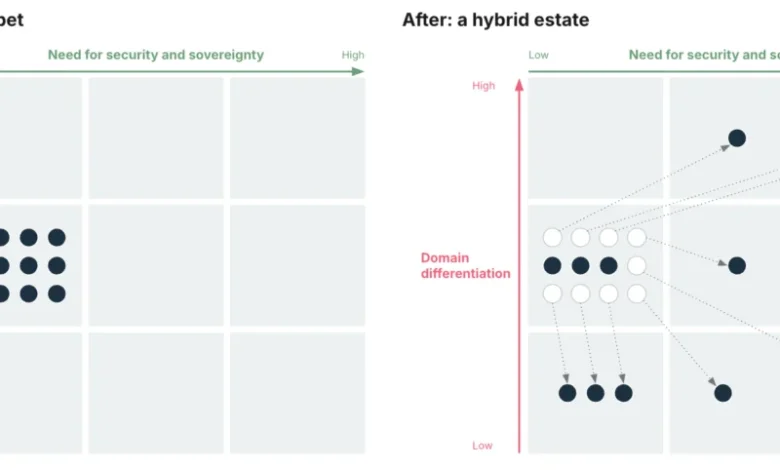
To mitigate these expenses, leading technology firms are adopting hybrid token-sourcing strategies. By evaluating workloads across two primary axes—domain differentiation and security/sovereignty—organizations can distribute computational tasks across a multi-tiered grid. Under this framework, high-complexity reasoning tasks rent expensive frontier models, while routine, high-volume workloads or sensitive intellectual property processing utilize fine-tuned open-weight models hosted on private infrastructure. This strategic segmentation allows large enterprises to dramatically reduce projected token expenditures while maintaining rigorous data security standards.
Conclusion
The current inflection point in artificial intelligence represents more than a transient technological trend; it marks a structural evolution in how human labor, enterprise architecture, and software engineering are conceptualized. While ethical concerns regarding economic displacement, environmental impact, and market hype persist, the trajectory toward supervisory control and agentic engineering appears fixed. Organizations that successfully navigate the data readiness barrier, optimize their token sourcing economics, and adapt their workforce to supervisory roles will define the next era of industrial productivity.