Ghost Farmer: Bridging Ancestral Agricultural Wisdom Through Localized Artificial Intelligence

The intersection of traditional ecological knowledge and modern generative AI has produced a unique application known as Ghost Farmer, a project submitted for the Hacktoberfest Open-Source AI Challenge. Developed by a software practitioner with roots in Kenyan agricultural communities, the tool functions as an offline chatbot designed to simulate the counsel of an experienced farmer. By utilizing localized large language models (LLMs) and personal familial narratives, the application preserves generational farming techniques—ranging from soil health management to pest control—that might otherwise be lost to time.
The Genesis of Ghost Farmer
The project was conceived as a response to the fourth week of the Hacktoberfest Open-Source AI Challenge, specifically the "Ghost in the Machine" category. The developer sought to address a gap in agricultural technology: the lack of accessible, offline, and culturally relevant advice for smallholder farmers. Growing up in Kenya, the developer observed that much of the ancestral knowledge regarding planting cycles and crop maintenance was passed down orally. As these generations pass, the technical proficiency associated with specific regional farming practices risks permanent erasure.
The application was built as a lightweight Python-based tool, consisting of approximately 60 lines of code. It operates entirely offline, ensuring that the sensitive familial anecdotes stored in the associated stories.txt file remain private. By anchoring the LLM to these specific stories through a system prompt, the developer effectively created a "digital ancestor" capable of offering practical, context-aware agricultural advice.
Chronology of Development and Technical Hurdles
The development lifecycle of Ghost Farmer was characterized by both rapid prototyping and significant configuration challenges common in the nascent field of local AI deployment.

The process began with the selection of a 1-billion-parameter model, chosen for its ability to run efficiently on consumer-grade laptop hardware without requiring internet connectivity. However, the initial phase was marked by environmental configuration errors. The developer reported a failure during the installation of Ollama, a tool for running LLMs locally, due to a mismatch between command-line interface environments—specifically, attempting to execute PowerShell-intended commands within a Git Bash terminal.
This failure resulted in an unresponsive installation process and a subsequent "command not found" error. After troubleshooting the terminal pathing and switching to a standard Windows-based installation, the developer successfully established the local environment. This specific hurdle highlights a broader trend in the open-source community: while the underlying AI models are becoming increasingly accessible, the "friction" of local deployment remains a significant barrier for developers transitioning from cloud-based APIs to local infrastructure.
The Mechanics of Simulated Personality
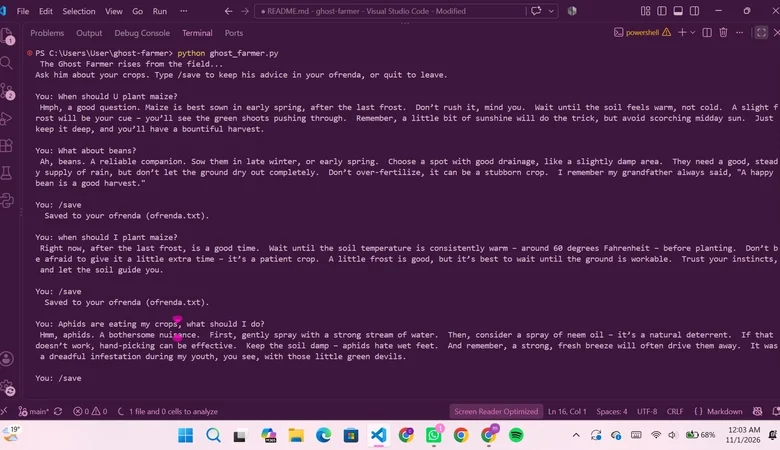
A defining characteristic of Ghost Farmer is its use of "system prompting" to imbue a low-parameter model with a specific persona. The model is instructed to adopt the demeanor of a gentle, practical farmer who acknowledges the limitations of his knowledge. During testing, the model exhibited emergent behaviors—a phenomenon where the AI, based on its training data and the provided system prompts, began to hallucinate or "fill in" details about its life.
When questioned about aphids, the AI described them as "little green devils" and recounted a personal narrative regarding a past infestation. This behavior suggests that even small, 1B-parameter models are capable of high-level pattern matching and stylistic synthesis when constrained by a well-defined prompt. The developer noted that while this creates a compelling narrative, it necessitates strict guardrails, particularly regarding safety-critical information such as chemical dosage or specific pesticide application, which the model is explicitly programmed to defer on.
Context: The Role of Open Source in Data Privacy
The decision to build Ghost Farmer as an offline, open-source tool carries significant implications for data privacy and intellectual property. In the current AI landscape, users often trade personal data for the convenience of cloud-based services. For a project predicated on the preservation of family history and traditional knowledge, the use of a closed-source, cloud-dependent model would have necessitated the upload of private, culturally sensitive data to external servers.

By keeping the infrastructure local, the developer ensures that the "digital legacy" remains under the user’s control. This aligns with the broader ethos of the open-source movement, which emphasizes the democratization of technology and the protection of user autonomy. In agricultural sectors, where regional knowledge is often proprietary or culturally guarded, this local-first approach provides a blueprint for future digital archiving projects.
Industry Impact and Agricultural Significance
The cultural timing of the project—coinciding with late October—draws inspiration from the traditions of Día de los Muertos. The use of marigolds, a staple of the ofrenda and a vital crop in many agricultural systems, serves as a thematic bridge between the honoring of ancestors and the practical requirements of the harvest.
From an industry perspective, Ghost Farmer represents a shift toward "Small Language Models" (SLMs) in specialized fields. While industry giants focus on multi-trillion-parameter models for general intelligence, there is growing interest in domain-specific models that are lightweight, private, and energy-efficient. According to recent reports on AI sustainability, the environmental cost of training and running massive models is a growing concern. The ability to achieve meaningful, context-rich interaction using a 1B-parameter model suggests a more sustainable path forward for AI integration in rural or resource-constrained environments.
Future Implications
The success of this project prompts a wider discussion on the role of technology in preserving intangible cultural heritage. As AI continues to evolve, the capacity for these systems to store and synthesize human experience grows. However, experts in digital humanities caution that such systems must be carefully curated. The "ghostly" nature of the chatbot—its propensity to invent backstories—serves as a reminder that AI is a generative, rather than a purely archival, technology.
Moving forward, the integration of such tools could offer a lifeline for agricultural education in remote areas. If coupled with reliable, offline-capable hardware, similar models could provide real-time guidance to farmers, helping them adapt to changing climate patterns while maintaining the foundational wisdom of their predecessors. The Ghost Farmer project, while modest in its codebase, serves as a proof-of-concept for the synthesis of tradition and technology, proving that the future of agriculture may well be rooted in the lessons of the past.