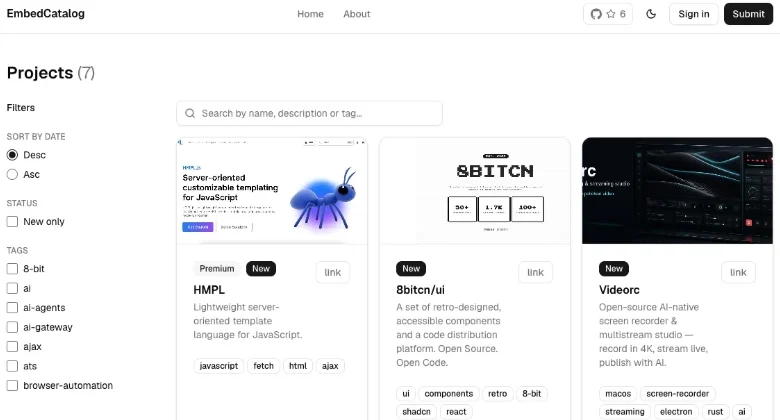
The digital landscape for software development is increasingly visual, with platforms like GitHub, GitLab, and various documentation sites relying heavily on rich media to capture user attention. In this context, developer Anthony Max has officially released EmbedCatalog, a dedicated utility designed to provide developers with customizable, aesthetically pleasing "embeds" that can be used to decorate project repositories, README files, and documentation sites. The platform aims to move beyond the standard, often repetitive imagery found in most open-source projects, offering a more professional and personalized aesthetic.

The Genesis of EmbedCatalog
The concept for EmbedCatalog originated from a personal necessity. While working on a series of open-source projects, Max identified a recurring problem: the lack of high-quality, project-specific visual assets that could effectively communicate a project’s purpose and status to potential contributors and users. Most developers rely on default badges or static, generic images, which often fail to convey the unique identity of a project.
"I found myself wanting to highlight my projects in a way that felt distinctive," Max stated in technical documentation regarding the project’s launch. "The goal was to avoid the common pitfall of simply copying the visual styles of other, more established projects."

The development process for the platform spanned several weeks, focusing on creating a robust editor that allows users to generate visual assets without requiring advanced graphic design skills. By centralizing these assets, the platform seeks to standardize the way projects are presented while maintaining a high degree of visual variety.
Chronology of Development
The development cycle of EmbedCatalog has been characterized by rapid iterative improvements. Following the initial conceptualization phase, the project moved into a private alpha, where core features—such as the embed editor and user authentication—were tested for stability.

- Conceptualization Phase: Identifying the gap between generic repository badges and the need for high-quality, bespoke project branding.
- MVP Development: Over a period of several weeks, the core infrastructure was built, including the integration of user accounts to save and manage personalized embeds.
- Beta Release: The platform was introduced to the developer community, allowing for feedback on the editor’s usability and the variety of templates available.
- Public Launch: The official release of the current version, which includes a simplified interface for creating and hosting embeds, alongside the transition of the project to an open-source model on GitHub.
Technical Architecture and Features
At its core, EmbedCatalog functions as a web-based service that generates dynamic images. Users can register for an account to access the "Embed Editor," a tool that enables the creation of custom visuals. These images are specifically optimized for inclusion in Markdown files—the primary language of project documentation.
The platform includes several key functional pillars:

- Authentication Systems: To ensure that users can return to their projects and modify their assets, the platform includes a secure login and registration system.
- The Embed Editor: This is the primary engine of the platform, providing a suite of tools for users to define the look and feel of their project badges.
- Hosting and Integration: Once an embed is created, the platform generates the necessary links for direct insertion into external websites, such as GitHub’s
README.mdfiles.
By providing these tools, the platform addresses a "friction point" in the developer experience. Previously, a developer would need to use third-party design software, host the resulting image on a CDN, and manually manage the links. EmbedCatalog streamlines this by acting as both the design engine and the host.
Market Context: The Importance of Project Aesthetics
In the current software ecosystem, the visual presentation of an open-source project is no longer a peripheral concern; it is a critical component of project adoption. Data from platform engagement metrics suggest that repositories with high-quality visual documentation—including badges, clear status indicators, and professional-looking headers—experience higher rates of engagement from contributors.

According to studies on open-source sustainability, projects that present themselves with clear, branded, and professional assets are statistically more likely to receive "stars," forks, and pull requests. This "professionalization" of open source is a growing trend, as developers compete for attention in an increasingly crowded market. Tools like EmbedCatalog provide the necessary infrastructure to facilitate this, effectively democratizing access to high-quality project design.
Open Source Philosophy and Community Impact
A significant aspect of the project’s release is its decision to be fully open-source. By hosting the code on GitHub, Max has invited the community to contribute to the growth of the platform. This allows other developers not only to use the tool but also to suggest new templates, improve the editor’s performance, and ensure the long-term sustainability of the service.

The decision to keep the project open-source aligns with the broader ethos of the development community. By allowing users to inspect the code, the project gains transparency and trust. It also invites collaborative development, which is essential for a tool that relies on user-generated content and evolving design trends.
While the platform is not currently focused on aggressive user acquisition or monetization, it operates with a "steady-state" philosophy. As described by the creator, the project is intended to be maintained with the consistent, diligent effort of an "ant," ensuring that it remains a reliable resource for the community over the long term.
Implications for Future Project Documentation
The launch of EmbedCatalog suggests a shift toward more specialized tooling for developer documentation. As documentation becomes more interactive and visually rich, the demand for services that bridge the gap between design and code will likely increase.
The broader implications of this platform are twofold:
- Standardization: It provides a common language for how projects can display status, licensing, and branding, potentially reducing the visual clutter in README files.
- Accessibility: By providing an easy-to-use editor, it lowers the barrier for developers who lack formal design training but wish to maintain a professional appearance for their projects.
As the tool matures, its success will likely be measured by the adoption rate within the developer community and the extent to which it integrates with other popular repository management tools. Currently, the project is available for use at its primary web domain, with technical support and community engagement managed through its GitHub repository.
In conclusion, EmbedCatalog serves as a practical solution to a common aesthetic challenge in software development. By providing a streamlined, open-source pathway for creating professional-grade embeds, it empowers developers to better showcase their work, potentially influencing the way open-source projects communicate their value to the wider technical community. As the project continues to evolve, it remains a testament to the importance of developer-led initiatives in solving niche, yet significant, problems in the digital workspace.