Oxford Researchers Harness Hybrid Quantum Computers to Recreate the Invisible Aharonov-Bohm Effect and Freeze Particle Motion

In the strange domain of quantum mechanics, physical proximity is not always a prerequisite for influence. Demonstrating one of the most counterintuitive principles of modern physics, a team of researchers at the University of Oxford has successfully recreated the Aharonov-Bohm effect using an advanced hybrid quantum computer. By encoding an invisible magnetic influence into a dynamic quantum system, the research team managed to bring a simulated particle’s movement to a complete, absolute stop. The breakthrough, which bridges theoretical high-energy physics and state-of-the-art quantum hardware, was published in the journal Nature Physics, marking a significant milestone in how scientists model fundamental forces.
The experiment revives a theoretical prediction first put forward in 1959 by physicists Yakir Aharonov and David Bohm. In classical physics, a charged particle responds exclusively to the electric and magnetic fields it physically encounters along its trajectory. However, Aharonov and Bohm calculated that a charged particle traveling around a region containing magnetic flux would experience a measurable shift in its quantum state—specifically, an alteration of its quantum phase—even if its path never intersected the magnetic field itself.
While this phenomenon has historically been verified using real electrons in specialized laboratory setups, the Oxford team’s achievement lies in where and how the effect was reproduced. Rather than observing the phenomenon in a static environment, the researchers embedded the magnetic influence within a dynamic lattice gauge theory using trapped-ion quantum technology.
The Anatomy of a Hybrid Quantum Simulation
The project, which commenced in 2022, was spearheaded by lead author Dr. Sebastian Saner and Dr. Oana Bazavan alongside their Oxford colleagues, in close collaboration with theoretical physicist Dr. Alejandro Bermudez of the Instituto de Física Teórica in Madrid. To tackle the complex mathematics of lattice gauge theories—mathematical frameworks that describe how matter interacts with fundamental force fields by mapping space onto a grid—the team designed a novel hybrid quantum architecture.
Conventional supercomputers face exponential computational hurdles when attempting to simulate lattice gauge systems as they grow in complexity, due to the sheer volume of interacting components. To bypass this bottleneck, the Oxford researchers constructed a quantum simulator that mirrors the mathematics of the target system rather than calculating it brute-force.
Their experimental design utilized two distinct quantum components integrated into a single hardware platform:
- The Qubits: Encoded in the internal states of electrically charged atoms (trapped ions) held in place by electromagnetic fields, these qubits served as the gauge fields within the theoretical model.
- The Quantum Oscillators: Created by the controlled physical vibrations of those exact same trapped ions, these oscillators represented matter moving through space.
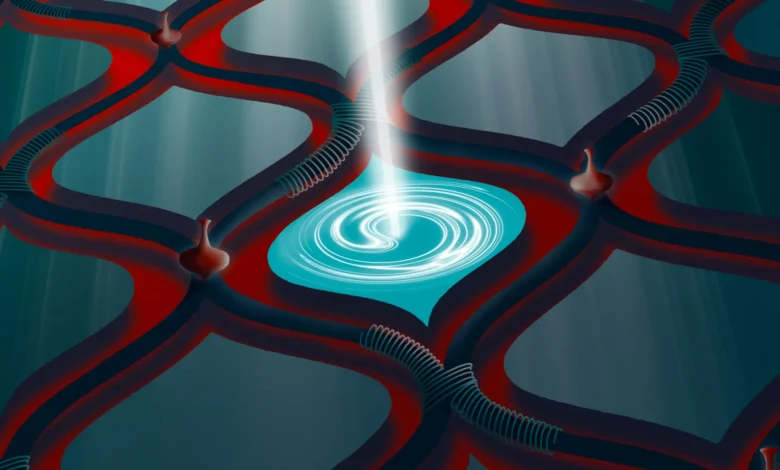
By linking these components into a localized loop, the researchers built a fundamental building block of a lattice gauge theory. Two oscillators simulated matter at distinct geographical points on the grid, while two qubits represented the dynamic fields connecting those points.
From Technical Workaround to Scientific Breakthrough
Initially, the research team intended to introduce the magnetic flux as a static, unchanging background condition. However, the technical limitations of their existing quantum hardware made it exceptionally difficult to apply a fixed external field without disrupting the delicate quantum states of the system.
To overcome this limitation, the team devised an alternative approach: they encoded the magnetic flux directly into the qubits themselves. This pragmatic workaround yielded an unexpected scientific windfall. Instead of remaining a passive, external backdrop, the magnetic flux became an active, evolving participant in the system’s overall quantum dynamics.
"For us, the exciting step was to encode the magnetic flux in a gauge field that was itself dynamical," explained Dr. Saner during discussions surrounding the publication. "Rather than having matter evolve in a fixed background, the matter and gauge field become part of the same quantum dynamics."
This integration allowed the researchers to observe a more sophisticated version of the Aharonov-Bohm effect, wherein matter and the force field actively influenced one another in real time.
Quantum Tunneling and the Complete Suppression of Motion
With the hybrid loop fully operational, the researchers directed their attention to the behavior of a matter particle moving through the system via quantum tunneling—a probabilistic phenomenon allowing particles to cross physical or energetic barriers that would be impassable under the laws of classical mechanics.
When the simulation was executed in the absence of simulated magnetic flux, the particle tunneled freely and continuously around the loop. However, introducing the dynamical simulated flux altered the trajectory fundamentally.
Because the particle had two distinct potential pathways around the loop, the presence of the embedded magnetic flux altered their relative quantum phases. As the particle’s wave functions propagated, this phase shift induced destructive quantum interference. The two paths effectively canceled each other out mathematically, arresting the tunneling process entirely and leaving the simulated particle frozen rigidly in its original state.
Parallel Progress and Independent Validation
The publication of the Oxford findings in Nature Physics coincided with the release of a complementary study conducted independently by a research team at the University of Maryland, led by Professor Norbert Linke.
While the Oxford group focused on the dynamics of lattice gauge fields and the Aharonov-Bohm effect, the Maryland team utilized a similarly configured hybrid quantum system to simulate the Yukawa potential—a mathematical model crucial for understanding nuclear interactions and particle physics. Although both groups pursued their investigations without prior coordination on the experimental specifics, they ultimately synchronized their submissions to Nature Physics, underscoring a broader, coordinated shift in the quantum computing community toward hybrid architectures.
Broader Implications for High-Energy Physics
The successful execution of these experiments highlights the growing utility of quantum simulators as empirical laboratories for theoretical physics. By combining discrete qubits with continuous-variable quantum oscillators, researchers can construct physical analogues of complex mathematical universes that defy traditional computing methods.
The implications extend directly into particle physics, cosmology, and quantum chemistry. Phenomena that occur under extreme conditions—such as the strong nuclear force, quark-gluon plasmas, and cosmological phase transitions—rely heavily on lattice gauge theories. Simulating these environments on classical hardware requires approximations that can obscure subtle physical behaviors. Hybrid quantum computers offer a pathway to study these interactions organically, observing how matter and fields co-evolve without simplifying assumptions.
As quantum hardware scales in qubit count and coherence time, experiments like the Oxford Aharonov-Bohm simulation demonstrate that quantum computers are evolving from theoretical calculators into practical instruments of discovery. By making the invisible visible and the dynamic testable, researchers are opening new windows into the fundamental architecture of the physical universe.