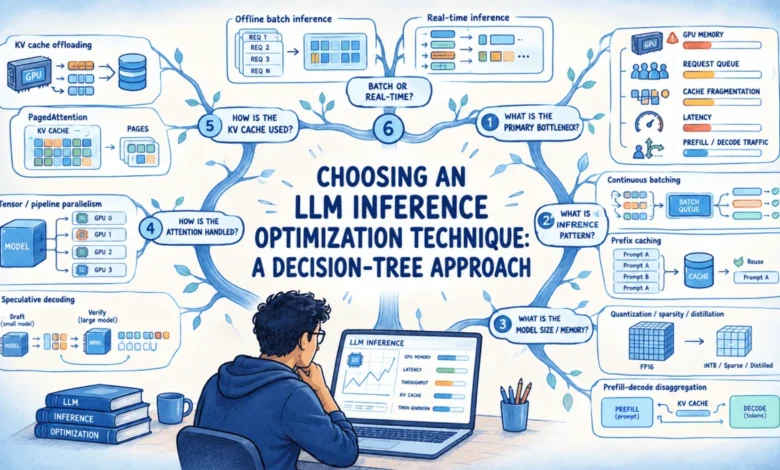
As Large Language Models (LLMs) transition from research prototypes to critical components of enterprise infrastructure, the challenge of deploying them at scale has shifted from model training to inference optimization. The operational reality for many engineering teams is that as traffic grows, the cost of latency and GPU utilization becomes unsustainable. Without a structured approach to optimization, organizations often fall into the trap of implementing complex, high-overhead solutions that fail to address the specific performance bottlenecks inherent in their unique workloads.
To navigate this complexity, architects must treat inference optimization as a diagnostic process rather than a grab-bag of features. By working through a systematic decision tree, engineers can match specific technical interventions to the actual hardware constraints of their deployments, ensuring that resources are applied where they yield the highest marginal gain in throughput and latency reduction.
The Evolution of the Inference Bottleneck
The demand for high-performance LLM inference has surged alongside the proliferation of Retrieval-Augmented Generation (RAG) and agentic workflows. Historically, the primary constraint was simple: memory capacity. In early 2023, the industry focused heavily on model compression techniques, such as 4-bit quantization, to shoehorn massive parameters into consumer-grade hardware.
However, as of late 2024 and throughout 2025, the bottleneck has evolved. Today, the challenge is frequently related to the "KV cache"—the memory used to store the context of a conversation. As request volumes scale, the management of this cache has become the primary point of failure. This shift has necessitated the rise of sophisticated serving engines that handle request scheduling, memory paging, and parallelization. Understanding the chronology of these developments is essential: from the initial reliance on simple model quantization to the current focus on architectural strategies like PagedAttention and prefill-decode disaggregation.
Diagnostic Phase: The Six-Question Framework
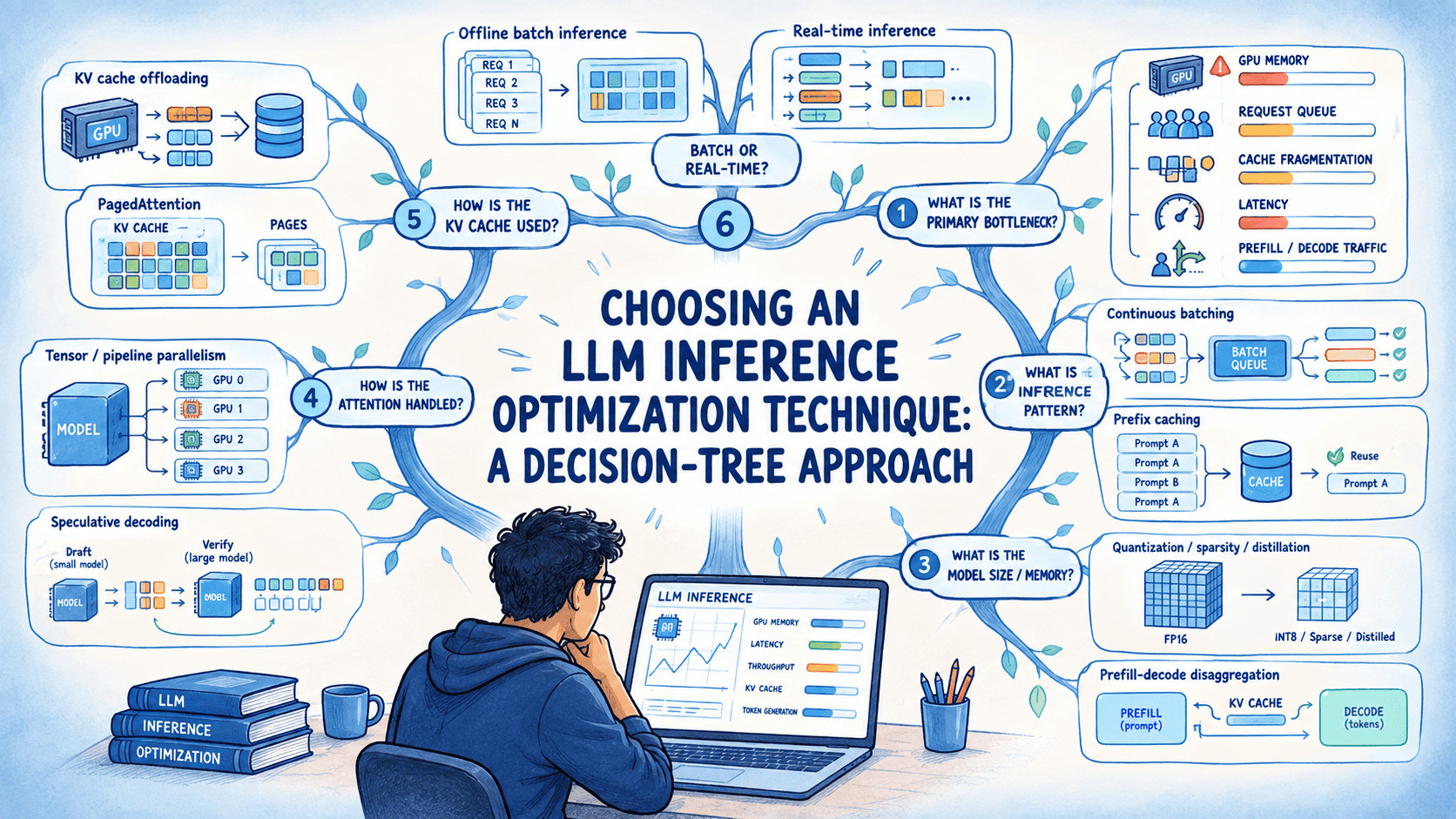
To determine the optimal strategy, engineers should evaluate their deployment against a six-step diagnostic framework.
1. Hardware Memory and Model Footprint
The baseline for all inference optimization is the relationship between model size and available GPU VRAM. If a model occupies nearly the entirety of a device’s memory, there is no headroom for the KV cache. When this occurs, even the most efficient scheduling algorithms will result in performance degradation. In this scenario, model-level compression—such as quantization, sparsity, or distillation—is the mandatory first step. These methods reduce the memory footprint, allowing for larger batch sizes and improved throughput.
2. Identifying Redundant Prompt Structures
In modern chat applications and agent frameworks, a significant portion of traffic often involves redundant prompt structures. Whether it is a shared system instruction or a common document context in a RAG pipeline, recomputing these tokens is a waste of compute cycles. Prefix caching allows the system to store and reuse the KV cache for these static segments. When implemented correctly, this significantly lowers the Time-To-First-Token (TTFT) by bypassing the prefill phase for repeated sequences.
3. Handling Asynchronous and Variable-Length Traffic
A common pitfall in naive serving implementations is "batch blocking," where the entire batch is forced to wait for the longest request to complete. In production environments where one user might request a concise summary and another a long-form code generation, this approach is disastrous for efficiency. Continuous batching—a technique where finished requests are ejected and new ones are admitted dynamically—is the industry standard for resolving this idle-time issue.
4. Mitigating KV Cache Fragmentation
When serving engines reserve large, contiguous blocks of memory for the KV cache based on maximum sequence length, they often leave massive amounts of memory unutilized. PagedAttention has emerged as a solution to this, functioning similarly to virtual memory in operating systems. By splitting the cache into smaller, non-contiguous pages, systems can achieve much higher batch sizes, effectively increasing overall GPU utilization.
5. Prioritizing Latency via Speculative Decoding
For applications where per-token latency is the primary metric—such as real-time coding assistants—speculative decoding offers a pathway to faster generation. By utilizing a smaller, "draft" model to predict tokens and a larger, "target" model to verify them, systems can generate multiple tokens in a single forward pass. However, the efficacy of this approach is entirely dependent on the draft model’s accuracy. If the acceptance rate is low, the overhead of the verification process can actually increase latency, making it a technique that requires rigorous A/B testing before production deployment.
6. Architecture-Level Disaggregation
At extreme scales, the contention between prefill operations (which are compute-intensive) and decode operations (which are memory-bandwidth-intensive) can create a systemic bottleneck. Prefill-decode disaggregation involves separating these two phases onto dedicated hardware nodes. While this offers significant improvements in latency for massive traffic volumes, it introduces substantial complexity, including the need for high-speed network transfers of the KV cache between nodes.
Quantitative Analysis and Implementation Pitfalls
Data from major cloud inference providers suggests that most production bottlenecks are not caused by a single, catastrophic failure, but by a series of misaligned optimizations. For instance, teams often enable PagedAttention without verifying the page-size configuration, leading to fragmentation that mirrors the very problem the technique was designed to solve.
Furthermore, a common, costly error is the assumption that quantization automatically yields throughput gains. If an engineer quantizes model weights but maintains full-precision activations, the GPU may spend unnecessary cycles performing on-the-fly conversion, nullifying the performance benefits of the smaller model size.
Official guidance from major framework maintainers, such as those behind vLLM and TensorRT-LLM, consistently emphasizes that optimization is context-dependent. A technique that serves a high-concurrency chatbot effectively may be completely inappropriate for a low-latency, single-user RAG pipeline.
Broader Implications for AI Infrastructure
The shift toward granular, bottleneck-focused optimization marks a transition from the "experimental" phase of generative AI to a "utility-grade" phase. As compute costs remain a significant hurdle for widespread adoption, the ability to squeeze maximum efficiency from existing hardware has become a key competitive advantage.
The industry’s current trajectory suggests that future inference stacks will move toward more automated, self-optimizing architectures. However, until such systems become the default, engineers must remain vigilant in their diagnostic approach. By correctly mapping the specific constraints of their workloads—be it memory fragmentation, redundant prompt structure, or compute contention—to the appropriate optimization techniques, organizations can achieve a sustainable balance between model performance, user experience, and operational expenditure.
Ultimately, the most successful deployments are those that resist the urge to apply every available optimization technique simultaneously. The goal is to apply the minimum number of changes necessary to resolve the bottleneck. As the ecosystem continues to evolve, the ability to accurately identify where the system is waiting will remain the most critical skill for anyone managing LLM infrastructure at scale.