The Fragmented Landscape of Digital Literature
The challenge of discovering public domain content is not a lack of supply, but a deficit of discoverability. Project Gutenberg currently hosts over 70,000 titles, focusing primarily on high-quality, text-based e-books. Conversely, the Internet Archive’s Open Library provides a broader, more archival approach, including scans of physical books that may contain unique annotations or formatting. LibriVox, relying on volunteers to record audiobooks, adds a third dimension of accessibility.
Until recently, a reader searching for a classic novel like Jane Austen’s Pride and Prejudice would be required to perform three separate queries, filter through duplicate entries, and manually reconcile different file formats—ranging from EPUB and Kindle-ready files to raw text and multi-part MP3 audio tracks. This technical friction has long limited the integration of public domain works into modern reading applications, e-ink devices, and AI-driven educational tools.
Development and Technical Architecture
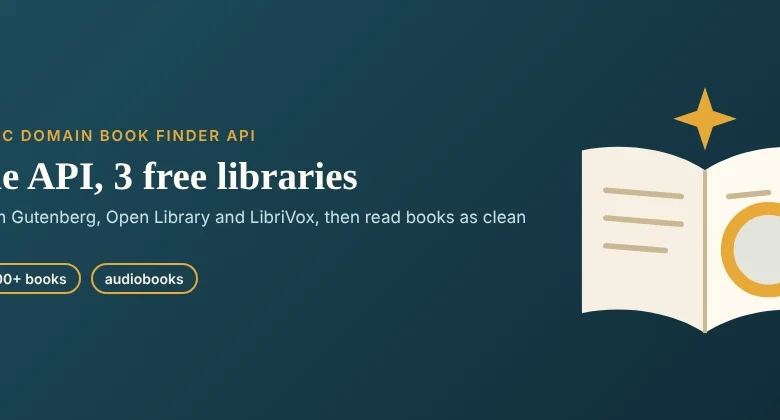
To address this inefficiency, developer Dani Frausto has launched the Public Domain Book Finder, a unified API designed to aggregate these three major sources into a single, cohesive interface. The tool functions as a middleware layer, abstracting the complexities of the underlying library APIs to provide developers with a clean, normalized response.
Built using Python and the high-performance FastAPI framework, the API leverages asynchronous HTTP requests via the httpx library to query the disparate data sources simultaneously. By normalizing the metadata—standardizing titles, identifying unique identifiers, and merging duplicate entries—the API provides a streamlined search experience. For instance, a search query for a specific title now returns a consolidated object that identifies the availability of that work across all three platforms, including various formats such as HTML, plain text, and audio, effectively removing the need for redundant API calls.

Technical Capabilities and API Endpoints
The API is structured to facilitate seamless integration into third-party applications through three primary endpoints. The GET /search endpoint serves as the entry point, allowing users to query the aggregate database. It filters through over 78,000 Gutenberg ebooks and the corresponding collections from Open Library and LibriVox. By programmatically merging results, the API eliminates the "noise" of multiple versions of the same work, enabling developers to build interfaces that offer readers the choice to "read or listen" without requiring multiple database lookups.
The GET /book/id endpoint provides a granular breakdown of available formats. This is particularly valuable for cross-platform applications, as it provides direct links to EPUB, MOBI, and HTML versions, alongside chapter-by-chapter metadata for audiobooks.
Perhaps the most significant innovation is the GET /read/id endpoint. Raw text files from older repositories often suffer from technical artifacts, such as hard-wrapped lines, legacy license headers, and inconsistent formatting that can break the layout of modern mobile applications. The Public Domain Book Finder automates the cleanup process, stripping extraneous metadata and re-flowing the text. This allows for page-by-page rendering, ensuring that content remains legible on everything from e-ink devices to browser-based readers.
Audiobooks and Podcast Integration
The rise of audio consumption in the digital age has made the accessibility of LibriVox’s library particularly relevant. The API treats audiobooks as first-class objects, providing not only the total runtime and chapter counts but also direct links to MP3 files. Furthermore, it supports the generation of podcast-ready feeds. By providing a URL that can be plugged into standard podcast players, the tool bridges the gap between historical text repositories and the modern habit of episodic audio consumption. This integration allows developers to build "on-the-go" listening apps that automatically sync with the latest public domain audiobook releases.
Broader Implications for the Ed-Tech Sector
The implications of such an API extend far beyond simple convenience for casual readers. In the field of Natural Language Processing (NLP) and Artificial Intelligence, access to clean, structured datasets is paramount. By providing a reliable way to fetch and parse the text of thousands of classics, this tool lowers the barrier for developers building AI summarizers, language learning tools, or analytical platforms that index literature.

Historically, researchers or hobbyists interested in large-scale literary analysis had to build their own "scrapers" to normalize text across these different repositories—a process that is both resource-intensive and prone to failure if the source websites update their layouts. By providing a stable, maintained API, the developer is essentially offering a utility that could catalyze the next wave of open-source literary tools.
Future Outlook and Technical Evolution
The launch of the Public Domain Book Finder represents the first in a three-part series of planned reading-focused APIs. The developer has already signaled that the next iteration will focus on a "Clean PDF Reader," aimed at solving the common issue of non-text-searchable, poorly scanned historical documents.
As the digital humanities continue to grow, the demand for interoperable, machine-readable access to historical records will only increase. Tools that act as bridges between archival institutions and modern software architecture are critical for preserving the accessibility of cultural heritage. While the project is currently in its early stages, the decision to host it on modern, scalable infrastructure like Render suggests a long-term commitment to stability and uptime.
Conclusion
The fragmentation of digital knowledge has long been an accepted trade-off for the democratization of information. However, projects like the Public Domain Book Finder prove that technical debt is not a permanent state. By treating the aggregation of data as a service, developers can create more intuitive, user-centric experiences that respect the underlying sources while modernizing their delivery.
For the developer community, this API provides a template for how to handle legacy data: prioritize clean output, normalize inputs, and ensure that the end-user—whether they are a reader, a student, or a machine learning model—can interact with the content without encountering the friction of the past. As we look toward the future of digital literacy, the success of such projects will rely on the continued collaboration between developers and the open-access institutions that safeguard the world’s literature.