Navigating the complexities of free forex API integration for production-grade financial applications

A free forex API can be a valuable asset for developers evaluating live market quotes, but the term "free" often masks the harsh reality of software development: zero-cost access rarely implies a permanent, scalable production tier. As digital transformation continues to reshape the fintech landscape, the gap between a successful prototype and a resilient, production-ready application has become a primary point of failure for many emerging trading tools. Developers must distinguish between the ephemeral nature of a seven-day trial and the rigorous demands of a live, multi-user trading dashboard.
The Anatomy of the Evaluation Trap
The fundamental challenge in API selection is not simply verifying that a system can return a price for a currency pair like EURUSD. Rather, the challenge lies in determining whether the current access levels will remain sustainable for the project’s future scaling needs. A prototype that functions perfectly when querying a single quote often collapses under the pressure of a multi-user dashboard, where connection limits, restrictive currency pair availability, and historical data queries create unforeseen bottlenecks.
As of November 13, 2026, industry data from providers like TickDB highlights this disparity. Their "Free" plan, for example, is explicitly categorized as a seven-day trial. It provides five concurrent subscriptions, one WebSocket connection, and a rate limit of 30 requests per minute. While sufficient for a weekend of testing, this configuration is structurally incapable of supporting a commercial application that requires consistent, high-availability market data.

Chronology of Integration Failures
The trajectory of a failed integration typically follows a predictable timeline. In phase one—the "Proof of Concept"—developers utilize a trial key to confirm that the API can successfully pull data into a local environment. At this stage, enthusiasm is high, and the limitations of the free tier are often overlooked as minor inconveniences that will be solved by "upgrading later."
By phase two, the "Alpha Deployment," the application begins to interact with live traffic. Here, developers often encounter the 3001-error code, signaling a rate limit breach, or 3006-series codes, which indicate that specific currency pairs or historical time-range queries are restricted under the trial account.
Phase three is the "Production Crisis," where the application goes live, only to hit the seven-day expiration cliff. Because the developer failed to establish a clear transition plan from the trial to a paid tier, the system experiences a hard cutoff, leading to downtime, data gaps, and potential loss of user trust.
Distinguishing Request Volume from Streaming Capacity
A common pitfall for developers is conflating REST API request limits with WebSocket streaming capacity. These are distinct architectural constraints. REST requests involve polling—sending a query and waiting for a response—which is inherently inefficient for high-frequency data. Streaming, or WebSocket connections, maintains an open channel, allowing data to be "pushed" to the client as it changes.

To illustrate the arithmetic of these limits: if an application polls for a single snapshot every two seconds, it consumes 30 requests per minute. This consumes the entire quota of the aforementioned Free plan, leaving zero headroom for authentication checks, error handling, or secondary data fetches. Relying on such a razor-thin margin is not a sustainable operational strategy; it is a precarious dependency on a service that offers no overhead for volatility or traffic spikes.
The Historical Data Disconnect
Perhaps the most frequent point of contention between providers and developers is the availability of historical data. Many developers assume that if an API provides real-time candlesticks, it will also provide access to months or years of historical OHLC (Open, High, Low, Close) data. This is frequently incorrect.
Documentation for platforms like TickDB demonstrates that even when a plan allows for basic candlestick retrieval, it often strips away the ability to define a specific start_time or end_time. Without the ability to define a range, the API is useless for backtesting trading strategies, which require precise, long-term historical datasets. Developers must verify not just the existence of an endpoint, but the specific parameter permissions associated with that endpoint within their specific pricing tier.
Fact-Based Analysis of Error Handling
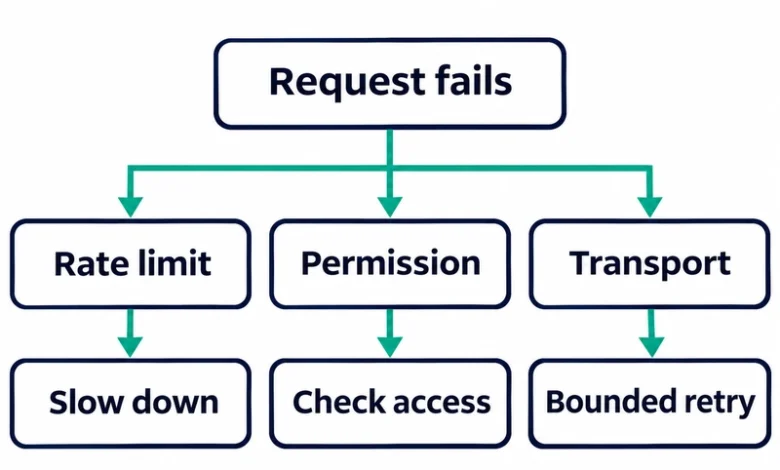
In a professional integration, the software must be designed to anticipate failure rather than ignore it. The following Python logic demonstrates a robust approach to managing API responses, specifically by distinguishing between different classes of errors:

import os
import requests

def fetch_forex_snapshot(symbol="EURUSD"):
    response = requests.get(
        "https://api.tickdb.ai/v1/market/ticker",
        params="symbols": symbol, "type": "forex",
        headers="X-API-Key": os.environ["TICKDB_API_KEY"],
        timeout=10,
    )
    # Business logic for parsing and error categorization
    try:
        body = response.json()
    except ValueError as exc:
        raise RuntimeError("Non-JSON response received") from exc

    code = str(body.get("code", "UNKNOWN"))
    if not response.ok or code != "0":
        if code == "3001":
            action = "Rate limited; implement exponential backoff"
        elif code in "3006", "3008", "3009":
            action = "Permission error; upgrade account or adjust query"
        else:
            action = "Unhandled error state"
        raise RuntimeError(f"API Failure: code - action")
    return body.get("data")
This code does not simply "check for errors"; it categorizes them to allow for automated, intelligent recovery. A production-grade system must honor the Retry-After headers and stop execution entirely if a permission error is encountered, rather than attempting to brute-force a restricted endpoint.
Broader Implications and Strategic Selection
The decision-making process for selecting an API provider should be driven by technical requirements rather than the pursuit of the "largest number" in a pricing table. While a Professional plan may offer 600 requests per minute compared to the 60 of a Starter plan, these numbers are irrelevant if the provider does not offer the specific data latency or historical coverage required by the application.
Industry experts suggest that developers treat API documentation as a binding contract. Before committing to a provider, organizations should generate an "acceptance record." This document should explicitly list:
- The specific currency pairs required for the application’s core functionality.
- The mandatory historical date ranges needed for backtesting.
- The anticipated peak request volume during high-volatility market hours.
- The legal usage rights, specifically regarding the redistribution of data, which is often prohibited under standard "free" or "starter" licenses.
Conclusion
The allure of a free trial is powerful, but it is often an illusion in the context of production software. Developers must move past the "it works for me today" mentality and embrace a rigorous evaluation framework that accounts for the life cycle of the application. By separating testing from production, auditing error codes, and verifying historical constraints, developers can build systems that are not only functional but also resilient against the inevitable limitations of third-party data providers. The honest assessment of an integration is not whether it works during a trial, but whether it can withstand the scrutiny of real-world, long-term operational demand.