J. Crew Unveils AI Style Advisor Powered by Anthropic’s Claude to Transform E-Commerce

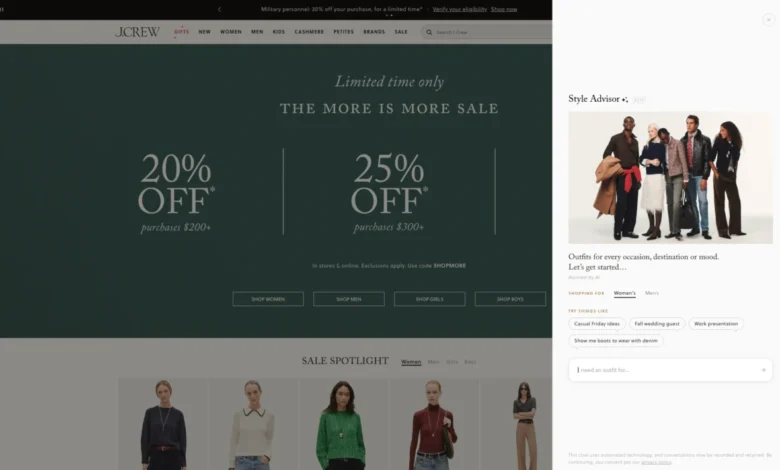
Retail giant J. Crew has officially launched an innovative artificial intelligence styling assistant on its primary e-commerce platform, integrating Anthropic’s advanced Claude models to redefine the digital shopping experience. Announced via a detailed corporate blog post, the new interactive tool—appropriately titled Style Advisor—aims to transition consumers away from traditional, rigid keyword searches and toward an intuitive, inspiration-led journey that mirrors a personalized consultation with a human fashion expert.
As consumer expectations shift toward hyper-personalization in digital retail, J. Crew’s deployment marks a significant milestone in the intersection of artificial intelligence and fashion merchandising. Ranked No. 80 in North America’s Top 1000 Database of largest online retailers by annual e-commerce sales, and securing the No. 135 position in Digital Commerce 360 and ReFiBuy’s specialized AI Commerce Rankings, J. Crew continues to cement its status as an industry innovator willing to embrace cutting-edge technologies to maintain its competitive edge.
The Evolution of the J. Crew Style Advisor
The genesis of Style Advisor stems from a deliberate effort by J. Crew’s internal product engineering team to rethink how shoppers interact with clothing catalogs online. According to insights shared by Anthropic, the development process began with engineers building an initial prototype utilizing sophisticated development tools, including Claude Code and the high-end Claude Opus 5.5 model. This foundational setup allowed the team to test complex, open-ended conversational flows that could accurately interpret nuanced fashion queries.
Once the conceptual framework was proven, J. Crew’s engineering and product teams transitioned the project into full production by leveraging the Claude Fable 5.1 model, specifically marketed by Anthropic for handling complex and open-ended workloads. To ensure optimal performance and seamless user experience on the live website, the production architecture employs a multi-model strategy. The Claude Sonnet 5.5 model is deployed to process intricate prompts and deliver detailed, styling-focused feedback, while the faster, lighter Claude Haiku 5.5 model handles shorter, highly focused backend tasks to maintain lightning-fast response times for users browsing JCrew.com.
Leadership Perspectives on the Future of Retail
The launch of Style Advisor is not merely a technical upgrade; it represents a fundamental philosophical shift in how J. Crew approaches customer engagement. Libby Wadle, CEO of J. Crew Group, emphasized that the brand is actively working to anticipate future consumer behaviors rather than simply reacting to market trends.
“As consumer expectations evolve and AI opens up new possibilities for retail, J. Crew is challenging the traditional model of online shopping, moving beyond individual product searches toward a more connected and inspiration-led experience,” Wadle stated. “For a long time, we’ve been thinking about how customers will want to shop in the future, and how we can lead that evolution rather than react to it.”
Wadle further highlighted that the initiative successfully bridges decades of accumulated institutional knowledge with modern technological capabilities. “We see an opportunity to fundamentally rethink the shopping experience,” she added. “Through our work with Anthropic, we’re bringing decades of J. Crew styling, merchandising, and creative expertise together to help shape what’s next for customer behavior.”
Anthropic executives have similarly praised the collaboration, pointing out that J. Crew’s distinct aesthetic required a specialized approach to generative artificial intelligence. Paul Smith, chief commercial officer at Anthropic, noted the precision with which the retailer integrated advanced language models without diluting its brand identity.
“J. Crew has one of the most recognizable points of view in fashion, and its team used Claude to bring that expertise to customers in a new way,” Smith explained. “They used a frontier model to build the experience and faster, more efficient models to run it, so customers get quick answers that stay true to the brand’s styling.”
How the Style Advisor Works for Online Shoppers
Accessible directly from the main menu on JCrew.com, Style Advisor opens within a streamlined web browser interface designed to reduce friction and encourage exploration. Upon opening the assistant, shoppers are greeted with a clean user interface featuring suggested prompts, guiding them on how to interact with the conversational tool.
Unlike traditional e-commerce filters that sort items strictly by color, size, or category, Style Advisor allows users to ask open-ended questions related to specific occasions, climate conditions, aesthetic preferences, or wardrobe integration. For example, a shopper can ask for outfit recommendations for a coastal autumn weekend, request ideas on how to style a specific heritage blazer already owned, or seek complete seasonal looks curated around a single statement piece.
Crucially, J. Crew maintains strict quality control over the underlying inventory and styling philosophy. Because all garments and accessories referenced by the AI originate directly from the brand’s human-curated merchandise teams, the recommendations remain consistent with J. Crew’s signature preppy, timeless aesthetic. This ensures that while the technology powering the recommendation is cutting-edge, the fashion advice itself remains authentically rooted in the brand’s decades-old heritage.
Broader Implications for E-Commerce and the AI Landscape
The successful rollout of J. Crew’s Style Advisor carries significant implications for the broader retail sector. As artificial intelligence models become increasingly sophisticated, retailers are facing mounting pressure to move away from static product recommendation grids—such as "customers who bought this also bought that"—and toward dynamic, conversational shopping assistants that replicate the high-touch service of a brick-and-mortar boutique.
The integration of advanced Large Language Models (LLMs) like Claude into mainstream retail platforms demonstrates a maturing market where generative AI is no longer viewed merely as a customer service chatbot tool, but as an active driver of merchandising and sales conversion. By lowering the cognitive load of browsing thousands of SKUs, tools like Style Advisor have the potential to increase average order values, reduce product return rates caused by poor styling choices, and enhance overall brand loyalty.
Furthermore, J. Crew’s implementation strategy offers a blueprint for other legacy retailers seeking digital transformation. By utilizing sophisticated frontier models during the prototyping phase to capture brand voice and nuance, followed by faster, cost-effective models for day-to-day operations, companies can achieve a balance between high-quality output and operational efficiency.
As digital commerce continues to evolve through platforms tracked by industry databases like Digital Commerce 360’s Top 1000 and specialized AI Commerce Rankings, early adopters like J. Crew are establishing new benchmarks for customer engagement. The industry will undoubtedly watch closely to see how consumer adoption rates translate into long-term sales growth and whether competing apparel brands accelerate their own generative AI roadmaps in response to J. Crew’s bold technological leap.