The modern landscape of software development is increasingly defined by the ability of individual developers to bridge the gap between theoretical knowledge and functional, production-ready applications. Wahib El Khadiri, a full-stack developer based in Kénitra, Morocco, has recently launched MovieVerse, a comprehensive movie discovery platform that serves as a case study for the practical implementation of React 19. By leveraging the The Movie Database (TMDB) API, the project offers a real-world demonstration of how contemporary frontend frameworks handle data-intensive applications.
Technical Architecture and The Stack
At its core, MovieVerse represents a shift toward the latest iteration of the React ecosystem. The application is built upon React 19, a version characterized by significant improvements in performance and developer experience. The project stack includes TypeScript, which serves as the primary structural integrity layer, ensuring that the application’s data handling is predictable and type-safe.
The application utilizes Vite as its build tool, a choice that reflects current industry standards for rapid development and optimized production builds. Routing within the application is managed by React Router, which enables a multi-page navigation experience that mimics the behavior of native enterprise applications. The entire project is deployed via Netlify, a cloud platform that facilitates continuous integration and global content delivery. This architecture reflects a growing trend among developers to move away from monolithic, local-only projects toward cloud-deployed, API-driven web applications.
Development Chronology and Implementation Challenges
The development of MovieVerse followed a deliberate trajectory from conceptualization to deployment. Initially, the project began as a single-page application focused on basic data fetching. However, the requirement to handle complex states—such as deep-linked detail pages, dynamic filtering, and user authentication preferences—necessitated a transition into a multi-page architecture.
A critical phase in the development cycle involved the integration of the TMDB API. Developers often underestimate the complexity of external API integration, but El Khadiri’s project highlights several distinct failure modes that engineers must account for. These include:
- Network Latency and Connectivity: The implementation of robust loading states (skeleton loaders) ensures that users maintain a perceived level of performance even when data fetching is delayed.
- Error Handling: Building for "real-world" conditions involves managing rate limits and HTTP status codes, ensuring that users receive actionable feedback rather than silent application failures.
- Type Safety: The integration of TypeScript served as a preemptive bug-detection mechanism. By formally defining the shape of incoming API data, the developer was able to mitigate runtime errors that typically plague applications relying on loosely typed JSON responses.
Data-Driven Development: The Role of External APIs
The reliance on the TMDB API is central to the project’s utility. The TMDB API provides a massive, community-maintained database of film metadata, which acts as the "source of truth" for MovieVerse. For developers, interacting with such a vast dataset provides a realistic environment to practice state management and caching.
Industry data suggests that the ability to effectively manage API responses—specifically through patterns like caching, memoization, and optimistic UI updates—is a key differentiator for frontend engineers. By building MovieVerse, the developer has demonstrated a mastery of these patterns. The project essentially acts as a functional portfolio, moving beyond the "tutorial-style" projects common in the junior developer circuit. It represents a shift in pedagogical focus: instead of following step-by-step guides, developers are increasingly encouraged to identify a specific data source and build an entire ecosystem around it.

Professional Implications and Industry Standards
For junior developers, the implications of building and shipping a project like MovieVerse are significant. In a competitive labor market, the existence of a live, public-facing repository serves as a verifiable metric of a candidate’s competency. Recruiters and technical hiring managers frequently look for three specific indicators of readiness: the ability to handle routing, the capacity to implement type safety, and the skill to manage complex application states.
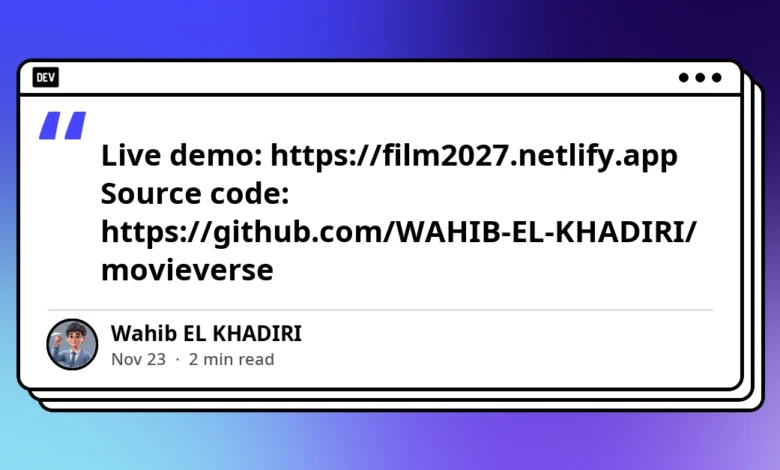
El Khadiri’s decision to publish the source code on GitHub and provide a live demo on Netlify aligns with the "open-source-first" mentality that has become the standard in modern software engineering. This transparency allows for peer review and community feedback, which are essential components of professional growth.
Technical Analysis: React 19 and Future-Proofing
The choice of React 19 is particularly noteworthy. As the framework continues to evolve, the shift toward server-side optimizations and improved hook management has changed how developers approach state. In MovieVerse, the use of these modern features demonstrates an understanding of the current trajectory of web development.
From an architectural standpoint, the project serves as an example of "defensive programming." By treating the API as an unreliable entity, the developer has implemented error boundaries and user-facing notifications that enhance the overall user experience. This focus on "features, not polish"—specifically regarding error handling and skeleton screens—reflects a mature understanding of what makes an application "production-ready."
The Broader Impact of Community-Led Education
Beyond the technical merits of the app itself, the project serves as a bridge for the developer community in Morocco and beyond. El Khadiri’s efforts in creating educational content, including teaching React in Darija on YouTube, highlight the importance of localized technical education. The democratization of development knowledge is a critical factor in the expansion of the global tech workforce.
By documenting the process of turning a single-page site into a multi-page app, the developer contributes to a collective repository of "lessons learned." Such documentation is invaluable for those navigating the transition from basic tutorials to professional software engineering.
Conclusion and Future Outlook
The launch of MovieVerse is more than just the deployment of a movie discovery app; it is a demonstration of the efficacy of project-based learning. As the industry moves toward more complex frontend requirements, the ability to synthesize various technologies—React, TypeScript, Vite, and external APIs—into a cohesive, functional product is the most sought-after skill in the market.
For those interested in the underlying code or the functionality of the application, the project remains open-source. The developer has invited community members to test the application, report bugs, and contribute to its development, further emphasizing the collaborative spirit of the modern web development community. As a testament to the efficacy of hands-on experience, MovieVerse stands as a benchmark for junior developers aiming to move from the classroom to the production environment.