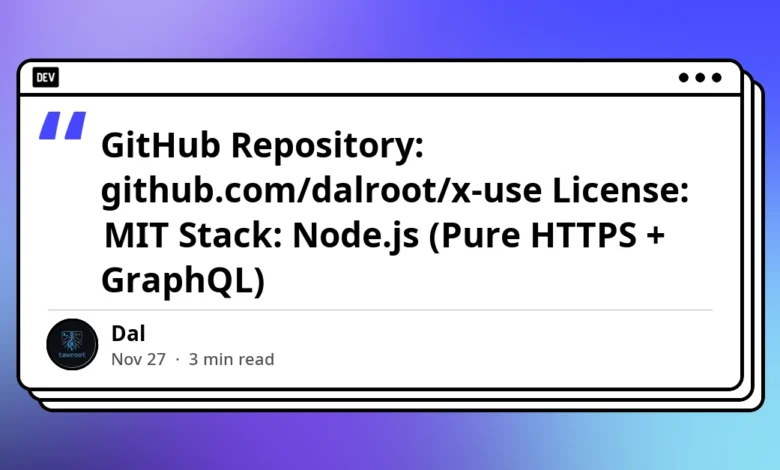
The landscape of autonomous artificial intelligence agents has undergone a rapid transformation, shifting from simple text-based conversationalists to complex, multi-modal systems capable of executing actions across the web. However, a significant technical barrier has emerged for developers attempting to integrate these agents with X (formerly Twitter). The traditional methods—relying on the official X API or heavy-duty browser automation tools like Playwright or Puppeteer—are becoming increasingly untenable due to restrictive API pricing, rate limits, and the high resource consumption associated with headless browsers. The emergence of x-use, an open-source Node.js library and CLI tool, marks a pivotal shift by enabling direct communication with X’s internal GraphQL endpoints, effectively bypassing the need for browsers or expensive API access.
The Technical Bottleneck: Why Automation Has Stalled
To understand the significance of this development, one must first examine the two primary methods developers previously utilized to bridge AI agents with the social media platform. The first is the official X API. Since the platform’s acquisition and subsequent restructuring, access to the API has been placed behind a high-cost paywall, with free or low-tier access providing severely limited functionality that is often insufficient for autonomous agents requiring high-frequency interactions.
The second, more common method has been browser automation. Tools like Playwright, Puppeteer, and Selenium simulate a human user by loading a full Chromium instance. While functional, this approach is notoriously inefficient. Launching a browser instance consumes substantial system memory and CPU, making it impractical for lightweight cloud environments, edge computing, or scaling dozens of agents simultaneously. Furthermore, browser automation is fragile; even minor changes to the X front-end interface can cause the automation scripts to break, leading to constant maintenance overhead.
The x-use Solution: Architectural Efficiency
The x-use project, developed by an independent contributor, takes a fundamentally different approach. By leveraging Node.js’s native https stack, the tool communicates directly with the GraphQL endpoints that the X web client uses to fetch and post data. This "zero-browser" architecture removes the need for rendering engines entirely.
By eliminating the browser, the tool operates at the network layer rather than the presentation layer. The performance benefits are immediate: execution times for posting tweets or retrieving user data are measured in milliseconds rather than the seconds required for a browser to spin up, navigate to a page, and wait for DOM elements to load. This efficiency allows developers to run autonomous agents on minimal server resources, such as low-RAM virtual private servers or containerized environments, which was previously impossible with standard automation stacks.
Chronology and Development
The move toward direct API interaction—often referred to in the developer community as "reverse-engineering the front-end"—has been gaining momentum throughout 2024. As AI coding agents like Claude Code and various autonomous research agents began to demand social media integration, the community sought a more stable, lightweight alternative to browser-based scraping.
The x-use project emerged from this necessity. By documenting the authentication flow—specifically utilizing standard session cookies like auth_token and ct0—the tool allows users to act as an authenticated user without needing the official API developer credentials. This transition represents a broader trend in the open-source community: developers are increasingly prioritizing "agent-first" interfaces, where tools are designed to output structured, machine-readable JSON rather than requiring a human to parse visual data.
Data-Driven Integration: The Agent-First Paradigm
A defining feature of x-use is its design philosophy, which prioritizes the requirements of Large Language Models (LLMs). The tool provides a built-in SKILL.md file, which acts as a documentation bridge for AI agents, explaining how to interact with the system without human intervention. Every command, whether it involves fetching profile metadata, posting a single tweet, or executing a complex multi-tweet thread, is designed to return a standardized JSON contract.

For instance, when a developer or an autonomous agent triggers the command to publish a tweet, the system returns a predictable object containing the tweetId and the direct URL of the published post. This reliability is critical for AI agents. In an autonomous loop, the agent needs to verify the success of an action before proceeding to the next step. If an action returns malformed data or requires visual confirmation, the agent is likely to fail. The JSON-first design of x-use ensures that the agent can maintain its state and error-handling logic with minimal complexity.
Authentication and Security Considerations
Security remains a primary concern for any tool that handles authentication cookies. Unlike standard OAuth flows, which provide limited-scope tokens, x-use requires session cookies that grant broader access to the account. The project mandates that these tokens be managed securely, either through environment variables or local configuration files.
From an industry perspective, this method of authentication highlights a friction point between platforms and users. While platforms like X seek to secure their data through APIs, the barrier to entry for developers has forced the community to find alternative pathways. While these methods are currently effective, they operate in a gray area of service terms. Developers adopting such tools must weigh the benefits of low-cost, high-performance automation against the risk of the platform updating its internal GraphQL schemas or security policies, which could disrupt the connectivity provided by these unofficial clients.
Broader Impact on Autonomous Agents
The introduction of tools like x-use signals a maturation in the development of AI agents. We are moving away from the "sandbox" era—where AI agents were limited to chat windows—toward an era of "actionable agents" that can perform real-world tasks. By abstracting the complexities of web communication into a simple, reliable command-line interface, x-use allows developers to focus on the reasoning capabilities of their agents rather than the underlying connectivity issues.
Furthermore, this development has implications for the accessibility of AI technology. By removing the need for paid API keys, the barrier to entry for building social-media-connected agents is lowered significantly. This allows researchers, hobbyists, and small-scale developers to experiment with autonomous social media management, sentiment analysis, and automated research dissemination on a scale that was previously only accessible to enterprise-level entities with significant budgets for API usage.
Future Outlook and Sustainability
The sustainability of the x-use approach rests on the stability of X’s internal GraphQL endpoints. While these endpoints are the backbone of the platform’s own mobile and web apps, they are subject to change. However, the modular nature of the x-use codebase is designed for rapid updates. Because it avoids the "brittleness" of CSS selectors and XPath queries used in traditional browser scraping, it is arguably more resilient. If a specific endpoint URL changes, the logic only requires a minor adjustment in the network configuration rather than a complete overhaul of the automation suite.
As the industry continues to push toward more capable, agentic workflows, the demand for lightweight, low-latency integration tools will only grow. The shift from "browser-based automation" to "direct network interaction" marks a significant step forward in the technical maturity of the AI agent ecosystem. For developers, the goal is clear: build systems that are fast, reliable, and capable of operating at the speed of the internet, without the overhead of the traditional, browser-centric web.
In summary, the release of x-use provides a robust template for how developers can bypass the limitations of current platform restrictions. By prioritizing machine-readable outputs and removing the heavy requirements of headless browsers, it empowers the next generation of autonomous agents to function more effectively, marking a milestone in the ongoing evolution of AI-driven web interaction. As this ecosystem matures, we can expect to see similar, highly efficient tools emerge for other platforms, further cementing the role of autonomous agents in our digital infrastructure.