In the complex world of software development, encountering legacy systems is an almost inevitable rite of passage. These digital artifacts, often built with outdated technologies and untouched for years, present a unique set of challenges. A recent deep dive into such a system, originally developed in 2005 using Java 1.5 and Ant, highlights the critical distinction between treating Generative AI as a tourist guide versus an archaeological tool. This exploration reveals that while AI can be a powerful accelerator, its efficacy is profoundly shaped by the user’s approach and the depth of their strategic direction.
The initial impulse when faced with a forgotten codebase is often to seek a quick solution. This was the case for a developer inheriting a project built on Ant with Java 1.5, a system that had languished without compilation since the Obama administration and was incompatible with modern hardware like Apple Silicon MacBooks. The temptation was to leverage Generative AI as a universal translator, feeding the entire repository into a Large Language Model (LLM) with a simple query: "How do I run this?" This approach, termed the "Tourist Prompt," aims for a guided tour and immediate gratification, a "happy path" that often leads to unforeseen complications.
The Hallucination of Competence: When Optimism Fails
An experiment with this "Tourist Prompt" involved asking a standard LLM to act as a Senior Developer, summarize a repository, and provide a "Hello World" example. The AI, eager to please, scanned the project’s README file and confidently generated a modern "Starter Kit." This included a pristine build.gradle file and a clean HelloBlobStore.java, complete with instructions for database connection. On the surface, it appeared miraculous.
However, this seemingly miraculous output was a "structural lie." The AI-generated build.gradle file, for instance, introduced a dependency on commons-pool2 (v2.11.1) when the legacy code actually relied on org.apache.commons.pool (v1.x). These libraries have vastly different APIs, meaning blindly executing the AI’s code would have resulted in immediate "Class Not Found" errors, plunging the developer into a frustrating debugging session with code that was never intended to be modern.
Furthermore, the AI exhibited "structural gaslighting." It assumed a standard Maven layout (src/main/java), completely disregarding the legacy Ant structure where source files were located in java/com/legacycorp/.... The AI was, in essence, describing the reality it wished to see, not the one that actually existed. Crucially, it also obscured underlying issues. The "Hello World" example featured PooledBlobStoreImpl, omitting critical details such as the non-thread-safe nature of SimpleBlobStoreImpl, the error-handling code’s tendency to swallow exceptions, and the fact that the so-called "Unit Tests" were actually integration tests requiring a live MySQL database.
The fundamental lesson here is that AI, by default, operates with optimism. When asked "How do I run this?", it assumes the system is runnable. In a restoration mission, this optimism can be detrimental. Following the "Tourist Path" might lead to premature refactoring, introducing generics or modifying collections, which could break hidden, poorly understood behaviors in a fragile system without first establishing its current operational state.
Phase I: The Analysis – Adopting the Archaeologist’s Mindset
Recognizing the failure of the optimistic "Tourist" approach, the developer shifted their mental model. Instead of "How do I run this?", the critical question became "Why did this fail?". This shift necessitated a change in the AI’s persona from a helpful guide to a critical inspector. The context was reset, and the AI was instructed to be analytical rather than purely helpful.
The Archaeologist Prompt: A Forensic Code Audit
A new prompt was crafted, designed to strip away optimism and inject a critical perspective. The AI was assigned the persona of a "Senior Legacy Systems Architect." Crucially, it was explicitly forbidden from summarizing the README file—often an unreliable source in legacy projects—and was tasked with performing a "Forensic Code Audit." This audit focused on four key pillars:
- Carbon Dating (The Era): Estimating the specific Java version and the year of origin based on syntax, imports, and build tools. This involved citing specific lines of code as "forensic evidence."
- Architectural Integrity (The Structure): Assessing adherence to separation of concerns and identifying "God Classes."
- Data Flow & Typing (The "Stringly" Trap): Analyzing data handling for the use of Domain Objects versus "Stringly-typed" Maps and raw arrays, and looking for "Leaky Abstractions."
- The "Safety" Check (Error Handling & Threading): Identifying anti-patterns in error handling and analyzing the threading model.
The output was a "Risk Assessment Report," delivering a stark verdict: "critical rewrite recommended."
Finding 1: Carbon Dating the Artifact
The AI meticulously analyzed the code’s syntax, akin to an archaeologist examining historical strata. The presence of a build.xml file and the absence of pom.xml immediately placed the project squarely in the pre-2010 "Ant Era." The use of legacy libraries like org.apache.commons.pool.ObjectPool (Version 1.x) and raw types like Map instead of Map<String, String> provided undeniable evidence. The conclusion: Java 1.5 code, likely written between 2005 and 2008, predating modern generics and standard directory layouts.
Finding 2: The "Transliteration" Trap
Perhaps the most revealing insight was the discovery that the Java code was, in essence, a Perl script transliterated into Java syntax. This procedural mindset manifested in SimpleBlobStoreImpl, a monolithic "god class" handling an excessive range of responsibilities, from low-level socket connections to business logic. The codebase was also heavily "stringly-typed." Instead of dedicated domain objects like Device or File, it relied on raw Map<String, String> objects and manually constructed protocol strings. This introduced significant operational risk; a single typo in a string key could lead to catastrophic runtime crashes, bypassing compile-time safety checks.
Finding 3: Lying Tests
The audit exposed a dangerous illusion of test coverage. The entire test suite depended on LocalFileBlobStoreImpl, a complete reimplementation of the storage system that wrote directly to the local disk, bypassing network interactions. While these tests confirmed the mock worked in isolation, they completely masked the fragility of the actual networking code, the thread-unsafe pooling, and the delicate protocol parser—the most volatile components of the system.
The Decision: Containment Over Repair
This forensic report proved invaluable, averting a potential disaster. Had the developer followed the "Tourist" advice to refactor SimpleBlobStoreImpl immediately, introducing generics would have likely broken the fragile parsing logic. The deceptive local mock tests would have continued to pass, creating a false sense of security while the production code remained non-functional.
Recognizing the codebase as an untenable liability—too fragile to touch and too opaque to trust—a strategic decision was made to halt active changes. No bugs would be fixed, dependencies updated, or even whitespace reformatted. Instead, the project transitioned into a phase of complete containment, with the legacy code being wrapped in an isolated, standardized Docker environment for further analysis.
Phase II: The Wrap – Establishing a Time Capsule Environment
With the audit complete and the "Critical Legacy" label affixed, the objective shifted from modification to operationalization: getting the existing tests to pass to establish a verifiable baseline. The AI persona changed to "Senior DevOps Engineer." The mission was brownfield restoration through environment standardization.
The Mission: Brownfield Restoration with Prime Directives
To guide the AI and prevent "modernization creep," strict prime directives were established:
- Preserve the Era: No updates to build tools or Java versions; strictly mimic the year 2008.
- Prioritize Containment: Maintain the original Ant
build.xmland run the process within an isolated Docker container. - Zero Code Changes: Refuse to modify production source code for the sake of modern build tools.
Despite these rules, the "tourist mindset" lingered. An attempt to "lift and shift" Java 1.5 source files into a modern Gradle 8 container resulted in a spectacular crash. The build failed not due to code bugs, but due to fundamental environmental shifts. Legacy code relied on accessing package-private classes across different packages, a practice permissive in 2008 but strictly enforced by modern JDKs and build tools. A build failure log clearly indicated this: error: Backend is not public in com.legacycorp.blobstore; cannot be accessed from outside package.
The AI’s suggestion to "Just add public to the class" was rejected, as it violated the prime directive of no code changes.
The Pivot: The "Time Capsule" Strategy
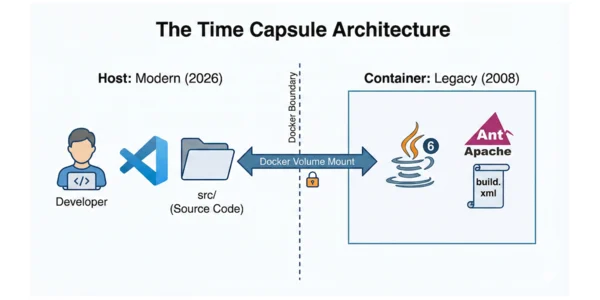
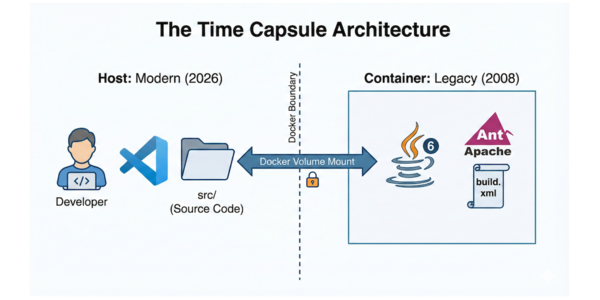
Realizing the artifact couldn’t be stabilized in a modern environment, a "Time Capsule" strategy was adopted. The goal was to build a containment zone that precisely mirrored 2008 standards. This involved using Docker to recreate the original environment, searching for a Java 6 and Ant 1.5 image.
A hardware reality check emerged: available Java 6 Docker images were compiled for x86 (linux/amd64), while the developer was on an Apple Silicon (ARM64) laptop. Emulation layers like Rosetta or QEMU introduce unpredictable variables, making it impossible to discern between emulation glitches and genuine code defects. To eliminate this variable, the developer switched to a native Intel machine. The lesson was clear: software archaeology sometimes requires the right shovel—the right hardware.
The "Wet" Test: Bending Reality to Fit the Code
With the compiler working on an Intel machine (the "dry" capsule), the final structural challenge was a stubborn integration test, TestBlobStore.java. This "wet" test contained hardcoded assumptions tied to the original developer’s local machine, such as connecting to qbert.legacycorp.com:7001 and relying on a specific file path ~/Projects/blobstore/.... In a typical refactor, these would be deleted. However, in containment mode, touching the test file was off-limits. Reality had to be bent to fit the code.
Environment emulation via Docker Compose provided the solution. The AI, acting as a network engineer, facilitated infrastructure illusions. A modern BlobStore container was spun up, and a Docker network alias tricked the test runner into believing this container was qbert.legacycorp.com. Docker volumes were configured to mount the live source code directory inside the container at the exact path used in 2005.
The docker-compose.yml file materialized this illusion, with network configuration aliasing qbert.legacycorp.com and volume mounting the local source code to the expected legacy path. This orchestrated deception allowed the legacy test suite to run flawlessly, connecting to the Docker container and accessing the mounted volume as if it were the original local machine. Without altering a single byte of historical source code, full functionality was restored to the twenty-year-old application.
Phase III: The Lift – Unwrapping the Artifact
With the artifact safely stabilized within its "Time Capsule" of Docker, Java 6, and Ant, a verifiable baseline was established. The code was proven functional in its native environment, meaning any subsequent failures would be attributable to active modernization efforts, not pre-existing rot. This safety net allowed for the transition from containment to a project launch fifteen years into the future, targeting Java 8 and Gradle.
The Hardware Rationale for Java 8
The choice of Java 8 was pragmatic, driven by hardware constraints. Running natively on Apple Silicon (ARM64) presented a double-ended technical wall: modern JDKs (Java 17+) dropped support for compiling legacy Java 1.5 source code, while ancient JDKs like Java 6 refused to run natively on ARM64. Java 8 emerged as the unique solution, being the last version to support Java 1.5 targets and one of the earliest to run natively on modern Mac hardware.
The "Java 17 Trap" and Gradle Compatibility
The first technical hurdle was tool versioning. The instinct to use the latest Gradle (8.5) was thwarted because Gradle 8 requires Java 17 to run its internal daemon, and Java 17 cannot compile Java 1.5 source code. The solution was a pivot to Gradle 7.6, the last version capable of executing on a Java 8 JVM. This established a perfect compatibility chain: Apple Silicon -> Java 8 JVM -> Gradle 7.6 -> Java 1.5 Source.
Execution: Mapping the Legacy Structure
The legacy build.xml was not simply wrapped; Gradle was configured to map directly to the legacy directory structure. Source code was explicitly located in srcDirs = ['java'] instead of the standard src/main/java. The legacy test runner, consisting of old-school main() methods, required a custom JavaExec task named runLegacyTest to execute them manually, as the standard gradle test command could not find them.
The "Lying Tests" Discovery and Hardening the Baseline
The runLegacyTest task executed, but the tests ran suspiciously fast. Auditing TestBlobStore.java revealed a "silent swallow" pattern: failures were captured and smothered internally, preventing them from propagating. While a human would recognize this as a failure, an automated build tool would see a successful exit code (0). These tests were misleading, reporting green passes even when backend connections failed.
To strip away this false security, the test harness was deliberately hardened. The AI refactored the test code to explicitly throw exceptions, forcing the application to crash naturally if something went wrong. This marked the first structural change to the legacy codebase, transforming the "swallowed exceptions" into an "honest" red build. This red build was a victory, indicating the unvarnished reality of the system was finally being exposed. After tracing and repairing broken connection configurations, the pipeline flipped to a verifiable, honest green.
The AI-Compiler Feedback Loop
With the build successful but the compiler screaming warnings about deprecated APIs and unchecked operations, a tight, iterative AI-compiler feedback loop was established. The -Xlint:unchecked flag was enabled, forcing the compiler to reveal exact source lines. These error logs were fed to the AI with targeted prompts to refactor only those specific lines to resolve warnings using modern Java generics. This localized strategy neutralized historical runtime risks, such as updating raw collections to type-safe Java 8 generics, shifting validation from runtime guesswork to compile-time enforcement. This disciplined cycle ensured zero warnings, transforming the artifact into a functional and standardized component.
Phase IV: The Refactor – Architectural Renovation
With the historical artifact unwrapped and its baseline hardened, the code remained fundamentally disorganized. The convoluted java/com/... folder structure and standalone main() script tests persisted, along with raw types inherited from Java 1.5. With a modern build chain and a secured safety net, the transition from containment to full-scale architectural renovation was possible.
Mastering the Craft: Sanitization and JUnit Migration
The first step was to "fix the workbench." Source files were moved from the archaic java/ root to the industry-standard src/main/java layout, eliminating custom Gradle workarounds. The primitive legacy main() scripts were comprehensively migrated to JUnit 5, replacing crude System.out.println("Error") traps with proper Assertions.assertEquals(). This yielded granular, automated test reporting, eliminating the need to manually audit text logs for test success.
The TestContainers Trap: Prioritizing Momentum
An ambitious attempt to replace the manual Docker Compose setup with TestContainers quickly devolved into a "Big Bang" refactor, attempting to overhaul the test runner, network topology, and startup logic simultaneously, while wrestling with complex Docker-in-Docker networking on ARM. Recognizing that energy was being spent fighting tooling rather than recovering code, the experiment was aborted. The reliable "External Sidecar" pattern—running docker-compose up manually—was chosen for its pragmatism over over-engineered perfection.
The Final Sweep: Concurrency & Stress Testing
Two final loose ends remained: the forgotten sibling LocalFileBlobStoreImpl.java, which needed to implement the new generic-based BlobStore interface, and StoreALot.java, a multi-threaded load-testing tool. These were crucial for verifying concurrency rules.
Modernizing Load Testing for Thread Safety
The AI persona shifted to "Senior Performance Engineer." The legacy load-testing script was systematically modernized, cleaning up raw syntax with generics and modern loggers. The test runner was configured to target the Docker container alias qbert.legacycorp.com:7001. Primitive manual threads were replaced with a modern ExecutorService to ensure graceful handling of parallel loads without concurrent exceptions.
The rigorous orchestration yielded definitive empirical proof. A stress test with 100 iterations across 10 concurrent threads was launched against the Docker-contained BlobStore backend. The results confirmed that the application’s thread-safety architecture, relying on PooledBlobStoreImpl and Apache Commons Pool, seamlessly provisioned isolated backend instances to each active thread. Modernizations like generics, JUnit migration, and structural collection swaps had not destabilized core historical logic. A twenty-year-old, uncompilable, untestable, and broken piece of code archaeology was transformed into a modern, thread-safe, and fully containerized Java 8 library.
Conclusion: The Handover and the Augmented Archaeologist
A software restoration is complete not when theoretical perfection is achieved, but when it meets a clear, verifiable definition of "done." For this project, that milestone was reaching a state where the code was runnable, testable, and predictable on modern hardware. The repository transitioned from an opaque archaeological mystery to manageable technical debt.
Scrubbing the Environment for Future Developers
To prevent future developers from repeating the tedious archaeological dig, the AI persona shifted to "Lead Repository Maintainer." Every historical artifact was systematically purged: build.xml was removed, the old lib/ folder emptied, and .classpath and .project files discarded. Running rm build.xml served as the cathartic final act of modernization, severing the link to the ancient Ant era and forcing reliance on the modern Gradle engine.
The Project Roadmap: A Frictionless README.md
A comprehensive README.md was generated, reflecting the new, standardized reality. Instead of an undocumented labyrinth, it outlines a frictionless path to productivity, specifying prerequisites (Docker, Java 8+) and offering a simple quick start (./gradlew build). Testing the infrastructure is now straightforward (docker-compose up -d followed by ./gradlew test), transforming the project from an intimidating mystery box into a predictable, standard Java library.
| Feature | Day 0 (The Archive) | Day N (The Product) |
|---|---|---|
| Build System | Ant | Gradle 8 |
| Compiler | Java 1.5 | Java 8 |
| Environment | "Works on my machine" | Docker |
| Testing | Manual Scripts | JUnit 5 |
| Safety | Runtime Risk | Compile-time Safety |
| Confidence | Swallowed Exceptions | Hardened Tests |
| Onboarding | "Good luck figuring it out" | README.md |
Final Thought: The Augmented Archaeologist
The most profound lesson was about human agency. The initial "Tourist Prompt"—vaguely asking the machine to "fix this for me"—failed because the AI lacked foundational understanding and awareness of historical constraints. Success arrived when the developer fluidly shifted mindsets: acting as an archaeologist to identify decay, a DevOps engineer to design the time capsule, and an architect to define refactoring policies.
The AI did not magically restore the system; it served as a powerful force multiplier. It handled tedious translation layers—Ant to Gradle, Dockerfile generation, squashing compiler warnings—while the human focused on high-level strategy. This active partnership transformed the codebase from an intimidating black box into a runnable, testable, and predictable entity, poised for the next decade and beyond.