Critical Nginx Vulnerability CVE-2026-42533 Disclosed: Potential for Remote Code Execution Requires Immediate Patching

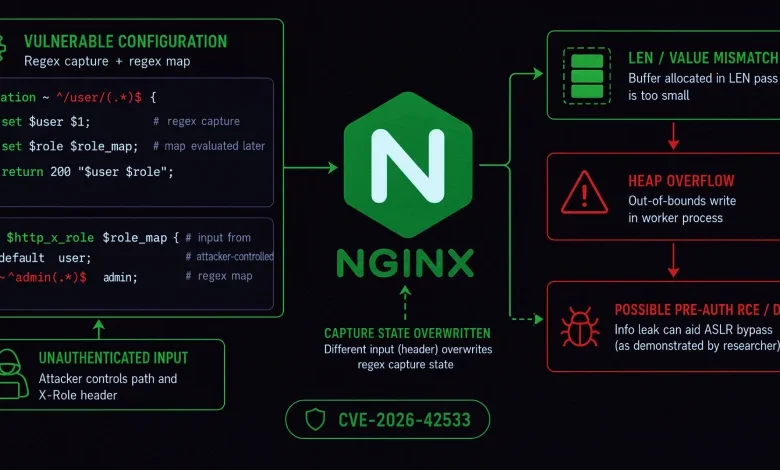
F5 has issued critical security advisories detailing a severe vulnerability within the widely-used Nginx web server, identified as CVE-2026-42533. This flaw, if successfully exploited, could allow a remote, unauthenticated attacker to execute arbitrary code on affected systems. The vulnerability stems from a heap buffer overflow within Nginx’s worker process, triggered by specially crafted HTTP requests. While the most immediate impact of exploitation is a denial-of-service (DoS) condition leading to worker process crashes or restarts, researchers warn that under certain circumstances, particularly where Address Space Layout Randomization (ASLR) is disabled or can be bypassed, the vulnerability could escalate to full remote code execution (RCE).
The vulnerability was patched by F5 on July 15th, with fixes incorporated into Nginx version 1.30.4 (stable branch) and 1.31.3 (mainline branch), as well as NGINX Plus 37.0.3.1. Organizations running earlier versions of Nginx are strongly urged to upgrade to the patched releases as soon as possible to mitigate the risk. The severity of CVE-2026-42533 is underscored by its high CVSS scores: 9.2 out of 10 on the CVSS v4 scale and 8.1 out of 10 on the older CVSS v3.1 scale.
Technical Deep Dive: The Mechanics of the Vulnerability
At the heart of CVE-2026-42533 lies a complex interaction within Nginx’s script engine, specifically concerning how it handles string construction from directives during request processing. The vulnerability is not a simple bug; it requires a precise and specific configuration to manifest. This configuration involves a regular expression-based map directive where the output variable from this map is subsequently referenced within a string expression. Crucially, this reference must occur after a capture from an earlier regular expression match within the same request.
The Nginx script engine employs a two-pass evaluation mechanism for constructing these strings. In the first pass, the engine calculates the required buffer size for the resultant string, allocating memory accordingly. The second pass then populates this buffer with the actual data. The flaw arises because both passes read from the same shared capture state. When the map directive’s regular expression is evaluated between these two passes, it can overwrite the capture state that the first pass relied upon.

The consequence is a critical desynchronization. The initial measurement pass allocates a buffer based on the original capture value (e.g., a $1 capture from a location match). However, the second, writing pass then attempts to fill this buffer with data derived from a different, potentially attacker-controlled, and much larger source. Because the buffer was sized for the smaller, original capture, this leads to a heap buffer overflow. The attacker can directly control both the length of the overflow and the content that overwrites adjacent memory structures, creating a pathway for exploitation.
Scope of Exposure: Configuration is Key
It is important to note that not all Nginx installations are inherently vulnerable to CVE-2026-42533. Exposure is highly dependent on the specific server configuration rather than solely on the Nginx version. F5’s official advisory highlights that the vulnerability impacts not only the core Nginx server and NGINX Plus but also several related products, including NGINX Ingress Controller, Gateway Fabric, App Protect WAF, and Instance Manager. However, at the time of publication, F5 had not yet released specific patch information for these four additional products, indicating a potential delay in comprehensive protection for users relying on these components.
The vulnerability affects a broad range of Nginx versions, spanning from 0.9.6 up to 1.31.2. This extensive version history, reaching back to 2011 when regular expression support was introduced to the map directive, means a significant number of active Nginx deployments could be at risk if they employ the vulnerable configuration. The high attack complexity rating noted by F5 suggests that exploitation requires a degree of technical skill and understanding of the specific configuration patterns.
Discovery and Disclosure: A Collaborative Effort
The discovery and reporting of CVE-2026-42533 appear to be the result of a significant collaborative effort from the security research community. F5’s advisory acknowledges that the vulnerability was reported independently by more than a dozen researchers. This collective vigilance underscores the importance of proactive security auditing and responsible disclosure practices.
Key contributors credited for their work on this vulnerability include Mufeed VH of Winfunc Research and Nginx maintainer Maxim Dounin, who are credited in Nginx’s own changelog for their role in developing the fix.

One of the prominent researchers, Stan Shaw, operating under the handle "cyberstan," has provided a detailed analysis of the vulnerability, extending beyond F5’s official advisory. Shaw’s research suggests that the risk of remote code execution might be more prevalent than initially stated by F5.
Deeper Implications: Beyond Denial of Service
While F5’s advisory primarily flags the vulnerability as a denial-of-service risk, Stan Shaw’s in-depth analysis presents a more alarming picture. Shaw argues that the heap overflow mechanism itself can provide the means to bypass ASLR protections, a critical security feature designed to make exploitation more difficult.
According to Shaw, the vulnerability’s "capture clobbering" can operate in reverse. When the overwritten capture is smaller than the original, the oversized buffer can leak uninitialized heap data. On a default Ubuntu 24.04 build, Shaw demonstrated that a single unauthenticated GET request could recover memory addresses necessary for crafting an exploit payload.
"A reader of the F5 advisory could reasonably conclude this is DoS-only on default systems. It is not," Shaw stated in his analysis. This assertion, if proven, significantly elevates the threat posed by CVE-2026-42533. Shaw claims a 100% success rate in his own testing but is currently withholding exploitation details and proof-of-concept (PoC) code to prevent immediate widespread exploitation. This cautious approach mirrors industry best practices, aiming to give users sufficient time to patch before public exploit code becomes available.
Timeline of Events and Disclosure
- Pre-July 15, 2026: Researchers discover the heap buffer overflow vulnerability (CVE-2026-42533) in Nginx. Multiple researchers independently report the issue to F5.
- Early July 2026: F5 investigates the vulnerability, develops patches, and coordinates with the Nginx project.
- July 15, 2026: F5 releases security advisories and patches for Nginx 1.30.4 (stable) and 1.31.3 (mainline), and NGINX Plus 37.0.3.1. Nginx’s changelog is updated to reflect the fix.
- Mid-July 2026: Stan Shaw ("cyberstan") publishes a detailed technical write-up on the vulnerability, offering a more aggressive assessment of its RCE potential.
- July 20, 2026 (as of article publication): CVE-2026-42533 is not yet listed on CISA’s Known Exploited Vulnerabilities (KEV) catalog, and no public exploit code is available. Stan Shaw indicates plans to release a PoC 21 days after the patch date.
This timeline highlights the rapid pace of vulnerability discovery and patching in the current cybersecurity landscape. The fact that the vulnerability has not yet been added to the KEV catalog suggests that active exploitation in the wild has not been widely observed, at least not publicly. However, the history of similar vulnerabilities, such as Rift (CVE-2026-42945), which saw its exploit code published within days and rapid exploitation follow, serves as a stark warning.

Mitigation Strategies and Temporary Fixes
For organizations unable to immediately upgrade their Nginx instances, F5 has proposed a temporary mitigation strategy. This involves reconfiguring affected regex-based map directives. Specifically, the recommendation is to switch from using unnamed captures within the map to using named captures. According to Shaw, this configuration change effectively closes the primary exploitation path and should mitigate the risk for most vulnerable setups.
However, even this mitigation is not without its nuances. Shaw’s further research suggests that a narrow attack vector might still remain. If a map directive defines the same named group as the location regex, and this map variable is referenced alongside a numbered capture (e.g., $1, $2) from an earlier regex match, a similar overflow condition can be triggered through a secondary code path. F5’s advisory does not explicitly mention this secondary path, making Shaw’s findings particularly significant.
"Upgrading to 1.30.4 / 1.31.3 is the only complete fix," Shaw emphasized, reinforcing the urgency of applying the official patches.
Tools for Detection and Broader Context
To aid in identifying vulnerable configurations, Stan Shaw has developed an automated scanner. This tool, available on GitHub, is designed to analyze Nginx configuration files, including those that are included from other files. The scanner is programmed to flag configurations that exhibit the specific exploitable ordering of directives, without actually attempting to exploit the vulnerability. While not an official vendor product, it serves as a valuable resource for administrators seeking to assess their exposure.
The disclosure of CVE-2026-42533 is particularly notable as it represents the third significant heap overflow vulnerability found in Nginx’s expression evaluation code within approximately two months. This pattern suggests a systemic issue or a recurring class of bugs within this component of the web server. The previous vulnerabilities include:

- CVE-2026-42945 (Rift): Disclosed in May 2026, this vulnerability was exploited in the wild.
- CVE-2026-9256: A bug related to overlapping captures in the rewrite module, disclosed shortly after Rift.
All three vulnerabilities share a common underlying weakness: Nginx’s two-pass script engine. In each case, the engine measures a buffer in one pass and then writes into it in a subsequent pass. The exploit occurs when the writing process exceeds the measured capacity. The specific trigger mechanism differs – a stale flag in Rift, overlapping captures in the rewrite bug, and the clobbered capture state in CVE-2026-42533. The common thread is the engine’s trust in its own initial measurement, which can be manipulated by attackers.
Call to Action: Prioritize Patching
The cybersecurity implications of CVE-2026-42533 are substantial. While the immediate risk is DoS, the potential for remote code execution, especially if ASLR bypass is confirmed to be achievable as Shaw suggests, transforms this into a critical threat. The broad reach of Nginx as a web server, powering a significant portion of the internet’s infrastructure, means that a successful widespread exploitation could have far-reaching consequences.
As of July 20, 2026, CISA had not yet added CVE-2026-42533 to its Known Exploited Vulnerabilities catalog, and public exploit code remained unavailable. However, the swift progression from vulnerability disclosure to exploit availability in past incidents, such as CVE-2026-42945, serves as a potent reminder. The 21-day window Shaw plans to release his PoC will be a critical period for monitoring exploitation attempts.
The Hacker News reached out to F5 for clarification on the effectiveness of the named capture mitigation in light of Shaw’s findings and for an update on the release of patched builds for the affected downstream Nginx products. As of publication, F5 had not provided a response.
In conclusion, the disclosure of CVE-2026-42533 by F5 and the subsequent in-depth analysis by researchers like Stan Shaw highlight a serious security concern for Nginx users. The vulnerability’s technical intricacies, coupled with its potential for escalation beyond denial-of-service, underscore the critical importance of applying the latest patches and security updates. Organizations running Nginx are strongly advised to prioritize upgrading to the patched versions (1.30.4, 1.31.3, or NGINX Plus 37.0.3.1) to safeguard their systems against this critical threat. Until patching is feasible, careful review and potential reconfiguration of specific map directives as per F5’s mitigation advice are recommended, with the understanding that upgrading remains the only complete solution.