Build Intelligent Android Apps with Gemini Nano and ML Kit Prompt API for Privacy-First On-Device Features

The landscape of mobile application development is undergoing a fundamental shift as Google integrates advanced generative artificial intelligence directly into the Android operating system. Through the "Jetpacker" reference application, developers are now demonstrating how basic utility apps can be transformed into personalized, intelligent, and agentic experiences. This evolution is driven by the deployment of Gemini Nano, Google’s most efficient large language model (LLM), accessed through ML Kit’s Prompt API. By shifting processing from the cloud to the device, the industry is addressing critical concerns regarding data privacy, latency, and operational costs, signaling a new era of "on-device intelligence."
The Architecture of On-Device Intelligence
Building intelligent on-device features refers to the capability of a mobile device to process complex prompts and data locally, without the necessity of transmitting information to an external server. This architectural choice provides three primary advantages: enhanced privacy, reduced latency, and cost-efficiency. In the context of the Jetpacker travel application, these benefits are realized through three core features: trip itinerary summarization, automated expense management, and intelligent voice note transcription.
The engine behind these features is Gemini Nano 4, a model built upon the architectural foundations of the Gemma 4 model. Gemini Nano is specifically optimized for mobile environments, prioritizing battery longevity and performance efficiency. As of mid-2026, Google reports that Gemini Nano is active on over 140 million devices. The latest iteration, Gemini Nano 4, represents a significant leap in reasoning capabilities and multimodal processing, allowing it to handle not just text, but also visual and auditory data with high precision.

Chronology of AI Integration in Android
The integration of Gemini Nano into the Android ecosystem has followed a structured timeline of development and deployment:
- Initial Launch: Gemini Nano was introduced several years ago as a lightweight solution for basic text tasks like Smart Reply.
- Infrastructure Expansion: The introduction of AICore provided a standardized system service for managing on-device foundation models.
- The Gemma Foundation: The release of the Gemma model family provided a more robust architectural base, leading to the development of Gemini Nano 4.
- Developer Preview (April 2026): Google launched the AI Core Developer Preview, allowing developers to test advanced reasoning and multimodal features.
- Current Implementation (July 2026): The full integration of Gemini Nano 4 through ML Kit APIs, enabling structured outputs and advanced speech recognition on flagship devices like the Pixel 10.
Enhancing User Experience Through Tailored Summarization
One of the most immediate applications of on-device AI is the condensation of high-density information. In the Jetpacker app, the itinerary screen often becomes cluttered with various activities, flights, and bookings. To mitigate information overload, developers implemented a "Get ready for your trip" section.
By utilizing the ML Kit Prompt API, the application inputs the raw itinerary data and requests a summary that includes the "overall vibe" of the trip, preparation tips, and essential local phrases. For instance, a complex schedule for a trip to Paris is distilled into a "classic Parisian adventure blending art, sights, and delicious food," complete with packing advice for variable weather and basic French greetings.
Optimization and Performance Data
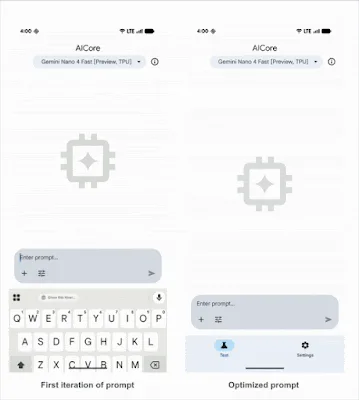
The transition from prototype to production-ready feature requires rigorous prompt engineering. Initial tests of the summarization feature showed a response time of approximately 13 seconds—a duration considered unacceptable for a fluid mobile user experience. Through iterative testing in the AICore developer environment, developers optimized the prompts to limit token generation and focus on concise outputs. This refinement reduced the latency to under 2 seconds, demonstrating the importance of "FAST" model preferences when complex reasoning is not the primary requirement.

Local Processing for Sensitive User Data
The second major implementation focuses on expense management, a feature that inherently involves sensitive user information. When a user captures a photo of a restaurant bill or a shopping receipt, the application parses the data to extract titles, amounts, and categories.
The Privacy Mandate
Handling financial documents in the cloud presents significant security risks, as receipts often contain partial credit card numbers, merchant addresses, and personal spending habits. By using Gemini Nano 4, the Jetpacker app ensures that all Optical Character Recognition (OCR) and data extraction tasks occur entirely within the device’s secure environment. No data is transmitted to Google servers or third-party cloud providers, fulfilling the "privacy-by-design" requirement that modern consumers increasingly demand.
Technical Implementation: Structured Output API
To ensure that the AI’s output is actionable for the application’s logic, developers utilize ML Kit’s Structured Output API. Unlike traditional LLM responses, which may return unstructured conversational text, this API forces the model to output data in a specific format, such as a Kotlin data object.
In the Jetpacker implementation, a ParsedReceipt class is defined with specific guides for the AI:

- A generated name of fewer than six words based on the merchant.
- Amount: A double-precision value identified from keywords like "total" or "balance due."
- Category: A strictly typed enumeration (e.g., travel, food, shopping).
When configuring the model for this task, developers often opt for ModelPreference.FULL. While this may slightly increase latency compared to the "FAST" setting, it provides the superior reasoning power necessary for visual data extraction and complex OCR tasks.
Multimodal Input and Advanced Speech Recognition
The final pillar of the Jetpacker AI suite is the intelligent voice notes feature. This allows users to record audio memos during their travels, which are then transcribed and automatically associated with specific activities in their itinerary.
Basic vs. Advanced Recognition Modes
The ML Kit GenAI Speech Recognition API offers two distinct operational modes:
- Basic Mode: Utilizes a standard on-device speech recognition model. It is widely compatible with devices running Android API level 31 and higher.
- Advanced Mode: Leverages the full power of Gemini Nano. This mode offers significantly broader language coverage and higher transcription quality. As of current reporting, this mode is optimized for the Pixel 10 series, utilizing the specialized Neural Processing Units (NPUs) found in the latest silicon.
Once the audio is transcribed, the text is passed to the Prompt API. The model is tasked with two goals: removing filler words (e.g., "um," "ah," "like") to create a clean record, and cross-referencing the content of the note with the existing trip events. If a user records a note about a "great pasta dish," the AI identifies the corresponding dinner event in the itinerary and tags the note accordingly.

Broader Impact and Industry Implications
The move toward on-device AI represented by the Jetpacker demo and Gemini Nano 4 has profound implications for the mobile ecosystem. It shifts the burden of computational costs from the developer’s server infrastructure to the user’s hardware, which is increasingly capable of handling these workloads.
Economic and Operational Analysis
For developers, the adoption of on-device models eliminates the "per-token" billing associated with cloud-based AI services like OpenAI or Google’s Vertex AI. This allows for the deployment of intelligent features to millions of users without a linear increase in operational costs. Furthermore, it enables "offline intelligence," allowing travel apps to function in areas with poor connectivity—a common scenario for international travelers.
Hardware Evolution
The success of these features is inextricably linked to the evolution of mobile hardware. The performance gains seen in Gemini Nano 4 are largely due to the tighter integration between Android’s software layers (AICore) and the hardware’s NPU. This trend is expected to continue, with future mobile processors being designed with "AI-first" architectures to support increasingly complex agentic workflows.
Conclusion and Future Outlook
The integration of Gemini Nano through ML Kit represents a milestone in the journey toward personalized, agentic mobile experiences. By providing developers with the tools to summarize itineraries, manage sensitive financial data, and process multimodal inputs locally, Google is setting a new standard for app intelligence that does not compromise on privacy or performance.

As the series on "Building Intelligent Android Apps" continues, the focus is expected to shift toward hybrid and cloud reasoning, exploring how on-device models can work in tandem with cloud-powered data—such as Google Maps and live web context—to provide even deeper insights. For now, the Jetpacker app serves as a powerful proof-of-concept that the future of AI is not just in the cloud, but in the palm of the user’s hand.
Related posts: