React Native 0.86 Official Release Brings Edge-to-Edge Android Support and Transitions to the React Foundation

The React Native project, a cornerstone of modern cross-platform mobile development, has officially announced the release of version 0.86. This milestone update represents a significant step forward in the project’s technical maturity, emphasizing stability, ecosystem alignment, and improved developer tooling. By maintaining a strict adherence to a no-breaking-changes policy for the second consecutive release, the maintainers have underscored their commitment to simplifying the upgrade lifecycle for the thousands of enterprises and independent developers relying on the framework.
A New Institutional Era for React Native
The most profound shift accompanying the 0.86 release is not found in the code, but in the organizational structure governing the project. As part of a long-term strategy to ensure the sustainability and neutrality of the ecosystem, the React Native repository, alongside associated projects like React, Metro, and Yoga, has migrated from the Meta (formerly Facebook) GitHub organization to the dedicated "react" organization.
This move marks the formal integration of the framework into the React Foundation, an independent entity established to provide long-term stewardship. For the developer community, this change signifies a transition away from corporate-centric management toward an open, collaborative model that mimics the governance structures of other successful open-source foundations. While the technical infrastructure—including URLs, issue tracking, and pull request workflows—will remain functional through automated redirects, the symbolic shift is expected to bolster confidence among third-party contributors and large-scale corporate adopters who prioritize long-term, community-backed stability.
Technical Advancements: Android 15 and Edge-to-Edge Display
With the release of Android 15, the mobile landscape has shifted toward mandatory edge-to-edge display configurations, where application content is expected to render behind system bars. React Native 0.86 arrives as a critical update for developers navigating these requirements, providing comprehensive, out-of-the-box fixes for edge-to-edge mode.
Historically, implementing full-screen experiences in Android often required manual adjustments to the manifest or custom Gradle configurations. Version 0.86 addresses scenarios where the operating system enforces edge-to-edge behavior even when developers have not explicitly enabled the edgeToEdgeEnabled Gradle property. By resolving these discrepancies, the framework ensures that layouts do not overlap with system UI elements, such as the gesture navigation bar or the status bar, preventing common visual bugs that have plagued developers since the beta phases of Android 15. These improvements reduce the need for custom native code wrappers, allowing developers to maintain a "write once, run anywhere" philosophy while still adhering to the latest platform-specific design language.
Elevating the Developer Experience: DevTools 2.0
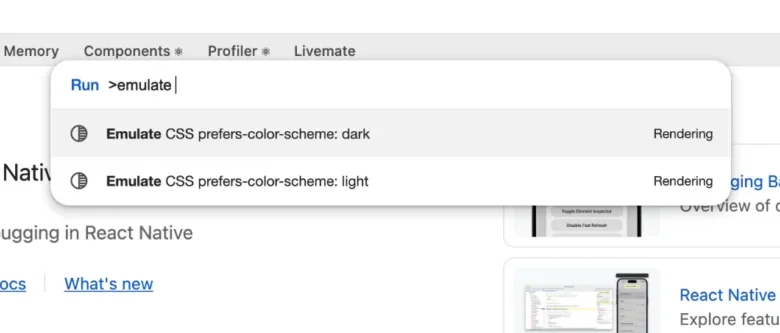
Developer productivity remains a primary focus for the core team, and the 0.86 release introduces a major enhancement to React Native DevTools. The integration of light and dark mode emulation directly within the browser-based debugging interface is a direct response to the increasing complexity of modern design systems.
Previously, testing how an application reacted to system-wide theme changes required toggling deep-level settings on a physical device or an emulator, a process that frequently interrupted the development flow. With the introduction of Emulation.setEmulatedMedia, developers can now toggle appearance modes using the Command Palette (accessed via the standard cmd or ctrl + shift + P keyboard shortcut). This emulation is ephemeral; it mirrors the behavior found in modern web browsers, where the override resets upon disconnecting the debugging session. This feature not only streamlines the visual verification process but also reduces the time spent on manual QA, allowing for more rapid iteration on UI/UX components.

The Commitment to Stability and Predictability
The decision to include zero user-facing breaking changes in version 0.86 is the result of a rigorous internal testing and deprecation cycle. Following the precedent set in version 0.83, the maintainers have demonstrated that high-frequency updates do not necessarily require high-effort maintenance from the consumer.
This predictability is vital for the ecosystem, as React Native is frequently used in mission-critical applications where the cost of a breaking change—which could involve rewriting native modules or refactoring complex UI trees—is prohibitive. By prioritizing "seamless upgrades," the core team is effectively lowering the barrier to entry for the latest features, ensuring that the community as a whole can move toward newer versions of Android and iOS without being tethered to legacy technical debt.
Infrastructure, JSI, and Internal Enhancements
Under the hood, version 0.86 incorporates a substantial volume of architectural refinements. With over 596 individual commits from 97 contributors, the release reflects a broad collaborative effort. Key areas of improvement include:
- JSI (JavaScript Interface) Expansion: The native-to-JS bridge has received new API capabilities, allowing for more performant data exchange between C++ native modules and the JavaScript engine. These enhancements are critical for high-performance applications that rely on complex, real-time calculations or heavy image processing.
- Runtime and Web Spec Alignment: The core team continues to push for parity between the React Native runtime and standard web APIs. This alignment minimizes the cognitive load for developers switching between web and mobile development environments.
- Rendering and Layout Engine: Improvements to the Yoga layout engine have resulted in more predictable flexbox behavior, particularly in complex nested structures, further reducing the frequency of layout shifts.
- Networking and Input: Significant updates to the Android networking stack ensure better handling of modern HTTP/3 protocols and more reliable input event propagation, addressing edge cases in text input and navigation that had been identified in previous versions.
A Chronology of Progress
The path to version 0.86 has been defined by a clear timeline of incremental updates. Following the release of 0.83, the project shifted toward a more robust, stable release cycle. By moving to the React Foundation, the project has effectively bifurcated its development history: the "Meta-era" and the "Foundation-era."
The data confirms the scale of this project: with nearly 100 contributors per release cycle, the framework maintains one of the most active repositories in the open-source world. The transition period for 0.86 is expected to be short, as the project officially marks 0.83.x as unsupported. Developers are strongly encouraged to utilize the "React Native Upgrade Helper," a community-maintained tool that provides a side-by-side comparison of code changes, which is particularly useful for teams managing custom native modules.
Broader Implications and Future Outlook
The release of React Native 0.86 is not merely a collection of bug fixes; it is a signal of the project’s long-term viability. By fostering an independent foundation, prioritizing non-breaking updates, and aligning with the latest OS-level design requirements, the framework is positioning itself to remain the dominant choice for cross-platform mobile development.
Industry analysts note that as mobile platforms like Android and iOS continue to diverge in their handling of system-level features—such as edge-to-edge rendering and dark mode—the value of an abstraction layer like React Native becomes more pronounced. By offloading the burden of these platform-specific adjustments to the framework level, businesses can continue to focus on product differentiation rather than infrastructure maintenance.
For developers and organizations, the immediate recommendation is to assess the upgrade path to 0.86 as soon as possible. With the deprecation of earlier versions and the shift in repository ownership, staying on the latest stable version is the most reliable strategy to ensure continued security support, access to the latest DevTools features, and compatibility with the rapidly evolving mobile hardware landscape. As the React Foundation begins its tenure, the community can expect a continued focus on stability, performance, and cross-platform consistency, reinforcing the position of React Native as a foundational pillar of modern software engineering.