Large language models (LLMs) are fundamentally probabilistic engines designed to predict the next token in a sequence based on vast datasets. While this architecture excels at linguistic fluency, it creates a significant cognitive blind spot: these models lack an inherent mechanism for "stop and think" deliberation. When tasked with complex, multi-step logical problems, standard LLMs often default to a "system 1" approach—fast, intuitive, and highly prone to compounding errors. To bridge this gap, researchers have developed specialized reasoning frameworks, primarily Chain of Thought (CoT) and Tree of Thoughts (ToT), which move AI closer to a deliberate, "system 2" style of processing.
The Evolution of Machine Reasoning
The historical trajectory of LLM development shows a clear shift from simple pattern matching to sophisticated reasoning architectures. In the early stages of generative AI, models operated on a direct stimulus-response basis. However, as these systems were applied to mathematics, code generation, and strategic planning, researchers noted a recurring failure pattern: the "hallucination of logic." A model might correctly state the final digit of a math problem but arrive there through a sequence of nonsensical arithmetic.
This led to the 2022 landmark research, "Chain-of-Thought Prompting Elicits Reasoning in Large Language Models," which demonstrated that by encouraging a model to verbalize its intermediate steps, accuracy on benchmarks like GSM8K (grade school math) improved by significant margins. Following this, the 2023 introduction of Tree of Thoughts (ToT) by researchers at Princeton and Google DeepMind addressed the inherent fragility of linear chains, enabling models to backtrack and explore multiple cognitive paths simultaneously.
Chain of Thought: The Linear Foundation
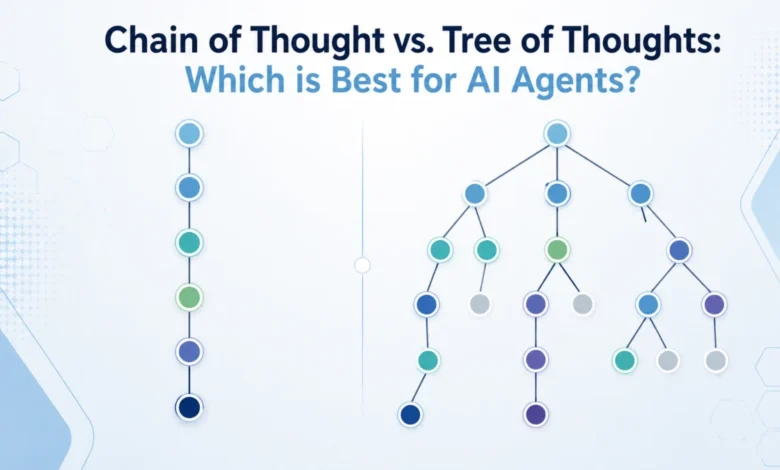
Chain of Thought (CoT) functions as a structured narrative of reasoning. By utilizing simple prompt engineering—often as rudimentary as appending "Let’s think step by step"—users force the model to linearize its logic. This technique creates a paper trail of the model’s internal state, which serves as a significant benefit for auditability and error detection.
From a technical perspective, CoT increases the model’s "compute at inference time." By expanding the number of tokens generated before a final answer is reached, the model effectively allocates more processing cycles to the problem. Data from the original CoT studies indicated that for tasks requiring logical deduction, models using CoT outperformed standard prompting by nearly 30% in specific benchmarks. However, the limitation is systemic: because the process is linear, it lacks a mechanism for self-correction. If the model makes a calculation error in step three, the logic in step four and five is fundamentally poisoned. In high-stakes environments, such as medical diagnostics or legal analysis, this linear trajectory can lead to high-confidence failures.
Tree of Thoughts: Architecting Deliberate Search
Tree of Thoughts (ToT) represents a shift from a narrative approach to a combinatorial one. If CoT is a student showing their work on a page, ToT is a chess engine calculating moves. In this framework, the AI generates a "tree" of potential solutions, branching out into different possible paths of reasoning.
This process involves four distinct components:
- Thought Decomposition: Breaking the problem into manageable, intermediate units.
- Thought Generation: Creating multiple, distinct candidates for the next step.
- State Evaluation: Using a heuristic or a secondary model to score the viability of each branch.
- Search Algorithm: Applying Breadth-First Search (BFS) or Depth-First Search (DFS) to navigate the tree, discarding dead ends and backtracking when a path fails to meet criteria.
Empirical testing has shown that on complex tasks—such as creative writing, complex game theory, and multi-step planning—ToT significantly outperforms CoT. For instance, in "Game of 24" puzzles, where the goal is to reach the number 24 using four numbers and basic operations, standard CoT success rates hovered around 74%, while ToT approaches reached up to 90% accuracy. The cost, however, is a massive increase in latency and token expenditure, as each branch requires a separate model inference call.
Implications for AI Agentic Systems
The integration of these frameworks into AI agents marks a new era in autonomous systems. An "agent" differs from a chatbot in its ability to interact with external tools—databases, browsers, or APIs. The choice between CoT and ToT in an agentic workflow is a strategic trade-off between efficiency and reliability.
For routine tasks—such as fetching a weather forecast or parsing a simple email—the latency overhead of ToT is counterproductive. Here, CoT acts as the "Standard Operating Procedure." It provides enough structure to ensure the agent uses the correct tool, such as selecting a SQL database instead of a search engine, without incurring the cost of recursive branching.
Conversely, for complex engineering tasks, such as debugging a legacy codebase, agents increasingly employ ToT. When an agent is tasked with fixing a bug, it cannot afford a "one-shot" approach. It must propose a fix, evaluate its impact, potentially encounter a compilation error, backtrack to its previous state, and propose an alternative. This recursive, trial-and-error cycle is the hallmark of sophisticated agentic behavior.
Comparative Analysis: A Decision Matrix
Organizations and developers must evaluate these frameworks based on three critical vectors:
1. Latency and Throughput:
Chain of Thought is highly efficient. It generally results in a single, continuous stream of text. ToT, by contrast, is computationally expensive. If an agent calls the model 50 times to explore a tree, the response time increases by a factor of 50. For real-time user-facing applications, this is often unsustainable without significant optimization, such as parallelizing model calls.
2. Complexity of the Problem Space:
Problems that are "linear" in nature—where one step logically necessitates the next without ambiguity—are best suited for CoT. Problems that are "branching" or "adversarial"—where there are multiple potential solutions, or where early moves significantly constrain late-game options—demand ToT.
3. Error Tolerance:
In environments where an error is "recoverable" (e.g., a summarization error), the efficiency of CoT is preferred. In environments where an error is "terminal" (e.g., executing a command that deletes a file), the "search and verify" capability of ToT is essential.
Broader Impact and Future Outlook
The emergence of these techniques points toward a future where "inference-time compute" is as important as the model’s training data. Leading AI laboratories, including OpenAI and Anthropic, are increasingly focusing on "reasoning models" that implicitly bake these techniques into their architecture. Rather than relying solely on the user to prompt for reasoning, future models will likely trigger these search processes autonomously based on the complexity of the input.
Critics and industry analysts suggest that while ToT provides higher reliability, it is still an architectural bandage for the underlying limitations of current transformer architectures. True "reasoning" may eventually require a move away from pure next-token prediction toward more integrated symbolic-neural hybrid systems. Until that shift occurs, the strategic application of CoT and ToT remains the primary lever for developers looking to move AI from the realm of "clever mimics" to "reliable agents."
The industry trend is clear: we are moving away from monolithic, one-pass responses. The next generation of AI agents will be defined by their ability to navigate uncertainty through structured exploration. By matching the reasoning framework to the specific requirements of the task, developers can achieve a balance of speed, cost, and accuracy that is robust enough for enterprise-grade deployment. As these tools become more accessible, the barrier to building high-functioning, autonomous agents will continue to drop, shifting the challenge from "can it think?" to "how efficiently can it reason?"