Powering the AI Revolution: Why Data Center Architecture Must Evolve to Prevent Grid Collapse

The rapid expansion of artificial intelligence infrastructure is pushing the global power grid to a critical inflection point. As data centers scale into gigawatt-class facilities, the traditional methods of power distribution and protection—designed for static, predictable industrial loads—are proving inadequate. Recent grid disturbances in Northern Virginia, the global epicenter of data center activity, have highlighted a systemic vulnerability: the current "behind-the-fence" power architecture is creating an adversarial relationship between hyperscalers and utility providers. To sustain the growth of AI, industry experts argue that the power stack must undergo a fundamental transformation, moving protection mechanisms outside the building and integrating them directly into the medium-voltage path.
A Chronology of Grid Instability
The fragility of the current model was laid bare during two significant events in the Ashburn, Virginia, corridor. In 2024, a single failed surge arrester triggered a cascading protection event, causing approximately 60 data centers to simultaneously drop 1,500 megawatts of load. This reaction occurred because facility protection logic, designed to disconnect upon sensing voltage instability, triggered a mass exit from the grid at the exact moment the grid needed stability the most.
The situation repeated on July 22, 2026, when a transmission line fault in the same region resulted in the loss of more than 3 gigawatts of load in seconds. In both instances, the data centers functioned exactly as engineered: they protected their internal compute assets by disconnecting from a "dirty" or unstable grid. However, the aggregate effect of these individual, rational decisions created a systemic shock that threatened regional grid reliability. These incidents serve as a warning that the "first-do-no-harm" approach of individual data center operators is, when scaled to gigawatt levels, causing broad, unintended consequences for the energy infrastructure.
The Mismatch of Legacy Engineering
The core of the problem lies in an architectural disconnect between the modern AI compute load and the century-old power distribution stack. Traditional data center design relies on stepping down medium-voltage power to low-voltage, then utilizing Uninterruptible Power Supply (UPS) units located deep within the facility. This design, while sufficient for smaller enterprise loads, creates three primary failure points when applied to AI-scale campuses.
First, the battery capacity in traditional UPS systems is designed for short-term emergency backup, not for the high-frequency, volatile load swings characteristic of AI training clusters. AI workloads can trigger demand spikes of 70% in mere milliseconds, followed by sudden drops. Legacy battery systems are effectively "undersized spare tires" that cannot dampen these rapid fluctuations.
Second, the reliance on "eco-mode" operations—where power bypasses filtration to save costs and reduce heat—leaves both the grid and the compute hardware vulnerable. When power is fed raw from the grid, sub-millisecond transients are not filtered, potentially damaging sensitive GPU hardware. Conversely, the rapid, raw load swings of the compute equipment are pushed back onto the grid, creating the very instability that the utility protection systems are programmed to isolate.
Third, protection logic in legacy data centers remains calibrated to outdated definitions of "large loads." When these systems encounter voltage dips, they are often hard-coded to disconnect after a set number of occurrences. In a modern, interconnected grid, this "hair-trigger" approach results in the mass disconnection events seen in Virginia, turning a manageable grid fluctuation into a major regional outage.
Engineering a Paradigm Shift: The Medium-Voltage Solution
To address these challenges, engineers are proposing a shift in the power architecture, defined by three strategic movements: moving the protection up, moving it out, and moving it into the path.
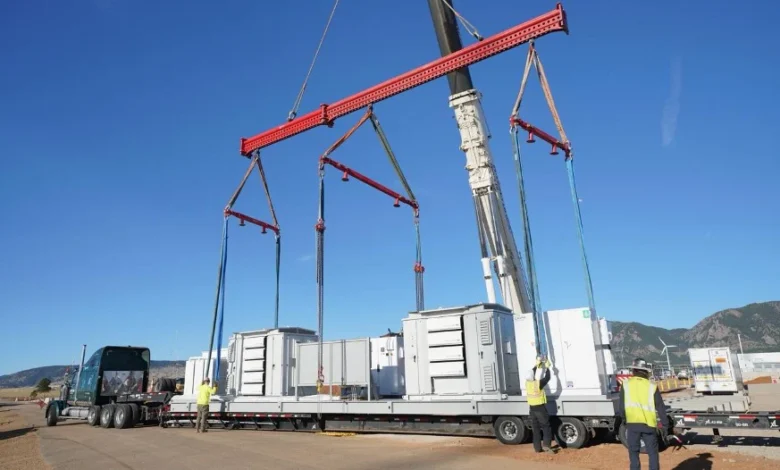
By shifting the power conditioning layer from low-voltage to medium-voltage (13.8 kV or higher), facilities can handle significantly larger energy throughputs with greater efficiency. Moving this infrastructure from the data hall into modular, outdoor enclosures near the substation serves two purposes: it removes high-risk equipment from the proximity of sensitive hardware, and it allows for a more streamlined integration with the utility’s medium-voltage distribution.
Finally, by placing this system directly into the power path—ensuring every electron flows through the conditioning system—the industry can eliminate the need for detection and switching. This "inline" architecture creates a buffer that masks the volatility of AI loads. When a training cluster demands a massive power surge, the system absorbs the request internally, presenting the utility with a stable, flat load profile. When a grid disturbance occurs, the system provides instantaneous ride-through, preventing the data center from dropping offline.
Economic and Regulatory Implications
This architectural shift offers a significant advantage in terms of regulatory compliance and permitting. Currently, utility companies require exhaustive interconnection studies to ensure that a new data center won’t destabilize the grid. Because traditional designs include complex arrays of transformers, UPS units, and switchgear, every component must be analyzed and certified.
An integrated medium-voltage system simplifies this process. The utility is asked to certify a single, standardized medium-voltage interface, which remains constant even if the facility upgrades its compute hardware. This standardization can shave months off the permitting timeline, providing a clear economic incentive for developers.
Furthermore, the economics of backup power are fundamentally altered. Under the legacy model, UPS units and backup generators are strictly cost centers—insurance policies that sit idle for most of their operational life. By moving these systems to the medium-voltage level and enabling them to interact intelligently with the grid, they become assets. These systems can participate in demand-response programs, peak-shaving, and frequency regulation, turning a capital expense into a revenue-generating resource.
Validation Through Real-World Testing
The viability of this approach was put to the test in early 2026 at the National Laboratory of the Rockies. As the only facility in the Western Hemisphere capable of simulating real-world grid faults alongside AI-scale load swings, the laboratory provided a rigorous testing ground.
During the evaluation, the medium-voltage inline system was subjected to full zero-voltage grid faults and aggressive AI load profiles. The system successfully maintained stable voltage for the compute load while simultaneously clearing the rigorous voltage ride-through requirements mandated by the Electric Reliability Council of Texas (ERCOT). The results confirmed that the architecture could effectively act as a shock absorber, shielding both the compute environment from grid noise and the grid from compute-induced volatility.
The Path Forward
The "AI power crisis" is not necessarily a shortage of electrons, but a crisis of architecture. As the next wave of massive AI factories comes online, the industry faces a choice: continue to rely on legacy power stacks that treat the grid as an adversary, or adopt a new, medium-voltage architecture that treats the data center as a grid asset.
Industry analysts suggest that the adoption of these "medium-voltage AI UPS" systems will be the defining trend for the next generation of data center construction. By treating power reliability as a fundamental design constraint rather than an afterthought, the industry can ensure that the rapid expansion of AI does not come at the expense of national energy stability. The technology is mature, the economic incentives are shifting, and the engineering proof is clear. The question now is how quickly the broader market can pivot to this new standard, transforming a significant grid liability into a reliable, high-performance asset.
Related posts: