The landscape of local software development is undergoing a paradigm shift as autonomous coding agents become increasingly integrated into the daily workflows of engineers. Traditionally, developers have faced a significant economic and operational hurdle: the high cost of API tokens when utilizing advanced models like OpenAI’s Codex or Anthropic’s Claude for complex, codebase-wide reasoning tasks. As these agents are tasked with drafting architectural blueprints, generating intricate design specifications, and managing multi-file pull requests, the associated API expenses have ballooned, often creating a disconnect between productivity gains and infrastructure costs. A new open-source initiative, dubbed "Codex with ChatGPT," has emerged as a potential solution to this inefficiency, introducing a "dual-engine" architecture that leverages the underutilized capacity of flat-rate ChatGPT subscriptions to handle reasoning, while reserving the local terminal for execution.
The Economic Paradox of Modern Coding Agents
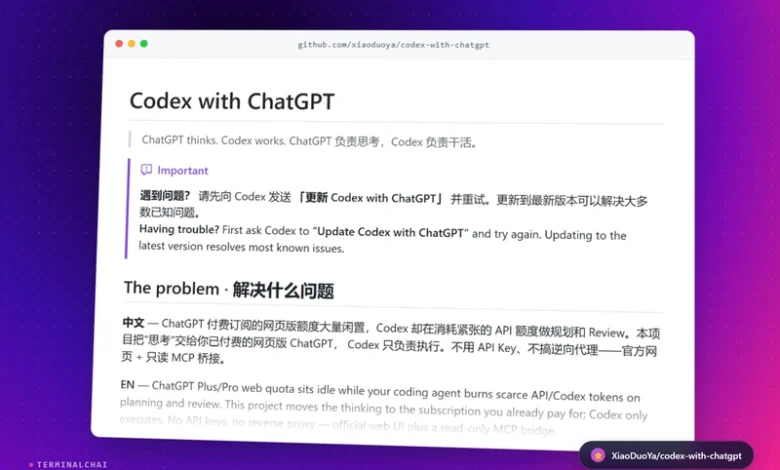
For many software engineers, the current environment is defined by a paradox. Professionals frequently pay for premium, flat-rate monthly subscriptions to tools like ChatGPT Plus or Pro, which offer extensive web-based interaction quotas. Simultaneously, these same engineers incur significant, usage-based API bills when running automated coding agents within their local environments. These agents—which require deep, high-context reasoning to parse entire repositories—frequently consume millions of tokens, turning what should be a cost-effective productivity boost into a source of unpredictable financial overhead.
The core philosophy driving the "Codex with ChatGPT" project, developed by XiaoDuoYa, is distilled into a simple, functional division of labor: "ChatGPT thinks. Codex works." By separating the cognitive process of software engineering from the mechanical process of code execution, the tool seeks to harmonize the developer’s existing subscription ecosystem with the technical requirements of modern agentic workflows.
Technological Architecture and Implementation
The project functions as an open-source bridge, connecting the official ChatGPT web interface to a local Codex terminal session. The system relies on the Model Context Protocol (MCP), a standardized framework that facilitates secure, read-only communication between AI models and local development environments.
The technical architecture is defined by a two-layer separation:
- The Reasoning Layer: Hosted on the ChatGPT web interface, this layer utilizes the high-reasoning capabilities of the latest large language models to analyze architectural requirements, review logic, and plan structural changes.
- The Execution Layer: Residing within the local Codex terminal, this layer is responsible for the actual manipulation of files, the execution of shell commands, and the management of version control systems like Git.
Unlike previous attempts to bridge these worlds, which often relied on insecure reverse proxies or manual, error-prone copy-paste workflows, this implementation utilizes OAuth 2.1 authentication. This ensures that the ChatGPT interface only gains access to specific, required lines of code, maintaining a strict "least privilege" security posture throughout the development lifecycle.

Chronology of Development and Integration
The integration of agentic coding into the local terminal has evolved rapidly over the past 24 months. Early iterations of autonomous coding agents were largely experimental, confined to simple script generation. By early 2023, the industry saw the rise of more sophisticated "Copilot-style" integrations, which provided real-time suggestions but lacked the autonomy to handle multi-file architectural changes.
The emergence of the "Codex with ChatGPT" bridge marks the next phase of this evolution. By mid-2024, as token costs for high-reasoning models continued to rise, the developer community began prioritizing cost-optimization strategies. The implementation of the MCP bridge represents a technical response to these market pressures, allowing developers to move away from purely API-dependent workflows toward hybrid systems that maximize the value of existing software-as-a-service (SaaS) subscriptions.
Security and Data Integrity Protocols
One of the primary concerns regarding AI-assisted coding is the exposure of proprietary source code to third-party models. The "Codex with ChatGPT" framework addresses this through a robust, read-only security architecture. Because the ChatGPT interface acts as a remote controller for the local agent, it does not hold persistent ownership of the local files.
Furthermore, the system incorporates an independent post-execution review phase. Once the local agent has executed a command—such as a file modification or a test suite run—it does not rely on opaque summaries. Instead, the bridge facilitates a direct inspection of the resulting git diff and test execution logs. This ensures that the reasoning engine (ChatGPT) can verify the actual outcome of the mechanical execution, providing a secondary layer of validation before the developer merges any changes. This "check-and-balance" system is designed to reduce the risk of AI-generated errors or "hallucinations" infiltrating the production codebase.
Streamlining the Developer Experience
A significant barrier to the adoption of sophisticated AI tooling is the complexity of configuration. Many open-source agents require intricate setup processes, including environment variables, API key management, and dependency resolution. The "Codex with ChatGPT" project seeks to eliminate these frictions through an automated, one-paste installation process.
By providing a specialized "Codex skill," the project allows the terminal to self-configure. Upon execution of a single instruction—"Please install and configure ‘Codex with ChatGPT’ for me"—the system automatically handles the following:
- Prerequisite Scanning: Verifying that the local system meets the necessary dependencies for the bridge.
- Compilation and Provisioning: Compiling the local bridge software and establishing a secure tunnel.
- Pairing: Automating the OAuth 2.1 handshake to link the local terminal with the user’s web-based ChatGPT account.
This approach significantly lowers the barrier to entry, allowing developers to integrate these advanced capabilities in minutes rather than hours.

Broader Implications for the Software Industry
The implications of this "dual-engine" model are far-reaching. For individual developers, it represents a path toward sustainable AI usage, decoupling high-level productivity from the volatility of API pricing. For organizations, it offers a blueprint for how to leverage AI across internal codebases without necessitating the exposure of sensitive data to centralized, black-box model providers.
From an analytical perspective, the shift toward utilizing web-based reasoning agents as "orchestrators" for local "workers" mirrors broader trends in agentic AI, where multi-agent systems (MAS) are used to manage complex tasks. By decentralizing the execution—keeping it local—and centralizing the reasoning—keeping it within a familiar, high-performance web interface—this model effectively navigates the current limitations of AI token economics.
Furthermore, the adoption of the Model Context Protocol (MCP) in this project highlights a growing industry trend toward interoperability. As more tools adopt standardized protocols for AI-to-IDE communication, the ecosystem will likely become more modular. This reduces vendor lock-in, allowing developers to swap out the "reasoning engine" (e.g., switching between ChatGPT, Claude, or local Llama models) while maintaining a consistent "execution layer" within their terminal.
Conclusion and Future Outlook
The "Codex with ChatGPT" initiative stands as a testament to the ingenuity of the open-source community in optimizing emerging technologies for practical, everyday use. By prioritizing economic efficiency, security, and ease of deployment, it addresses the most significant hurdles facing the widespread adoption of autonomous coding agents.
As the software development lifecycle continues to integrate AI at every stage, from requirements gathering to deployment, the necessity for robust, cost-effective, and secure bridges between reasoning engines and execution environments will only grow. Projects like this provide a vital framework for developers who demand both the power of modern AI and the control of local development. While the field remains in its infancy, the "dual-engine" approach provides a scalable roadmap for the future of agentic coding, ensuring that as AI reasoning capabilities improve, the cost of innovation remains accessible to the individual engineer.
For those looking to adopt this workflow, the project’s documentation and source code remain publicly available on its GitHub repository, inviting further contributions and refinements from the global developer community. As the industry moves toward a future where AI acts not just as a tool, but as a collaborator, the success of such bridges will be instrumental in defining the next era of software engineering.