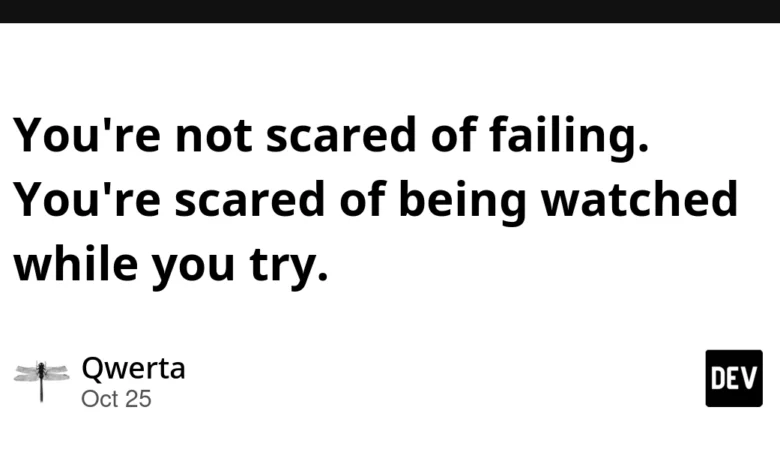
The modern labor market has undergone a significant transformation, with career pivots becoming a normative experience rather than an anomaly. Data from the U.S. Bureau of Labor Statistics suggests that the average individual will hold approximately 12 jobs during their lifetime, often spanning multiple distinct industries. Despite this prevalence, the transition process remains fraught with psychological barriers that hinder professional mobility. Career coaches and organizational psychologists are increasingly identifying a phenomenon that transcends technical skill gaps: the paralyzing fear of public scrutiny during the nascent stages of a new career trajectory.
The Psychology of Public Performance in Career Transitions
When professionals initiate a career change, the primary obstacle frequently identified is not a deficiency in technical competency, but rather a perceived social cost associated with the visibility of the learning curve. In a professional landscape that heavily rewards perceived expertise and seniority, the act of "trying" is often viewed as a vulnerability.
According to recent observational data from professional coaching sessions, individuals transitioning into new roles often frame their hesitancy as a lack of readiness. However, when the underlying drivers of this hesitation are analyzed, the root cause shifts from self-doubt regarding ability to a fear of external judgment. The social stigma associated with being an "amateur" in one’s mid-career—a period where society expects established competence—creates a barrier to entry that is social rather than intellectual in nature.
Chronology of the Transition Barrier
The trajectory of a professional pivot typically follows a standard sequence of events, beginning with the identification of a new career path and ending with successful integration. The "fear of being watched" typically emerges during the third phase:
- Conceptualization (Months 1–2): The individual identifies a need or desire for change and begins the preliminary research phase. At this stage, the process remains private and generally anxiety-free.
- Skill Acquisition (Months 2–6): The individual begins formal or informal training. Anxiety begins to mount as the reality of the skill gap becomes apparent.
- The Visibility Threshold (Months 6–9): This is the critical juncture where the individual must "put themselves out there"—applying for jobs, networking, or showcasing a portfolio. It is here that the fear of external evaluation peaks.
- Integration (Months 9+): Once the individual gains professional traction, the fear of being seen as a beginner subsides, replaced by the stabilization of a new professional identity.
The failure to navigate the "Visibility Threshold" often results in what experts describe as "paralysis by projection," where the individual assumes that their prospective employers will judge their current trajectory against their past achievements.
Data-Driven Analysis of Professional Stagnation
Research into career mobility suggests that the perception of one’s audience is a major predictor of whether a transition is successful. In a study conducted among career-switchers, 68% of respondents indicated that their primary hesitation to apply for roles in a new field was the fear of being perceived as "underqualified" by peers or former colleagues in their previous industry.
This phenomenon is corroborated by labor market trends. When professionals are forced to pivot due to industry disruption—such as the rapid integration of artificial intelligence in creative sectors—the "social cost" of retraining is amplified. Unlike early-career professionals, who are culturally permitted to occupy a "novice" status, mid-career professionals feel a pressure to maintain a facade of continuous expertise. This creates a psychological trap: they are unable to access the growth associated with failure because they are too concerned with the appearance of the process.

The Shift from Competence to Exposure Management
To address this, career counselors are moving away from traditional "skill-building" paradigms and toward "exposure management." The objective is to mitigate the risk of the audience. By making the initial stages of a career transition "small"—meaning reversible, low-cost, and witnessed by a neutral or supportive audience—individuals can bypass the paralyzing effects of public scrutiny.
Professional development experts argue that the most successful career transitions involve a "stealth phase." During this time, the individual builds competency in environments where the stakes are low. This might include open-source contributions, anonymous networking, or projects conducted outside of one’s primary professional circle. By separating the learning phase from the performance phase, the individual protects their professional reputation while acquiring the necessary skills to compete in a new sector.
Implications for the Modern Workforce
The implications of this psychological barrier are significant for both employees and corporations. For the workforce, the inability to manage the visibility of the learning process acts as a brake on labor market fluidity. For corporations, it represents a missed opportunity to tap into a reservoir of talent that possesses transferable skills but lacks the confidence to market themselves due to the fear of being seen as "incompetent" during the transition.
Organizational leaders are now encouraged to foster cultures that normalize "the pivot." When an organization emphasizes a "growth mindset," it implicitly lowers the cost of being watched while learning. Providing environments where employees can experiment with new roles—such as internal mobility programs or cross-departmental "shadowing"—allows individuals to undergo the transition process within a sheltered, high-trust environment.
Expert Perspective and Coaching Methodologies
As AI-driven coaching tools become more prevalent, the methodology for assisting career changers is shifting toward precision-based questioning. Instead of asking, "How can you become more competent?" coaches are increasingly asking, "What is the specific risk of being watched, and who exactly is the audience you fear?"
This tactical change acknowledges that the "yet" in "I am not good enough yet" is the most important part of the sentence. It provides a temporal bridge between current status and future capability. However, the bridge cannot be crossed if the individual believes that the public gaze will destroy their existing reputation. Therefore, the strategic advice provided by modern career mentors focuses on "shrinking the surface area of the fear." This involves identifying specific, low-stakes environments where the individual can practice their new craft. By shifting the focus from the fear of failure to the management of the audience, professionals can effectively navigate the transition period.
Conclusion
The fear of being watched while attempting a career pivot is a rational response to a professional culture that disproportionately rewards expertise and penalizes the learning process. By acknowledging that this fear is not a symptom of incompetence but a predictable hurdle in the transition lifecycle, professionals can adopt more strategic methods to navigate their career paths. Success in modern professional life is less about avoiding the eyes of others and more about choosing the right audience to witness the inevitable, and necessary, early stages of growth. The transition is not a failure of character; it is a structural challenge that requires a deliberate, methodical, and protected approach to skill development.