React Native 0.86 Official Release Brings Enhanced Android 15 Edge-to-Edge Support and Architectural Transition to the React Foundation

The release of React Native 0.86 marks a significant milestone in the evolution of the cross-platform framework, introducing critical enhancements for modern Android development and formalizing the project’s transition to the newly established React Foundation. Following the stable trajectory established in previous versions, this iteration focuses heavily on infrastructure stability, developer ergonomics, and long-term ecosystem sustainability. With 596 commits contributed by 97 developers, version 0.86 arrives as a testament to the framework’s ongoing maturity, offering a seamless upgrade path for teams currently operating on version 0.85.
The Strategic Relocation to the React Foundation
A pivotal development accompanying this release is the migration of the React Native repository, alongside associated projects like Metro, Yoga, and the official React Native documentation, from the legacy Facebook GitHub organization to the dedicated "react" organization. This move is not merely a change of digital address; it represents the formal integration of React Native into the React Foundation.
The React Foundation was established as an independent, non-profit entity tasked with the long-term stewardship of the React ecosystem. By separating the codebase from the internal infrastructure of Meta (formerly Facebook), the project aims to foster broader community participation and ensure that the framework remains a neutral, open-source asset. For developers, this change is largely invisible in terms of workflow; GitHub has implemented comprehensive redirect protocols, ensuring that all existing pull requests, issues, and documentation links remain functional. This institutional shift signals a maturation of the framework, moving away from a corporate-led project toward a community-governed standard.
Addressing Android 15 Edge-to-Edge Requirements
As mobile operating systems evolve, the demand for immersive, full-screen UI experiences has grown. React Native 0.86 addresses the complex requirements introduced by Android 15, particularly concerning "edge-to-edge" display modes. Android 15 enforces stricter adherence to full-screen layouts, which can often cause rendering conflicts or UI clipping if an application is not specifically optimized.
The 0.86 update includes robust, native-level fixes that ensure the framework handles edge-to-edge rendering seamlessly. This is particularly important for scenarios where the Android operating system enforces this display mode even when developers have not explicitly enabled the edgeToEdgeEnabled Gradle property. By automating the handling of status bars, navigation bars, and system insets, React Native 0.86 reduces the technical burden on developers who previously had to implement custom workarounds to prevent content from being obscured by system UI elements. These improvements reflect a concerted effort to keep the framework synchronized with the rapid pace of Google’s Android release cycle.
Advancements in Developer Ergonomics: DevTools
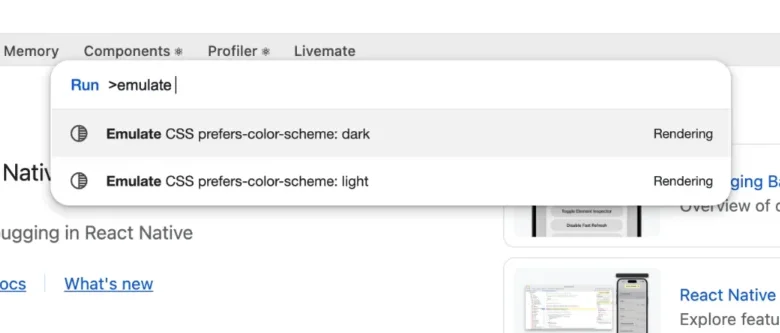
The React Native DevTools suite has received a critical quality-of-life update in this release: light and dark mode emulation. Previously, developers were required to modify system-level device settings to test how their applications responded to different color schemes. This was a cumbersome process, especially for rapid UI iteration.
With the new Emulation.setEmulatedMedia functionality, developers can toggle between light and dark modes directly from the DevTools Command Palette (accessible via the cmd or ctrl + shift + P keyboard shortcut). This feature mimics the behavior of modern web browser developer tools, providing a temporary override that resets upon disconnection. This alignment with web development standards is part of a broader strategy to make React Native feel as intuitive as standard web development, thereby lowering the barrier to entry for developers transitioning from React for the web.
A Predictable Upgrade Path and Stability
For organizations maintaining large-scale React Native applications, the cost of upgrading dependencies can be significant. The React Native core team has doubled down on its commitment to stability, declaring that version 0.86 contains no user-facing breaking changes. This follows the precedent set in version 0.83, reinforcing a new era of "boring" but highly reliable releases.

The decision to avoid breaking changes is a response to community feedback regarding the perceived volatility of the framework in previous years. By prioritizing backward compatibility, the maintainers are effectively encouraging teams to stay on the latest version, which in turn improves overall security and performance across the ecosystem. The framework’s versioning policy, which strictly defines what constitutes a "breaking change," remains a cornerstone of this initiative, ensuring that developers have a clear understanding of when and why their codebase might require manual intervention.
Technical Deep Dive: JSI and Runtime Alignment
Under the hood, version 0.86 continues the trend of aligning the React Native runtime with modern web specifications. This includes subtle improvements to how the JavaScript engine interacts with native code. Specifically, the JavaScript Interface (JSI) has received new APIs that improve the capabilities of the C++ layer. These enhancements facilitate more efficient communication between native modules and the JS engine, which is vital for applications requiring high-performance data processing or complex animations.
These infrastructural improvements are often invisible to the end-user but are critical for the framework’s long-term viability. By strengthening the bridge between native and JavaScript code, the framework ensures that developers can push the limits of mobile performance without hitting the bottlenecks that historically plagued early iterations of hybrid frameworks.
Community Contribution and Ecosystem Health
The sheer volume of contributions in this release—nearly 600 commits—underscores the health of the React Native contributor base. With 97 individual contributors, the project has successfully moved beyond its reliance on a small, internal group of engineers. This diverse pool of contributors helps ensure that bugs are identified and addressed across a wider variety of device configurations, screen sizes, and regional edge cases.
The official documentation and the "Upgrade Helper" tool remain the primary resources for teams looking to adopt these changes. As of the release of 0.86, version 0.83.x has moved into "unsupported" status, marking the standard lifecycle shift for the project. Organizations are advised to use the npx @react-native-community/cli@latest init command to bootstrap new projects, ensuring they start with the latest configurations and optimizations provided by the core team.
Broader Implications and Future Outlook
The release of React Native 0.86 is a strategic play for consistency. By stabilizing the API, moving to an independent foundation, and prioritizing Android 15 compatibility, the team behind React Native is positioning the framework as a mature, enterprise-ready solution that can withstand the demands of modern software development.
The integration with the React Foundation is perhaps the most significant long-term indicator of the project’s health. By creating a structure where the governance is decoupled from the interests of a single corporation, React Native secures its position as a primary choice for cross-platform development. This move is expected to attract more corporate sponsors and institutional contributors, further cementing the framework’s role in the mobile development landscape.
Furthermore, the focus on "Web Spec Alignment" suggests that the future of React Native will be increasingly intertwined with the future of React on the web. As the two environments move closer in terms of tooling and developer experience, the prospect of a "write once, run anywhere" paradigm becomes increasingly practical rather than aspirational.
As React Native 0.86 begins its rollout, the ecosystem remains in a strong position. For developers, the message is clear: the framework is moving toward a future defined by predictability, standard-compliance, and community-led innovation. The absence of breaking changes in this release, coupled with the sophisticated new DevTools, provides a clear roadmap for teams to adopt these improvements without fear of disrupting their existing production workflows. With the transition to the React Foundation now complete, the framework is well-prepared for the next phase of its evolution, promising to remain at the forefront of mobile application architecture for the foreseeable future.
Related posts: