React Native 0.86 release brings major Android 15 compatibility and transitions to the React Foundation

The release of React Native 0.86 marks a significant milestone in the evolution of the cross-platform mobile development framework, signaling both technical advancement and a structural transition for the project. Available immediately, this version introduces robust support for Android 15’s edge-to-edge display requirements and expands the capabilities of the React Native DevTools suite. Perhaps most significantly, this release accompanies the official migration of the React Native repository to the newly established React Foundation, an independent entity designed to oversee the long-term stewardship of the ecosystem.
A Structural Shift: The Move to the React Foundation
The migration of the React Native codebase, alongside related projects such as React, Metro, and Yoga, from the legacy "facebook" GitHub organization to the "react" organization is not merely a change in digital address. It represents a fundamental shift in the governance model of one of the world’s most widely used development frameworks. By joining the React Foundation, React Native joins an independent, non-profit framework intended to ensure that the technology remains a neutral, community-governed resource.
Historically, React Native’s reliance on Meta (formerly Facebook) infrastructure has been a point of both strength and concern for the open-source community. While the backing of a tech giant provided immense resources, the transition to a foundation model mirrors successful industry precedents like the Linux Foundation or the Apache Software Foundation. This move is expected to bolster long-term stability and encourage a broader range of corporate and individual contributors to invest in the framework without concerns regarding proprietary lock-in or shifting corporate priorities. GitHub has implemented automated redirects for all existing URLs, issues, and pull requests, ensuring that the transition remains invisible to the end-user while providing a cleaner, more sustainable architectural home for future development.
Android 15 and the Edge-to-Edge Imperative
With the release of Android 15, Google has pushed for stricter compliance regarding "edge-to-edge" display modes, which require applications to draw content behind system bars to provide a more immersive user experience. React Native 0.86 addresses this shift by providing comprehensive, out-of-the-box support for these requirements.
Previously, developers often faced layout inconsistencies when the operating system enforced edge-to-edge rendering without explicit configuration. The 0.86 release introduces critical fixes that ensure consistent behavior even when the edgeToEdgeEnabled Gradle property is not manually defined by the developer. This proactive approach by the core team is designed to prevent the common "visual clipping" or status-bar overlap issues that frequently plague developers during major Android OS version upgrades. By handling these complexities at the framework level, React Native 0.86 reduces the technical debt that individual teams would otherwise have to manage in their local configurations.
Enhancing Developer Productivity via DevTools
The developer experience (DX) continues to be a primary focus for the React Native team, as evidenced by the iterative improvements to React Native DevTools. A notable addition in the 0.86 release is the introduction of light and dark mode emulation.
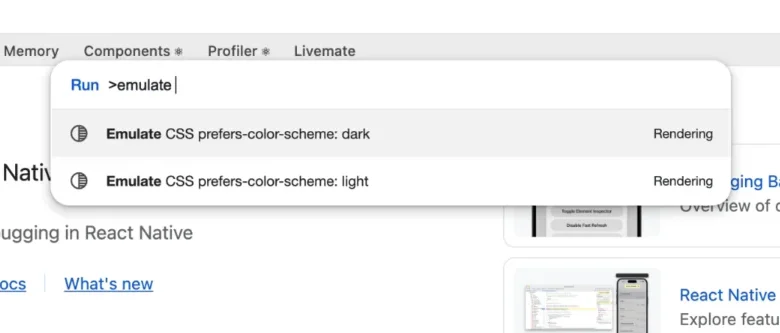
Using the Emulation.setEmulatedMedia command, developers can now toggle the system appearance theme directly from the DevTools Command Palette (accessible via cmd or ctrl + shift + P). This functionality allows for rapid iteration and testing of color schemes and contrast ratios without the tedious process of navigating to the physical or emulated device settings. This "temporary switch" feature—which resets upon disconnection—mirrors the functionality found in modern web browser inspectors, further narrowing the gap between web-based development workflows and native mobile application engineering.
A Predictable Upgrading Path
One of the most praised aspects of the recent React Native release cycle is the commitment to stability. Version 0.86 follows in the footsteps of 0.83, maintaining a strict policy of zero user-facing breaking changes. For development teams managing large-scale, enterprise-grade applications, the "upgrade fatigue" associated with frequent, non-backward-compatible releases has historically been a major barrier to adoption.

By prioritizing architectural stability, the React Native team is signaling that the framework has matured into a stable production environment. For developers already on version 0.85, the upgrade to 0.86 is intended to be seamless, requiring no modifications to existing application code. This predictability is vital for large organizations that cannot afford the high overhead of continuous refactoring. The official documentation emphasizes that the framework defines a "breaking change" with extreme rigor, ensuring that developers can rely on the long-term integrity of their APIs.
Technical Deep Dive: JSI and Runtime Alignment
Beyond the headline features, version 0.86 includes significant under-the-hood refinements that strengthen the framework’s core. The JSI (JavaScript Interface) has received several updates aimed at enhancing the communication layer between native modules and the JavaScript engine. By expanding the C++ interface, these updates allow for more complex and performant interactions between native code and JS.
Furthermore, the release continues the project’s broader goal of aligning its runtime with modern web specifications. This alignment is critical for developers who leverage shared codebases between React for the web and React Native for mobile. By ensuring that the underlying runtime behaves consistently with browser standards, the framework reduces the cognitive load on developers, allowing them to focus on feature delivery rather than environment-specific workarounds.
Community Impact and Global Contributions
The scale of the 0.86 release is underscored by the sheer volume of collaborative effort: over 596 individual commits were merged from 97 unique contributors. This distributed development model is the engine that keeps React Native competitive in a market dominated by alternative frameworks like Flutter or native Kotlin/Swift development.
The diversity of these contributions—spanning accessibility improvements, rendering engine optimizations, and bug fixes for Android input handling—demonstrates a healthy, vibrant ecosystem. The move to the React Foundation is expected to further incentivize this participation, as the governance structure becomes more transparent and inclusive of the global developer community.
Strategic Implications for Businesses
For CTOs and engineering managers, the implications of React Native 0.86 are clear: the framework is moving toward a mature, foundation-led model that prioritizes stability and cross-platform consistency. The integration of Android 15 edge-to-edge support ensures that applications remain compliant with the latest OS requirements without significant developer investment.
As the industry shifts toward more integrated mobile experiences, the ability to deploy features rapidly—supported by tools like the improved DevTools—provides a competitive advantage. The fact that the release is available for immediate adoption, and is slated for inclusion in the upcoming expo@canary releases, ensures that the latest improvements are accessible to the widest possible range of projects, from independent apps to massive, global-scale platforms.
Looking Ahead
The release of 0.86 marks the end of support for version 0.83.x, reinforcing the necessity of maintaining an active update cadence. Developers are encouraged to utilize the "React Native Upgrade Helper" tool to audit their specific project changes, as the framework continues its trajectory toward greater reliability. As the React Foundation begins its tenure, the community will be watching closely to see how this transition influences the roadmap for 2025 and beyond. With a solid foundation, improved tooling, and a renewed commitment to backward compatibility, React Native 0.86 is positioned to remain a cornerstone of the modern mobile development landscape.
Related posts: