Optimizing Gemma 4 E2B Deployment on Tesla T4 Hardware via vLLM and Python MCP Tools

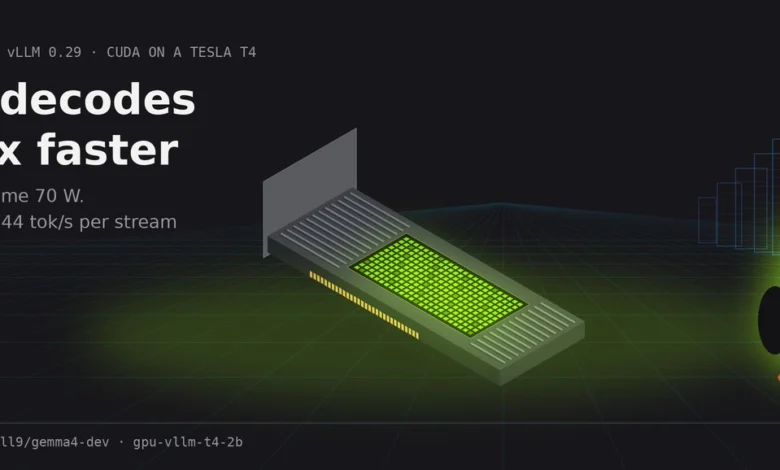
The deployment of large language models (LLMs) on legacy enterprise hardware presents a unique set of engineering challenges, particularly when balancing the demands of modern architectures like Google’s Gemma 4 against the constraints of older GPU microarchitectures such as NVIDIA’s Turing. A recent technical investigation into deploying the Gemma 4 E2B model on a Google Cloud Platform (GCP) Compute Engine instance equipped with a Tesla T4 GPU has yielded significant insights into performance optimization, memory management, and the efficacy of Model Context Protocol (MCP) tools for streamlined deployment. By leveraging vLLM 0.29.0 and comparing standard bf16 weights against Quantization-Aware Training (QAT) int4 variants, engineers have established a clear performance benchmark for low-cost, high-efficiency AI inference.
Architectural Context and Hardware Constraints
The Tesla T4, released in 2018, remains a workhorse for cost-effective inference in cloud environments. With a compute capability of 7.5 and 15,360 MiB of VRAM, the T4 is optimized for throughput rather than raw training power. However, it lacks native support for bfloat16, a standard format for modern LLMs, necessitating a conversion to float16 during runtime. When coupled with an n1-standard-2 VM—offering only 2 vCPUs and 7.8 GB of system RAM—the environment is lean, leaving little room for error in memory allocation.
The project utilized a suite of Python-based MCP tools to automate the deployment process, moving beyond manual configuration to a robust, repeatable framework. This approach is essential in cloud environments where resource provisioning costs are strictly tied to uptime. By automating the verification of GPU architecture, the application of critical software patches, and the management of vLLM parameters, the deployment team minimized the risks associated with complex software dependency chains.
Chronology of the Deployment and Optimization Process
The deployment followed a logical, incremental path designed to identify and mitigate points of failure. Initially, the team encountered significant hurdles: the base environment was configured with a CPU-only version of PyTorch, which effectively rendered the T4 GPU invisible to the vLLM stack. The first phase of the intervention involved replacing the environment’s existing stack with a CUDA-enabled version of PyTorch (2.13.0+cu130) and the latest version of vLLM.
A critical discovery during the setup phase was the "64 KiB problem." Gemma 4 employs a mixture of attention widths—256 in sliding-window layers and 512 in global layers. The standard Triton attention backend in vLLM, when operating at the 512-width threshold, requires shared memory exceeding the capacity of the Turing architecture’s per-block allocation. To resolve this, the team implemented a custom patch within the vLLM site-packages to clamp tile sizes. This modification was verified through an automated toolset, ensuring that the start_vllm_server function would only execute once the environment was confirmed to be stable.
Following software stabilization, the team addressed hardware-level memory exhaustion. Loading the model weights into the limited 7.8 GB of system RAM frequently triggered Out-Of-Memory (OOM) events. To counteract this, a 16 GB swapfile was provisioned on the persistent disk, allowing the system to successfully buffer the weight-loading process without terminating the engine.
Performance Analysis: bf16 vs. QAT int4
The central focus of the study was a head-to-head performance comparison between standard bf16 (cast to fp16) and QAT int4 weights. The results were conclusive regarding the efficiency of quantization for bandwidth-bound inference tasks.
In a single-stream decode scenario, the QAT build achieved a throughput of 72.31 tokens per second (tok/s), significantly outperforming the bf16 configuration’s 40.44 tok/s. When scaling the concurrency to eight streams, the QAT model maintained a robust 215.91 tok/s, compared to 164.62 tok/s for the bf16 version. These figures underscore a fundamental principle of inference engineering: decoding speed is predominantly governed by memory bandwidth. Because the QAT build requires significantly fewer bytes read per generated token (1.862 GB vs. 4.597 GB), it effectively circumvents the throughput bottlenecks inherent to the T4’s memory bus.
Implications of Prefill Latency
While decoding speed favored the QAT model, the study identified prefill latency as a persistent weakness for the T4 architecture. As prompt lengths increased from 512 to 4096 tokens, the Time to First Token (TTFT) grew exponentially, showing a 24-fold increase in latency for an 8-fold increase in input tokens. This non-linear scaling suggests that the attention mechanism—constrained by the custom tile-size clamping—creates a significant overhead during the prompt processing phase.
Engineers noted that while this latency is a limitation, the system remained stable across all tested conditions. The use of a prefix cache provided some relief, though the impact remained secondary to the underlying hardware constraints. These findings suggest that for applications requiring massive prompt ingestion, the T4 may require additional optimization or a shift toward architectural patterns that favor smaller prompt windows.
Broader Impact and Industry Outlook
This deployment guide serves as a blueprint for organizations seeking to maximize the utility of legacy cloud hardware. As high-end GPUs like the H100 and A100 become increasingly scarce or cost-prohibitive for smaller-scale projects, the ability to squeeze modern LLM performance out of the T4 is economically vital.
Industry observers suggest that the success of this deployment highlights a growing trend toward "software-defined hardware optimization." Rather than relying on the latest, most expensive silicon, companies are increasingly investing in sophisticated software layers—such as vLLM and custom MCP tools—to bridge the gap between model requirements and hardware capabilities.
Furthermore, the validation of QAT int4 weights on Turing-based hardware proves that quantization is no longer just a method for reducing model size, but a primary strategy for enhancing inference speed. For small-to-medium enterprises, the ability to serve Gemma 4 locally or within a low-cost GCP VM allows for the integration of high-performing AI without the significant capital expenditure typically associated with large-scale model deployment.
In conclusion, the investigation confirms that while the Tesla T4 has clear boundaries, it remains a viable platform for high-performance AI inference when properly configured. The use of automated deployment tools ensures that the complexity of maintaining these environments remains manageable, providing a sustainable pathway for scaling LLM applications in cost-sensitive production environments.