Optimizing Large Language Model Performance Through Intelligent Data Structuring and Token Reduction

The rapid proliferation of autonomous AI agents has introduced a silent but significant challenge for developers: the exponential consumption of input tokens. As these agents are tasked with increasingly complex workflows—ranging from deep-web research to multi-document synthesis—the volume of data processed per query has ballooned. A significant portion of this data consists of metadata, structural formatting, and redundant tracking information that, while essential for traditional web scrapers and front-end applications, provides zero utility to the reasoning capabilities of a Large Language Model (LLM). This inefficiency does not merely inflate operational expenditures; it clutters the limited context window of AI models, potentially degrading the quality of their outputs.
The current industry standard for data interchange, JavaScript Object Notation (JSON), was designed for machine-to-machine communication where strict typing and schema validation are paramount. However, when an LLM is the primary consumer of this data, the verbosity of JSON—with its repeated keys, nested objects, and structural syntax—becomes a liability. Emerging solutions, such as the implementation of Markdown-based output for search API results, are now demonstrating that reformatting data can achieve dramatic reductions in token usage without sacrificing the informational integrity required for high-level reasoning.
The Token Economy in Agentic Systems
In the architecture of modern AI agents, the cost of a single query is often compounded by recursive loops. When an agent initiates a search, it frequently retrieves multiple full-length files, logs, and HTML-heavy response blocks. For instance, a basic query for local services can trigger a massive payload containing tracking links, internal metadata, and nested arrays that the AI never actually utilizes. Because LLM providers charge based on the total number of tokens processed in the context window, developers are effectively paying for "noise."
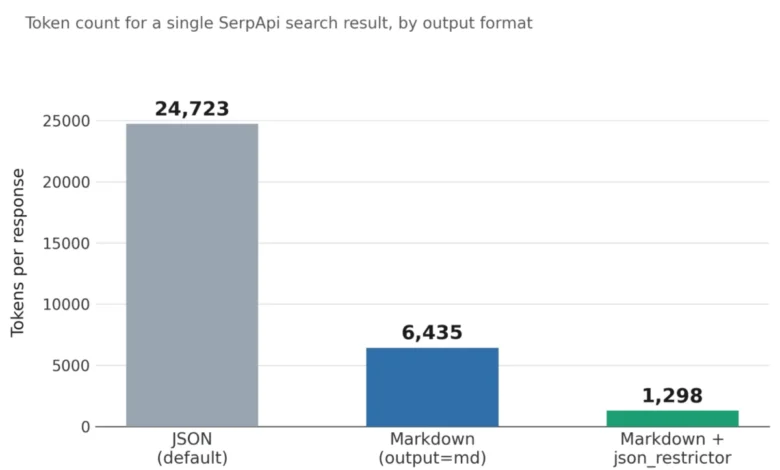
Recent benchmarks provided by industry practitioners highlight the scale of this waste. In a controlled test comparing traditional JSON responses against optimized Markdown output, a search query for "coffee" returned a JSON payload totaling 24,723 tokens. By switching to a Markdown-formatted response, the same search required only 6,435 tokens—a 74 percent reduction. With further server-side field restriction, that figure dropped to 1,298 tokens. This represents a nearly 20-fold decrease in token consumption, which has profound implications for both latency and cost-efficiency at scale.
Chronology of Data Retrieval Evolution
To understand the shift toward Markdown, one must look at the evolution of search APIs over the last decade. Historically, APIs were built to serve web developers who required structured, programmable data to build interfaces. The JSON format became the universal language of the web because it mapped perfectly to the object models of programming languages like JavaScript and Python.
- 2010–2018 (The JSON Era): APIs were optimized for developer utility. The goal was to provide exhaustive metadata so that a front-end engineer could build a rich, interactive map or list view. Token costs were non-existent or negligible.
- 2020–2022 (The Emergence of LLMs): As LLMs like GPT-3 became accessible via API, developers began piping raw JSON directly into model prompts. Initial results were impressive, but as agentic workflows became more complex, costs began to spiral.
- 2023–Present (The Optimization Phase): Developers and API providers recognized that LLMs have different "palates" than software applications. LLMs process natural language and structured text (like Markdown) more efficiently than they process deeply nested, key-heavy JSON objects. This realization has triggered a movement toward "AI-native" data delivery.
The Structural Differences: JSON vs. Markdown
The core difference lies in how information is encoded. JSON uses explicit, verbose structural markers: braces, brackets, quotation marks, and repeating keys. While these are necessary for a compiler to parse data, they act as "token bloat" for an LLM.
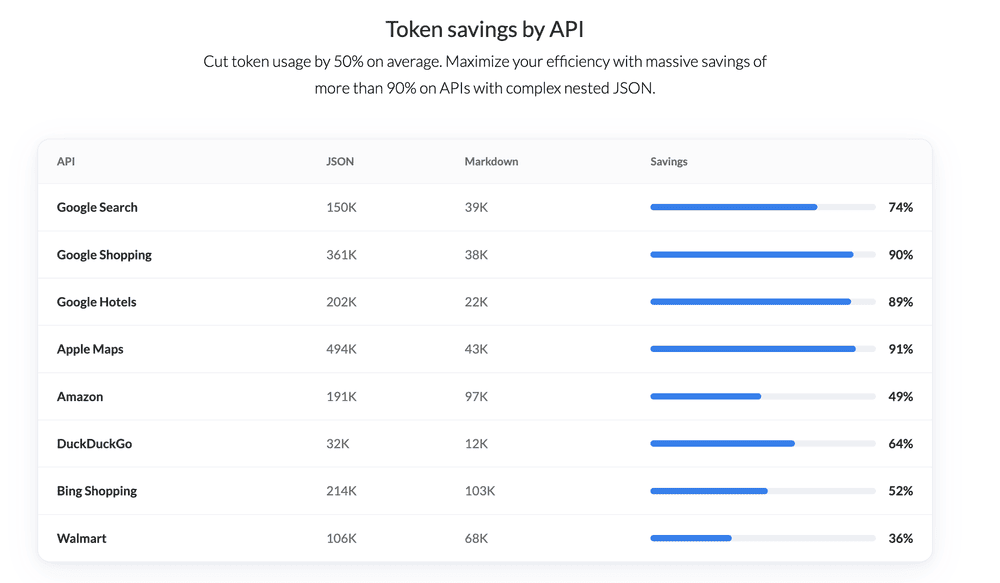
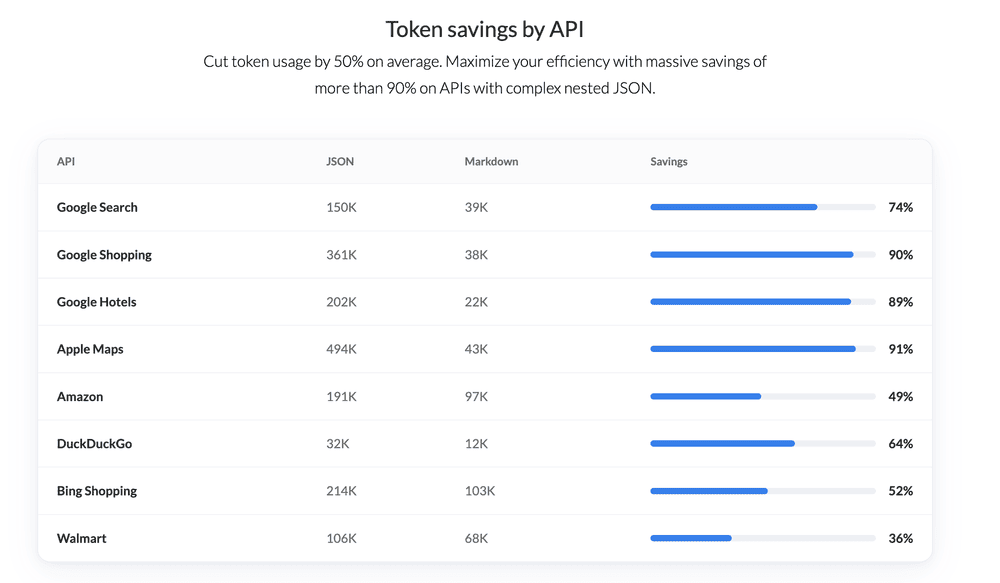
Markdown, conversely, uses a more concise syntax that maps intuitively to the way models are trained on natural language. It strips out internal tracking noise, duplicate fields, and machine-specific metadata that serves no purpose for reasoning. A table in Markdown, for instance, uses a few characters to define a structure that would require dozens of lines of JSON. By retaining the core informational signal while removing the "scaffolding" required for machine parsing, providers like SerpApi are creating a middle ground that serves the LLM’s need for context while respecting the user’s budget.
Technical Implications and Implementation
While Markdown is a clear winner for summarization and analytical agents, it is not a universal replacement for JSON. In systems where precision is critical—such as financial modeling, e-commerce pricing engines, or coordinate-based mapping—JSON remains the superior choice. If an agent must extract a precise floating-point number for a product price or a specific coordinate for a geospatial calculation, the typed nature of JSON prevents ambiguity.
However, for the vast majority of agentic tasks, such as content synthesis, research, and comparative analysis, Markdown offers a leaner alternative. Implementation is generally straightforward. Providers are now allowing users to toggle output formats via query parameters or header modifications. This allows developers to maintain a hybrid architecture: using Markdown for general research queries to minimize token costs, and switching to JSON only when specific, data-intensive tasks require high-fidelity structure.
Broader Economic and Operational Impact
The move to optimize data payloads is part of a larger trend toward "LLM Ops," where the focus is shifting from simply getting a model to work to making it run efficiently and economically. Companies that fail to manage their token footprint often find that their AI-driven applications become unsustainable as they scale.
Furthermore, reducing the payload size has a direct impact on the "context window" availability. Most models have a finite limit on the amount of information they can hold at once. By stripping away 70–80 percent of unnecessary token weight, developers can pack significantly more relevant information into that window. This allows agents to perform deeper research, analyze more sources, and maintain a longer "memory" of a conversation without hitting the model’s limitations.
Analytical Outlook
The industry is reaching a point where the raw capability of LLMs is no longer the sole differentiator; efficiency in data delivery is becoming equally critical. The adoption of Markdown as an output format represents a shift toward more thoughtful integration between information sources and reasoning engines.
Looking forward, we can expect to see:
- Standardization of AI-Native Schemas: Further development of serialization formats that are even more efficient than Markdown, specifically designed for LLM input.
- Automated Payload Trimming: More intelligent APIs that dynamically adjust the level of detail in a response based on the agent’s intent.
- Cost-to-Reasoning Metrics: A new focus on measuring the "reasoning per token" ratio, as organizations seek to maximize the value extracted from every dollar spent on AI inference.
Ultimately, the goal of these optimizations is to remove the friction between the vast expanse of the internet and the reasoning power of artificial intelligence. By reshaping data to match the needs of the model, developers are not just saving costs; they are creating more robust, efficient, and capable AI systems. As the ecosystem matures, those who treat their data payloads as a strategic asset to be managed—rather than an immutable constant—will likely gain a significant competitive advantage in the race to deploy large-scale, autonomous agentic solutions.