AI Workflows vs. AI Agents: A Strategic Framework for Technical Decision Making

The rapid evolution of large language models (LLMs) has introduced a confusing nomenclature into the software development landscape, where the term "agent" is frequently applied to everything from basic automated scripts to sophisticated, self-correcting autonomous systems. As enterprises accelerate their integration of generative AI, the distinction between a structured AI workflow and an autonomous AI agent has become a critical operational threshold. Failing to distinguish between these two architectures often leads to technical debt, inflated operational costs, and unreliable system performance. To optimize development, engineering teams must recognize that the choice between these paradigms is not a matter of technical sophistication, but one of operational predictability and control.
The Anatomy of an AI Workflow
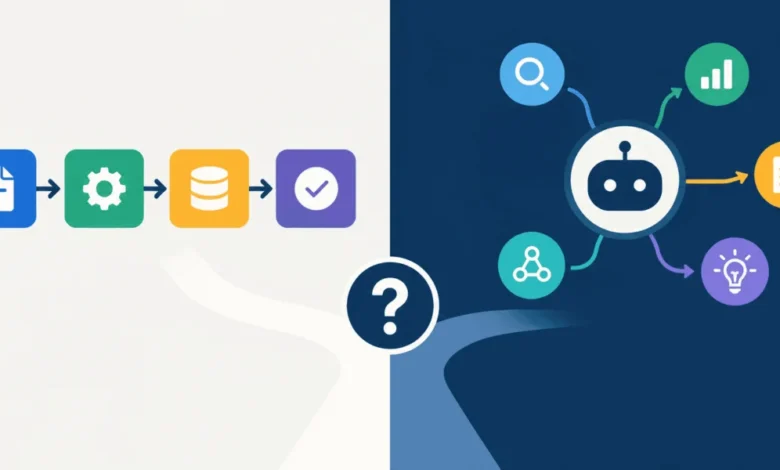
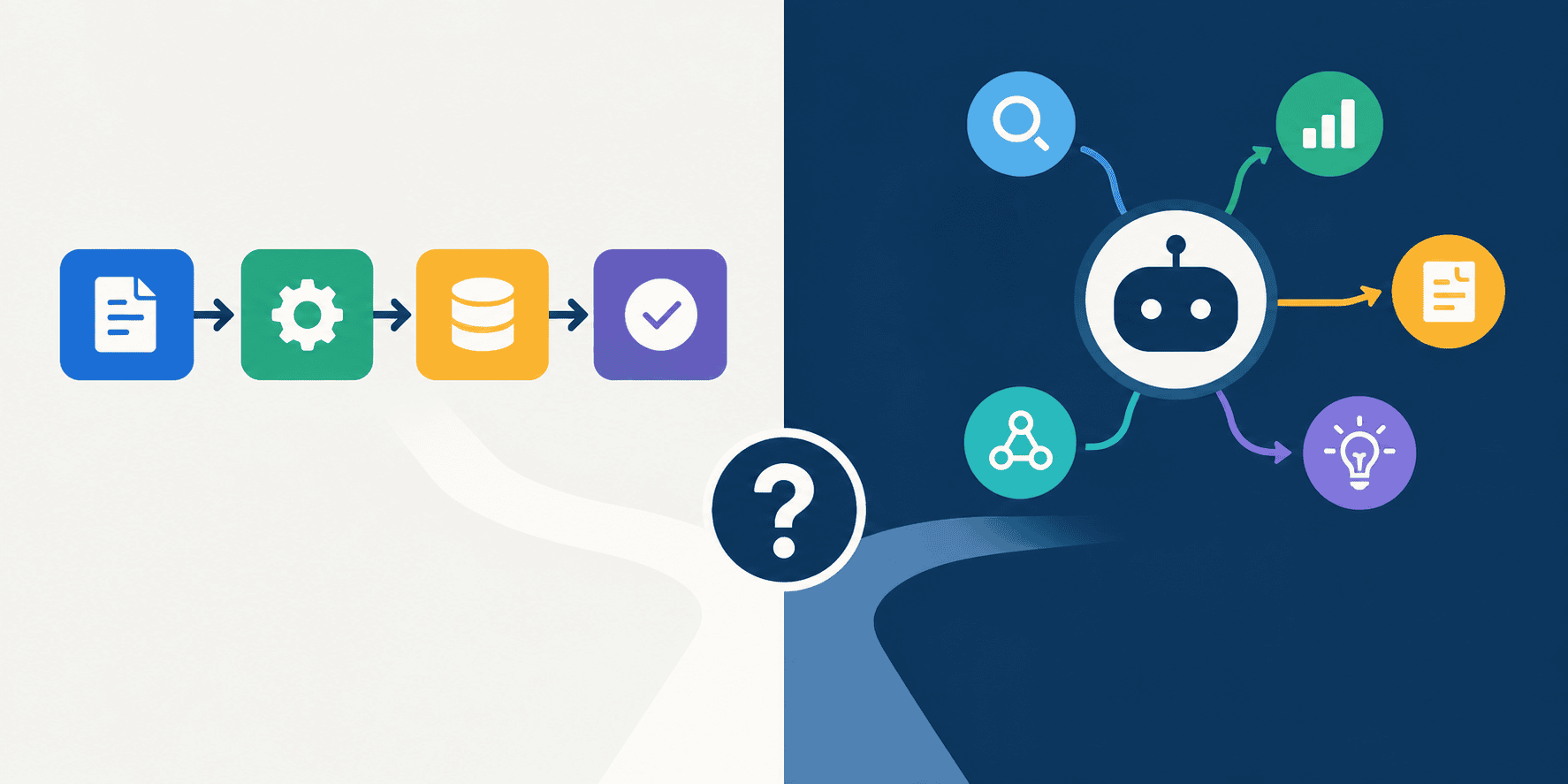
An AI workflow—often referred to as a pipeline, chain, or directed acyclic graph (DAG)—is a deterministic architecture where the control flow is defined by a developer at the design phase. In this model, the LLM functions as a modular component, serving specific tasks such as classification, extraction, or summarization within a rigid sequence of steps. The primary characteristic of a workflow is its static nature; the path from input to output is pre-determined, including conditional logic, error handling, and terminal states.
Historically, this methodology stems from traditional software engineering practices, where reliability is prioritized over autonomy. For instance, in an automated customer refund system, the process follows a strict protocol: verify user identity, check transaction history, validate against company policy, and initiate a refund if conditions are met. While an LLM may be utilized to analyze the customer’s request, the logic governing the movement through the "refund pipeline" remains firmly in the hands of the developer. This allows for rigorous auditing and predictable behavior, which are non-negotiable requirements in sectors like banking, healthcare, and legal services.
The Emergence of Autonomous AI Agents
Conversely, an AI agent is a non-deterministic system where the control flow is dynamic and managed by the LLM itself at runtime. Unlike a workflow, an agent is provided with a goal, a set of tools, and an environment in which to operate. It is tasked with "reasoning" through the problem: deciding which tools to invoke, in what sequence, and when the task is complete. If the agent encounters an unexpected result, it possesses the capability to backtrack, re-evaluate its strategy, and attempt a different path.
The distinction lies in where the "intelligence" of the process resides. In a workflow, the intelligence is baked into the code structure; in an agent, the intelligence resides in the model’s iterative planning. A typical agentic scenario involves complex, open-ended problem solving, such as diagnosing a multi-layered production outage. In this context, the system must navigate disparate logs, metrics, and incident documentation, adjusting its search parameters based on the feedback loop from each query. The sequence of actions is not known until the agent actively engages with the data, rendering traditional flowcharting impossible.
The Practical Test: A Decision-Making Heuristic
The most effective filter for architectural selection is the "Whiteboard Test." If a senior engineer can successfully map the entire lifecycle of a task—including all conditional branches and error states—on a whiteboard before a single line of code is written, a workflow is almost certainly the superior choice. This heuristic serves as a guardrail against the "agent-first" fallacy, where teams assume that agentic systems are inherently more "intelligent" or advanced than workflows.
In reality, the complexity of a system is independent of whether it is an agent or a workflow. A workflow can be highly sophisticated, incorporating multiple LLM models, complex retrieval-augmented generation (RAG) pipelines, and multi-layered human-in-the-loop approvals. Conversely, a simple agent can be fragile and unpredictable. Industry data suggests that over-engineering systems with agentic loops for tasks that require consistency can lead to a 30% to 50% increase in latency and significantly higher token costs, as the model consumes compute cycles merely to "decide" its next step.
Chronology of AI Development and Adoption
The adoption of these technologies has moved in distinct phases. Throughout 2023, the industry focused on "Prompt Engineering," where the LLM was treated as a monolithic black box. By early 2024, the focus shifted to "Chains" (e.g., LangChain, LlamaIndex), where developers began stringing together multiple prompts to create structured workflows. The current era, which began in late 2024, has been defined by the "Agentic Revolution," where the industry is attempting to push the limits of autonomy.
This rapid transition has led to a market correction of sorts. Many organizations that initially deployed agents for routine tasks, such as FAQ answering or data entry, have reported issues with "hallucinated loops"—where the agent continues to perform unnecessary actions, increasing API costs without improving the quality of the output. Consequently, industry leaders have begun advocating for a return to "workflow-first" design, suggesting that autonomy should be reserved only for tasks that are too ambiguous for predefined logic.
Strategic Implications for Enterprises
For technical leadership, the implications of this dichotomy are significant:
- Cost and Scalability: Agents require significant token overhead for planning and reasoning. High-volume production environments—such as real-time customer support or high-frequency data processing—must prioritize workflows to keep latency low and costs predictable.
- Auditability and Compliance: Regulatory frameworks often demand a clear, reproducible trail of decision-making. In a deterministic workflow, an auditor can trace exactly why a specific decision was made. In an agentic loop, the decision-making process is "black-boxed," making compliance difficult, if not impossible, in highly regulated industries.
- Reliability and Maintenance: Debugging a workflow is a traditional software engineering task involving standard logging and trace analysis. Debugging an agent, however, is a non-linear process that requires observing the model’s chain-of-thought, which can change based on subtle fluctuations in prompt context or model updates.
Summary Checklist for Implementation
Before commencing development, engineering teams should evaluate their requirements against the following criteria:
- Fixed Logic: If the steps can be written in a document or diagram, build a workflow.
- Variable Inputs: If the input is highly unstructured and requires dynamic discovery, consider an agent.
- Performance Constraints: For low-latency requirements, minimize the number of reasoning steps by using a structured workflow.
- Compliance Needs: If the process is subject to legal or financial oversight, favor a deterministic workflow.
- Iterative Testing: Always attempt to solve the problem with a workflow first. If the workflow proves insufficient, only then should you delegate specific, bounded components of the task to an agent.
Ultimately, the most successful AI systems of the next decade will likely be hybrid in nature. They will utilize robust, deterministic workflows for the core business logic and "agentic islands"—small, contained areas of autonomy—where the system is empowered to solve specific, highly ambiguous problems. By starting with a conservative, workflow-first approach, organizations can ensure that their AI implementations remain reliable, cost-effective, and aligned with core business objectives.