University of Oxford Researchers Recreate the Mysterious Aharonov-Bohm Effect Using a Hybrid Quantum Computer


In the peculiar realm of quantum mechanics, a physical particle does not necessarily need to experience direct contact with a magnetic field to feel its formidable presence. This mind-bending principle, long established in theoretical physics, has recently been brought to life in a laboratory setting. A dedicated team of researchers at the University of Oxford has successfully recreated this invisible influence by deploying an advanced hybrid quantum computer. Their breakthrough experiment demonstrated how an undetectable magnetic influence could bring the simulated movement of a particle to an absolute, unbreakable halt, opening unprecedented pathways for the study of fundamental physics.
The landmark experiment serves as a modern recreation of the famous Aharonov-Bohm effect. First theorized over six decades ago, this phenomenon dictates that a charged particle traveling around a localized region containing magnetic flux will experience a measurable modification to its quantum state. Remarkably, this shift occurs even though the particle’s physical trajectory completely avoids passing through the magnetic field itself.
To achieve this intricate simulation, the Oxford physicists merged two distinct quantum architecture types. They combined qubits—the foundational units of quantum information—with quantum oscillators, which represent physical vibrational motion. The resulting findings, recently published in the prestigious academic journal Nature Physics, highlight how hybrid quantum configurations can successfully model complex interactions between matter and energy fields. These interactions have traditionally overwhelmed conventional supercomputers, proving exceedingly difficult to calculate through standard digital processing.
The Genesis of a 1959 Theoretical Prediction
To understand the magnitude of the Oxford team’s achievement, one must examine the history of quantum theory. In everyday classical physics, a charged particle responds exclusively to the direct electric and magnetic fields it physically encounters along its journey. However, the advent of quantum mechanics revealed that subatomic entities frequently behave in ways that defy ordinary human intuition and classical mechanics.
In 1959, theoretical physicists Yakir Aharonov and David Bohm published a paper that fundamentally challenged conventional notions of electromagnetism. They predicted that a charged particle would be influenced by a magnetic flux vector even if it traveled entirely outside the confines of the magnetic field. Rather than colliding with or moving through a conventional magnetic force, the particle undergoes a distinct alteration in its quantum phase.
Quantum phase is a delicate mathematical attribute governing a particle’s wave-like behavior. It dictates how different probable trajectories interfere with one another—either reinforcing each other or canceling each other out. Although an isolated quantum phase cannot be directly observed with standard instruments, differences in phase produce highly measurable physical outcomes.
Decades after Aharonov and Bohm formulated their hypothesis, the prediction was verified experimentally using real electrons. The Aharonov-Bohm effect quickly cemented its status as one of the most striking proofs that the subatomic universe operates under rules entirely divorced from classical macro-physics.
The Computational Bottleneck of Lattice Gauge Theories
Building upon the legacy of the Aharonov-Bohm effect, contemporary physicists are eager to understand how this phenomenon operates within more elaborate theoretical frameworks known as lattice gauge theories.
Lattice gauge theories provide the mathematical language for describing how matter interacts with the fields associated with fundamental forces of nature. These models conceptualize space as a rigid, interconnected grid. Matter is positioned at specific nodes across the grid, while the fields are mapped onto the connections or links between those nodes. Such models are indispensable in high-energy physics and particle cosmology, where researchers strive to decode the elementary constituents of the universe and the forces binding them together.
The primary obstacle in advancing lattice gauge theories is computational scalability. As these simulated systems grow to incorporate more particles and multidimensional fields, the underlying mathematics becomes exponentially demanding. Even the world’s most powerful conventional supercomputers struggle to calculate how all interacting components evolve over time, hitting a hard computational wall known as the exponential sign problem.
Faced with these limitations, the scientific community has turned increasingly toward quantum simulation. Rather than forcing a classical computer to calculate every conceivable variable of a quantum system, scientists construct a bespoke quantum apparatus that naturally obeys the same underlying mathematical rules. By directly observing the behavior of this custom-built quantum simulator, researchers can bypass the limitations of classical processing entirely.
Building the Hybrid Quantum Simulator: A Chronology
The Oxford project commenced in 2022, driven by lead author Dr. Sebastian Saner and Dr. Oana Bazavan. Working alongside their departmental colleagues, the team set out to construct a viable simulator for lattice gauge theories using a hybrid system. To refine their theoretical models, they established a close international collaboration with Dr. Alejandro Bermudez of the Instituto de Física Teórica in Madrid.
The experimental design required an ingenious hardware configuration that paired two fundamentally different quantum mechanisms.
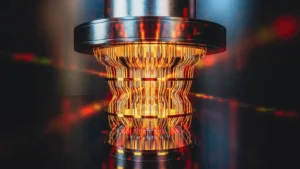
- The Qubits: The researchers utilized qubits encoded within the internal energy states of trapped atomic ions. These are electrically charged atoms suspended in a vacuum using precisely controlled electromagnetic fields. In the experiment’s framework, these qubits served as the dynamic gauge fields.
- The Quantum Oscillators: The second component leveraged the physical vibrational motion of those exact same trapped ions. These collective oscillations represented the matter particles within the grid.
By marrying these two components, the team constructed a closed micro-loop, serving as the fundamental building block of a larger lattice gauge theory. Two distinct quantum oscillators represented matter stationed at two different physical locations, while a pair of qubits represented the invisible fields bridging those locations. Although modest in scale, this configuration was powerful enough to replicate complex interactions between matter and magnetic flux.
Harnessing Quantum Entanglement for Dynamic Modeling
A crucial turning point in the experiment occurred when the researchers manipulated the two qubits into an entangled quantum state. Entanglement—famously described by Albert Einstein as "spooky action at a distance"—occurs when quantum particles become intrinsically linked, such that the state of one instantly dictates the state of another, defying classical explanations.
Within the simulated lattice gauge framework, this engineered entanglement successfully represented a concentrated magnetic flux piercing the exact center of the quantum loop.
Initially, the research team intended to introduce the magnetic flux as a static, unchanging background condition. However, engineering the exact hardware controls necessary to maintain a rigid external field proved beyond the capabilities of their current quantum apparatus.
Faced with this technical hurdle, the team pivoted. They chose to encode the magnetic flux directly into the qubits themselves. This practical workaround yielded a profound scientific advantage: rather than remaining an inert, external constraint, the magnetic flux became an active participant in the evolving quantum system.
"For us, the exciting step was to encode the magnetic flux in a gauge field that was itself dynamical," Dr. Saner explained. "Rather than having matter evolve in a fixed background, the matter and gauge field become part of the same quantum dynamics."
This evolution transformed a hardware limitation into a major asset, allowing the researchers to observe a more sophisticated version of the Aharonov-Bohm effect where matter and field co-evolved in real-time.
Freezing Motion via Destructive Quantum Interference
With their dynamic quantum loop fully operational, the scientists observed how a matter particle navigated between spatial locations via quantum tunneling. Quantum tunneling is a hallmark quantum phenomenon wherein a particle passes through an energy barrier that it classically lacks the energy to surmount.
When the researchers ran the simulation without any simulated magnetic flux present, the particle tunneled freely back and forth around the loop.
However, introducing the dynamic magnetic flux altered the outcome dramatically. Because the particle could theoretically traverse two distinct paths around the loop, the magnetic flux subtly modified the relative quantum phases of each path. When the particle’s wave functions met on the opposite side, they underwent destructive interference—meaning their quantum probability amplitudes canceled each other out completely.
This destructive interference brought the tunneling to an absolute halt, effectively freezing the simulated particle firmly in its original state.
The experiment successfully demonstrated the Aharonov-Bohm effect within a lattice gauge theory featuring a fully dynamical field. It moved beyond merely mimicking the textbook behavior of a particle circling a static magnetic field, proving that the phenomenon emerges organically when matter and fields interact dynamically at the quantum level.
Broader Implications and Independent Validation
The publication of the Oxford findings in Nature Physics coincided with the release of a complementary study conducted by a separate research team at the University of Maryland, spearheaded by Professor Norbert Linke.
The Maryland group also utilized a hybrid quantum architecture, though their investigation focused on simulating the Yukawa potential—a mathematical model vital for understanding nuclear forces and particle physics. Although the Oxford and Maryland teams developed their respective experimental methodologies entirely independently, they strategically coordinated their manuscript submissions to appear simultaneously, underscoring the rapid maturation of hybrid quantum simulation technologies.
Industry analysts and academic leaders view these coordinated publications as a watershed moment for quantum computing. For years, the sector has focused primarily on achieving quantum supremacy or error correction. These recent experiments signal a pivot toward practical scientific utility, proving that intermediate-scale quantum devices can actively solve complex problems in theoretical physics that baffle conventional supercomputers.
By demonstrating that hybrid architectures can seamlessly integrate stationary qubits with vibrational oscillators, researchers have established a versatile blueprint for future physics experiments. As these quantum simulators scale up in size and complexity, they could soon model subatomic phenomena previously deemed inaccessible, offering humanity an unprecedented lens through which to decode the deepest mysteries of the physical universe.