Google Expands Android Studio with Bring Your Own Agent Support to Revolutionize Mobile App Development

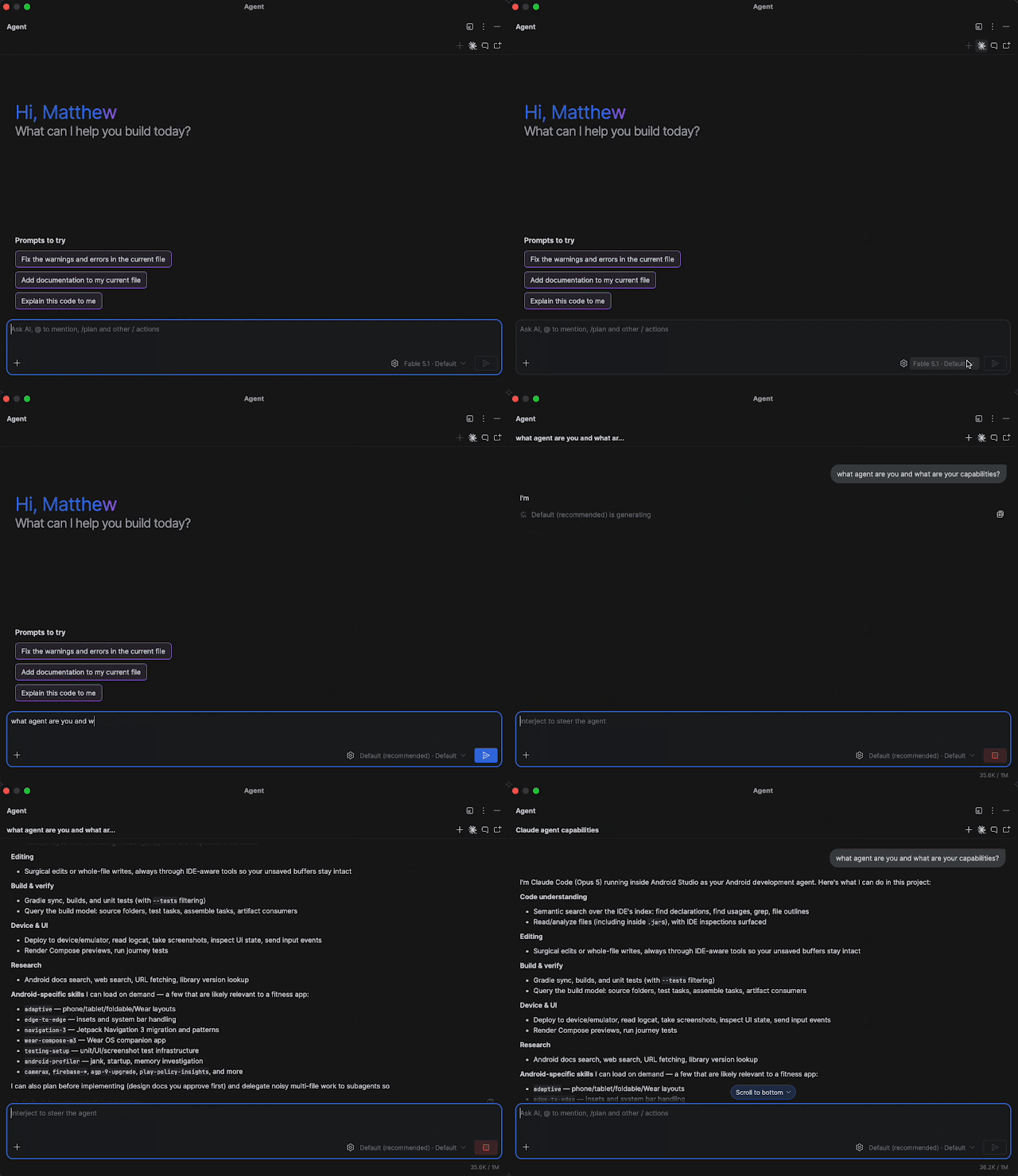
The landscape of mobile application engineering is undergoing a fundamental transformation as artificial intelligence shifts from a supplementary utility to a core infrastructural pillar. For years, software development kits and integrated development environments have locked developers into proprietary, single-provider ecosystems for automated code generation. Today, Google is dismantling those silos by introducing "Bring Your Own Agent" (BYOA) support to Android Studio, starting with the preview release of Android Studio Rabbit 2. This monumental shift allows engineering teams to integrate specialized coding agents—including Anthropic’s Claude Agent, OpenAI’s Codex, and Google’s proprietary Antigravity—directly into their native Android development environments. By combining third-party autonomy with IDE-optimized infrastructure, Google is addressing a long-standing developer demand for flexibility, precision, and choice in AI-assisted software creation.

The evolution of AI in Android development has accelerated at a staggering pace. Last year, Android Studio took its first major step toward an open architecture by allowing developers to connect any remote AI model to the IDE. While this move decoupled model access from the traditional development environment, it still left a gap in how autonomous agents could interact with complex, multi-file codebases and execute long-horizon engineering workflows. Software engineering teams increasingly rely on specialized coding agents that can plan, debug, and execute intricate technical tasks independently. Recognizing that no single AI model or agent fits every developer’s workflow, Google’s new BYOA architecture acknowledges a pluralistic future where engineering teams mix and match tools based on project requirements, organizational compliance policies, and budgetary considerations.
At its core, the newly introduced BYOA feature marries external agent intelligence with Android Studio’s native capabilities. Developers utilizing the Canary release of Android Studio can now configure their preferred coding environment without sacrificing IDE-native speed or accuracy. When an agent like Claude Agent or OpenAI Codex runs within Android Studio, it does not operate in a vacuum. Instead, it gains contextual awareness through Android skills and the comprehensive Android Knowledge Base. This deep integration ensures that external agents are not merely writing generic code, but are actively applying current Android best practices, Jetpack Compose paradigms, lifecycle management rules, and optimal performance patterns. Furthermore, Google’s concurrent updates to Android Bench 2 provide a standardized metric for evaluating how these long-horizon tasks affect model performance, offering engineering leads unprecedented visibility into agent reliability.

While the BYOA framework opens the door to multi-vendor solutions, Google continues to heavily invest in its own ecosystem through the introduction of the Google Antigravity agent. Designed to offer the most seamless and feature-rich experience for Gemini users, the Antigravity agent provides direct access to state-of-the-art models such as Gemini Flash 3.8. Developers who subscribe to Google AI Pro or Ultra plans can seamlessly authenticate within Android Studio to unlock their existing plan benefits and increased usage quotas. Alternatively, individual developers and teams can utilize a standard Gemini API key to operate on flexible, per-token rates. This dual approach ensures that whether an engineer is leveraging consumer subscription tiers or enterprise-grade cloud services, the financial and operational mechanics remain transparent and adaptable.
Enterprise adoption remains a critical driver for Google’s developer ecosystem strategy, and the new agent architecture accounts heavily for corporate security and governance requirements. Organizations utilizing Gemini Enterprise can deploy either the built-in agent or the Google Antigravity agent with the assurance that their proprietary codebases and intellectual property remain protected under rigorous enterprise-grade security and privacy frameworks managed by Google Cloud. This compliance layer is vital for financial institutions, healthcare providers, and large enterprises that must adhere to strict data residency and confidentiality regulations while adopting cutting-edge developer tooling. By providing a secure enterprise conduit for external and internal agents alike, Google aims to mitigate the friction that typically delays the adoption of autonomous development agents in regulated industries.

The rollout of BYOA in the Android Studio Rabbit 2 canary release marks the beginning of a broader transition across the software engineering toolchain. Industry analysts note that as coding agents become more autonomous, the competitive advantage will shift away from proprietary code editors and toward platforms that offer superior orchestration and context delivery. By opening Android Studio to third-party agents, Google is positioning its IDE as the ultimate operating system for mobile engineering, regardless of which underlying AI vendor generates the syntax. This strategy mirrors broader trends in cloud computing and enterprise software, where openness and interoperability increasingly trump walled gardens.
To begin utilizing the BYOA framework, developers must download the latest Android Studio Canary preview and access the agent registry settings. From there, authentication pathways vary depending on the chosen provider—ranging from enterprise platform tokens and Google account logins for Antigravity to API keys and OAuth workflows for third-party providers like Anthropic and OpenAI. As these agents begin executing complex workflows—ranging from automated UI testing and migration of legacy Java codebases to full-feature implementation—Google has emphasized the importance of community feedback. Engineering teams encountering bugs or edge cases are encouraged to utilize official feedback channels to help refine the stability and performance of the platform.

Ultimately, the introduction of Bring Your Own Agent support signifies a mature phase in AI-assisted software development. The conversation has moved past simple code completion and basic chat interfaces into the realm of true agentic engineering, where AI systems act as autonomous collaborators within the development team. By giving developers the freedom to choose their preferred intelligence while anchoring that intelligence in deep, domain-specific Android infrastructure, Google is empowering millions of developers to build higher-quality applications with unprecedented efficiency. As the preview phase expands toward general availability, the mobile development community stands on the precipice of a more flexible, powerful, and personalized era of software engineering.
Related posts: