Maximizing AI Efficiency Through Data Formatting: How Markdown is Replacing JSON in Agentic Workflows

The rapid proliferation of autonomous AI agents has brought the hidden costs of Large Language Model (LLM) operations into sharp focus. While the primary discussion in the artificial intelligence sector has long revolved around model parameter counts and GPU availability, a more immediate fiscal challenge has emerged: the "token tax" imposed by verbose data ingestion. As AI agents increasingly rely on real-time web retrieval to perform complex tasks, the structural format of that data has become a critical determinant of operational success and financial sustainability.
For years, JSON (JavaScript Object Notation) has served as the industry standard for data exchange. Its ability to represent nested objects, typed arrays, and precise numerical data makes it the backbone of modern web architecture. However, in the context of LLMs, JSON’s inherent verbosity—characterized by repetitive keys, structural metadata, and syntactical overhead—often results in thousands of unnecessary tokens being fed into the context window.
The Token Economy: A Hidden Financial Burden
To understand the scale of this inefficiency, one must look at the mechanics of LLM reasoning. When an AI agent performs a search query, it rarely consumes the raw HTML of a page. Instead, it relies on API-driven data providers to parse that information into a structured format. If an agent is tasked with a recursive search—such as "compare the top five coffee shops in downtown Seattle based on reviews"—it may pull dozens of logs, metadata headers, and tracking parameters.
In a traditional JSON payload, every bracket, comma, and recurring key consumes a portion of the model’s context window. Because LLM providers bill by the token, this bloat is not merely a technical annoyance; it is a direct drain on budget. Industry data suggests that for a single standard search query, JSON responses can easily exceed 20,000 tokens. When multiplied by thousands of agents running recursive loops or multi-step reasoning tasks, the annual expenditure on "useless" tokens—data that the model ignores during its inference phase—reaches significant figures.
The Shift to Markdown: A Case Study in Optimization
Recognizing this bottleneck, developers are increasingly pivoting toward Markdown as a leaner alternative for AI-to-agent data delivery. Unlike JSON, which is designed for machine-to-machine parsing, Markdown is optimized for human-readable content that LLMs are pre-trained to interpret with high efficiency.
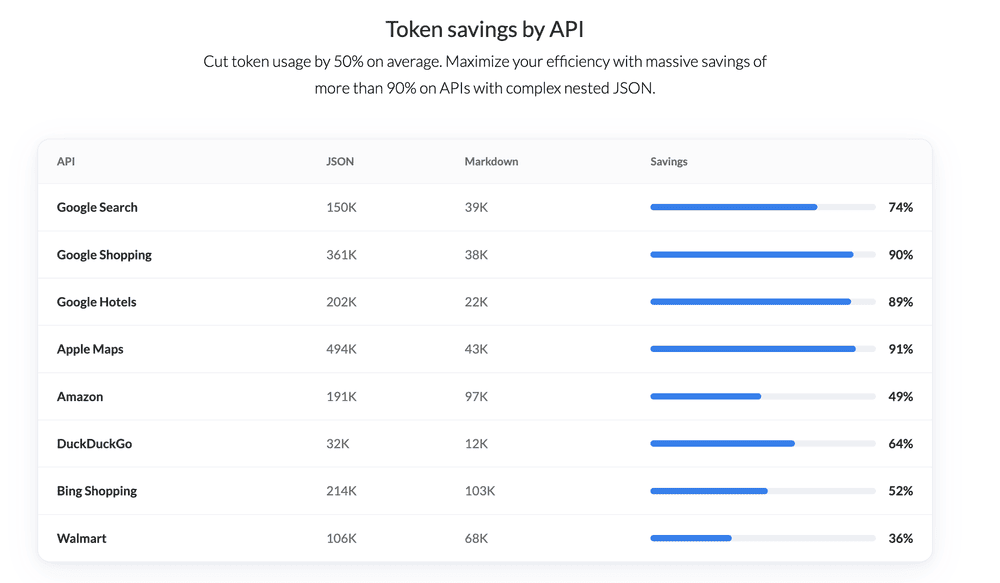
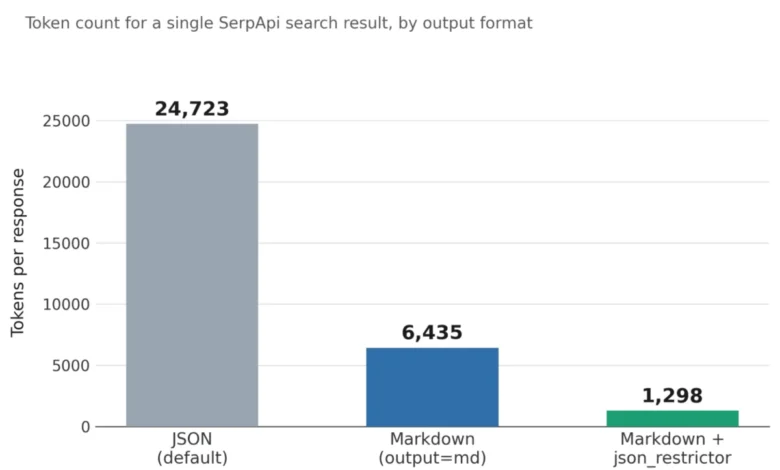
Recent benchmarks provided by SerpApi illustrate the magnitude of this shift. In a controlled test comparing data output for a generic "coffee" search, a JSON response required 24,723 tokens. When converted to Markdown, the same search returned identical informational content using only 6,435 tokens. This represents a 74 percent reduction in data volume. Further refinement, utilizing targeted field selection, allowed that same request to be satisfied with a mere 1,298 tokens.
This transformation does not involve the loss of critical information. Instead, it involves the stripping of syntactical noise. By eliminating redundant key-value tags and reformatting nested structures into clean tables and lists, Markdown provides the LLM with the exact same semantic signal while reducing the "noise" that the model must ignore.
Chronology of Data Delivery for AI
The evolution of data delivery for AI can be categorized into three distinct phases:
- The Raw HTML Era (2018–2020): Early agents relied on direct web scraping. The data was unstructured and prone to noise, requiring heavy pre-processing that often led to "hallucinations" or failures in reasoning due to the sheer volume of irrelevant tags.
- The JSON Standard Era (2020–2023): As APIs became more sophisticated, JSON became the default. While it provided structural reliability for developers, it introduced the current problem of token bloat, as models were forced to "read" structural syntax intended for front-end web development.
- The Semantic/Markdown Era (2024–Present): The current shift focuses on "LLM-native" formats. This phase prioritizes the semantic density of data, ensuring that the model spends its context window analyzing content rather than structural punctuation.
The Trade-off: Precision vs. Performance
Despite the clear advantages of Markdown in terms of cost and context management, industry analysts caution against a wholesale abandonment of JSON. The selection of data format must remain contingent on the specific requirements of the downstream pipeline.
JSON remains the superior choice for applications requiring rigid, typed data. Financial engines, inventory management systems, and algorithmic trading bots that require precise floating-point numbers or categorized arrays cannot afford the ambiguity of a markdown table. In these instances, the "cost" of the additional tokens is a necessary investment for the integrity of the data.
Conversely, for RAG (Retrieval-Augmented Generation) systems, summarization agents, and general-purpose research bots, the precision of JSON is often overkill. When an agent is tasked with synthesizing a summary, it does not require a price to be formatted as a float; it simply needs the information. By utilizing Markdown, developers can "fit" more information into the model’s context window, allowing for more comprehensive research without hitting the memory limits of the LLM.
Implementing Efficiency: Practical Strategies
For engineering teams looking to optimize their token spend, the path forward involves a more surgical approach to API configuration. Many leading API providers are now integrating "output-as-a-service" features that allow developers to toggle between JSON and Markdown via simple header requests or query parameters.
Beyond changing the file format, the integration of "field restrictors" represents the next tier of optimization. By using tools like json_restrictor or CLI-based field filtering, developers can instruct an API to send only the specific keys required for a task. For example, if a search result contains 50 fields but the agent only requires the title, description, and source URL, stripping the other 47 fields before the data reaches the model provides immediate, measurable savings.
Future Implications for AI Agents
The movement toward leaner data formats is symptomatic of a broader trend in the AI sector: the transition from "model-first" development to "infrastructure-first" development. As the capabilities of frontier models plateau in terms of raw reasoning, the competitive advantage will increasingly belong to organizations that can manage their data pipelines with the highest degree of efficiency.
The implication for the industry is clear: every token counts. As agentic systems move from pilot programs to production environments, the difference between a profitable application and an expensive, buggy prototype often comes down to the architecture of the data feed. By aligning the format of retrieved data with the architectural requirements of the LLM, developers can effectively "expand" their context windows and reduce latency, paving the way for more robust and cost-effective autonomous systems.
As data providers continue to iterate, the standard for professional-grade AI systems will likely involve dynamic data formatting. This means the ability to receive JSON when the system needs to calculate, and Markdown when the system needs to reason. Mastering this balance is no longer a luxury; it is a fundamental requirement for any enterprise-level AI strategy.