Build Intelligent Android Apps with Gemini Nano and ML Kit Prompt API

Google has unveiled a comprehensive roadmap for the next generation of mobile development, focusing on the transition of Android applications from static tools into personalized, intelligent, and agentic experiences. Central to this evolution is the integration of Gemini Nano, Google’s most efficient large language model (LLM) designed specifically for on-device execution, accessible through the refined ML Kit Prompt API. This strategic move signifies a shift in the mobile ecosystem, where local processing is no longer a secondary consideration but a primary architectural choice for developers seeking to balance performance, privacy, and cost-efficiency.
The Evolution of On-Device Intelligence
The current landscape of mobile artificial intelligence is undergoing a significant transformation. While cloud-based AI offers immense reasoning power, it is often hampered by latency issues, high server costs, and mounting concerns regarding data privacy. To address these challenges, Google has introduced Gemini Nano 4, a model built upon the architecture foundation of the recently released Gemma 4. This new iteration is specifically optimized for mobile hardware, ensuring maximum battery efficiency and high-speed performance across a growing ecosystem of devices.
According to Google’s latest metrics, Gemini Nano is currently active on over 140 million devices globally. This scale allows developers to deploy sophisticated AI features without the overhead of cloud infrastructure. By utilizing the ML Kit Prompt API, developers can leverage these models to process data directly on the user’s hardware. This local-first approach ensures that sensitive user information never leaves the device, providing a robust solution for industries such as finance, healthcare, and personal productivity where data sovereignty is paramount.

Case Study: The Jetpacker Transformation
To demonstrate the practical application of these technologies, Google developers have utilized "Jetpacker," a demo travel application, to showcase how basic features can be augmented with on-device intelligence. The transformation focuses on three core pillars: summarization, sensitive data extraction, and multimodal interaction.
1. High-Quality Tailored Summarization
One of the primary challenges in modern app design is information overload. In the Jetpacker app, the itinerary screen provides a comprehensive overview of trip activities, which can often become overwhelming for the user. To mitigate this, Google implemented a "Get ready for your trip" section powered by Gemini Nano.
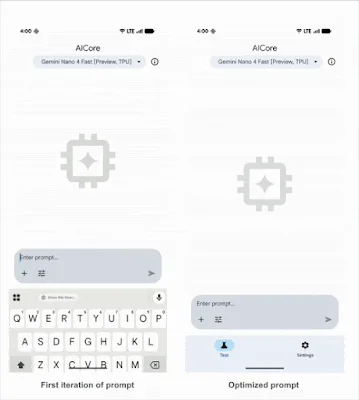
By inputting a raw trip itinerary into the model, the app generates a concise summary that includes the "overall vibe" of the trip, specific packing tips, and useful local phrases. This feature highlights the efficiency of the ML Kit Prompt API. During the development phase, engineers noted that initial prompts resulted in a 13-second response time. However, through iterative prompt engineering and the use of the AICore developer preview, this latency was reduced to under two seconds. This 85% improvement in speed underscores the importance of prompt optimization in on-device environments where computational resources are finite.
2. Local Processing for Sensitive Financial Data
Expense management is a critical feature for travel applications, yet it involves the handling of highly sensitive documents such as restaurant bills and retail receipts. These documents often contain credit card fragments, merchant addresses, and personal spending habits. To protect user privacy, Jetpacker utilizes Gemini Nano 4’s multimodal capabilities to perform Optical Character Recognition (OCR) and visual data extraction locally.

The implementation utilizes the ML Kit Structured Output API. Unlike traditional LLM outputs, which are often unstructured strings of text, the Structured Output API allows developers to define a Kotlin data object (such as a ParsedReceipt class). The model then populates this object with specific fields: a generated title, the total amount spent, and a category (e.g., food, shopping, or entertainment).
This deterministic output is vital for developers, as it allows the extracted data to be immediately integrated into the app’s UI and database without the need for complex parsing logic. By keeping this process on-device, the app avoids the security risks and costs associated with sending images to a cloud-based OCR service.
3. Multimodal Input and Speech Recognition
The final layer of the Jetpacker intelligence suite is a fully on-device voice note feature. This is achieved through a combination of the ML Kit GenAI Speech Recognition API and the Prompt API. The system allows users to record audio memos that are transcribed in real-time.
Google offers two modes for this functionality:

- Basic Mode: Utilizes a traditional on-device speech recognition model, compatible with most devices running Android API level 31 or higher.
- Advanced Mode: Powered by Gemini Nano, offering superior language coverage and higher transcription quality. This mode is currently optimized for flagship hardware, including the Pixel 10 series.
Once the audio is transcribed, the text is passed to the Prompt API, which identifies which specific trip activity the note refers to. The AI then "cleans" the transcription by removing filler words and tagging it to the relevant itinerary item. This creates a seamless "recap" experience, allowing users to browse their trip history with enriched, context-aware notes.
Technical Implementation and Developer Tools
The integration of these features is facilitated by a suite of developer tools designed to streamline the AI workflow. The AICore app serves as the central hub for managing on-device models. Through the developer preview option, creators can download various versions of Gemini Nano to test their prompts against expected outputs.
The selection of model configurations is a strategic decision for developers. The API provides two primary preferences:
- ModelPreference.FAST: Prioritizes latency, making it ideal for simple summarization or real-time interactions where a delay would disrupt the user experience.
- ModelPreference.FULL: Prioritizes reasoning power and complex logic, suitable for detailed data extraction or tasks requiring high levels of nuance.
This flexibility allows developers to tailor the AI’s performance to the specific requirements of each feature, ensuring that the app remains responsive while providing high-quality insights.

Chronology of Google’s On-Device AI Strategy
The release of these tools is the result of a multi-year effort to democratize AI for Android developers.
- Late 2023: Introduction of Gemini Nano and the initial integration with Pixel 8 Pro.
- Early 2024: Launch of the AICore service to standardize how apps interact with on-device LLMs.
- Mid-2024: Expansion of Gemini Nano to a wider range of silicon, including partnerships with MediaTek and Qualcomm, reaching the 140 million device milestone.
- July 2026 (Projected/Contextual): The release of Gemini Nano 4 and the full integration of the GenAI ML Kit APIs, marking the transition from experimental features to production-ready frameworks.
Industry Implications and Market Analysis
The move toward on-device intelligence carries significant implications for the broader mobile industry. Analysts suggest that by reducing reliance on cloud APIs, developers can significantly lower their operational expenditures (OPEX). For a high-traffic app, the cost of processing millions of LLM queries in the cloud can be prohibitive. Moving these queries to the user’s local hardware effectively shifts the computational cost to the edge, enabling "free" AI features at scale.
Furthermore, this technology addresses the "transparency gap" in AI. As global regulations like the EU AI Act begin to take effect, the ability to process data locally provides a clear path to compliance. Users are increasingly wary of how their data is used to train large models; on-device processing ensures that personal data remains under the user’s control.
From a competitive standpoint, Google’s integration of Gemini Nano into the Android system level (via AICore) provides a unified framework that rivals Apple’s "Apple Intelligence" approach. By providing these APIs through ML Kit, Google is ensuring that even independent developers can compete with major tech firms in delivering sophisticated, AI-driven user experiences.

Conclusion and Future Outlook
The "Build intelligent Android apps" series serves as a blueprint for the future of mobile software. By combining the efficiency of Gemini Nano 4 with the accessibility of ML Kit’s GenAI APIs, Google is providing the tools necessary to create apps that are not just reactive, but proactive and deeply personalized.
As the series progresses, upcoming modules are expected to explore hybrid inference models—where on-device AI works in tandem with cloud reasoning—and "agentic" workflows. These workflows will likely involve AI agents capable of performing multi-step tasks, such as booking travel or managing complex schedules, directly within the Android ecosystem. For now, the focus remains on building a solid foundation of privacy-first, high-performance on-device intelligence that sets a new standard for the Android user experience.
Related posts: