AWS Revolutionizes Scalable Architectures with the Launch of Enhanced Custom Event Buses for Amazon EventBridge

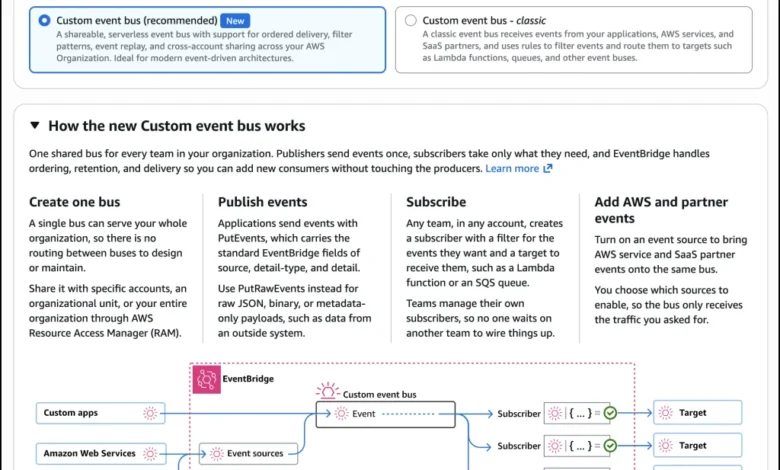
Organizations scaling event-driven architectures across complex, multi-account environments now have a streamlined path to managing data flow. AWS has officially introduced an enhanced custom event bus for Amazon EventBridge, a significant architectural shift designed to move away from the fragmented, multi-bus configurations that have historically defined large-scale serverless deployments. By offering centralized management, strict ordering guarantees, and a simplified subscription model, this release aims to resolve the operational overhead that has long challenged platform engineering teams.
The Evolution of Event-Driven Complexity
The transition to event-driven architectures is a hallmark of modern cloud-native development. By decoupling services, organizations can build systems that are highly responsive and resilient. However, as organizations grow, the "multi-account" paradigm—an AWS best practice for security and billing isolation—introduces significant friction.
In previous iterations, a single team might manage a primary event bus with relative ease. As departments multiply, each running in its own AWS account, the architecture often devolves into a web of cross-account rules and bus-to-bus configurations. This workaround approach creates a "spaghetti" of infrastructure: platform teams lose visibility, routing costs escalate due to repeated ingestion and egress charges, and the fundamental promise of serverless—operational simplicity—is undermined by the need to maintain complex inter-bus plumbing.

Chronology of the EventBridge Development
The announcement follows a multi-year trend of AWS prioritizing granular control for serverless developers. Since the inception of EventBridge, the service has evolved from a simple rule-based router to a sophisticated event backbone capable of schema discovery and cross-account pipes.
- Early Stages: Developers relied on standard custom buses, which provided basic routing but lacked advanced features like high-throughput ordering or native resource sharing.
- The Middle Period: To facilitate multi-account communication, AWS introduced cross-account bus targets. While functional, these required extensive IAM configuration and created management overhead for centralized platform teams.
- The Current Milestone: The launch of the Enhanced Custom Event Bus marks the integration of these disparate requirements into a single, cohesive resource, eliminating the need for intermediary plumbing.
Technical Architecture and Enhanced Capabilities
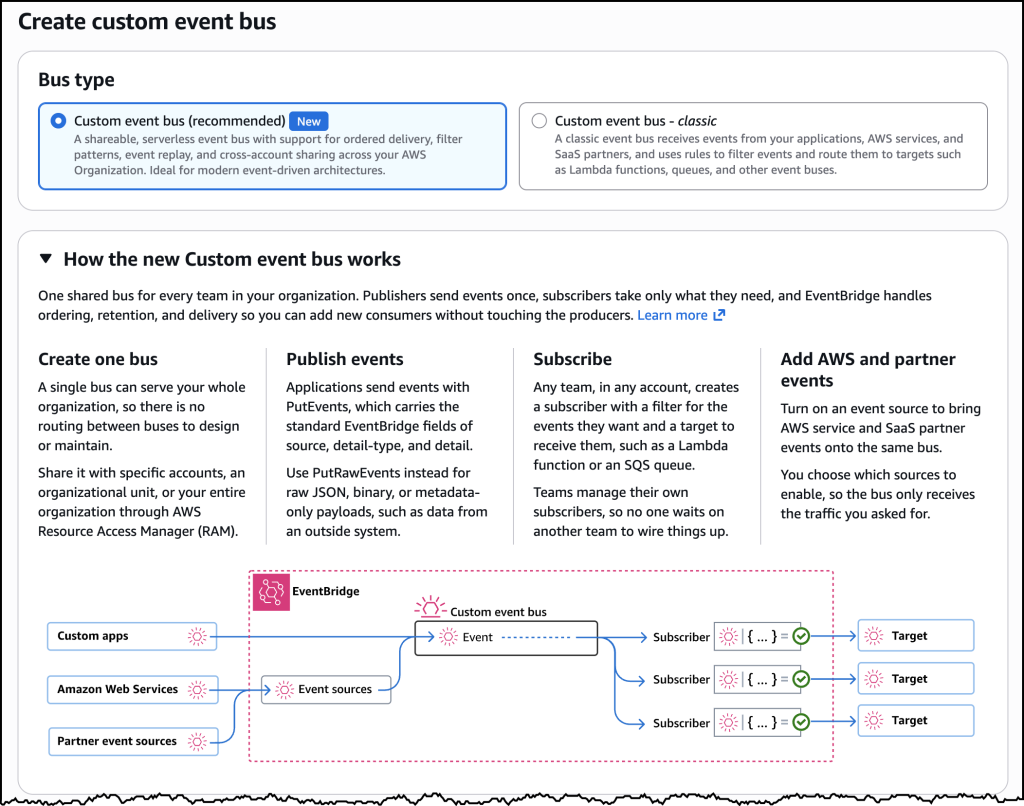
The new enhanced custom event bus acts as a centralized backbone, facilitating seamless communication across an entire AWS organization. By integrating with AWS Resource Access Manager (RAM), the service allows platform administrators to share a single bus across specific accounts, organizational units, or even granular IAM roles. This removes the administrative burden of manually managing cross-account permissions.
1. Deterministic Event Ordering
Perhaps the most significant technical upgrade is the introduction of ordering guarantees. In many event-driven systems, particularly those involving logistics, finance, or state-sensitive updates, the sequence of events is critical. Historically, EventBridge operated as an "at-least-once" delivery engine where out-of-order execution was a common side effect of horizontal scaling. The enhanced bus now supports an EventGroupId parameter. When utilized, EventBridge ensures that events sharing the same ID are delivered to subscribers in their original sequence. This feature eliminates the need for developers to build complex state-tracking workarounds, such as implementing Amazon SQS as a buffer to maintain order before reaching a Lambda function.
2. The Subscriber Resource Model
AWS has overhauled how consumers interact with the bus through the introduction of the "Subscriber" resource. Previously, consuming events required the orchestration of separate rules, targets, and individual retry policies. The Subscriber resource consolidates these into a single, manageable entity. This resource includes:

- Unified Filtering: Simplified logic for event selection.
- Configurable Retries: Integrated policies for fault tolerance.
- Dead-Letter Destinations: Built-in hooks for handling failed events, reducing the need for custom monitoring scripts.
3. Content-Based Deduplication
To further improve data integrity, the enhanced bus includes content-based deduplication. By hashing the payload, EventBridge can identify and suppress duplicate events within a five-minute window. This provides "exactly-once" delivery semantics for sources that cannot natively generate idempotency tokens, a common pain point in third-party integrations or unreliable network environments.
Economic Implications and Cost Structure
The pricing model for the enhanced bus represents a departure from traditional EventBridge billing. Previously, the accumulation of cross-account routing fees often led to "bill shock" in large organizations where events were passed through multiple hops. The new model adopts a simpler ingress-and-egress throughput structure: publishers pay for ingestion, and subscribers pay for delivery.
Industry analysts suggest this shift will provide more predictable cost allocation. By treating the bus as a shared resource rather than a series of point-to-point connections, finance teams can more accurately map event-driven costs to the specific business units or products responsible for publishing and consuming data.
Impact on Enterprise Platform Teams
For platform engineering teams, the primary value proposition is "infrastructure-as-a-product." By providing a single, reliable bus, they can delegate the consumption logic to application teams without sacrificing governance. With a default quota of 10,000 subscribers per bus, the new architecture reduces the need to fragment buses for the sake of scaling limits.
"The ability to maintain a central backbone while allowing decentralized consumption is the holy grail of enterprise cloud architecture," notes a senior systems architect familiar with the release. "By moving the responsibility of event ordering and routing into the service itself, AWS has essentially offloaded the most difficult aspects of distributed systems engineering from the customer to the platform."
Broader Context and Availability
This update is currently rolling out across major AWS regions, including US East (N. Virginia, Ohio), US West (Oregon), Europe (Ireland, Frankfurt, Stockholm, Spain), and several Asia Pacific regions. It is important to note that the existing "Classic" custom event buses remain fully supported and functional. AWS has positioned this as an additive release, allowing organizations to migrate at their own pace without disrupting legacy workloads.
The shift toward this centralized model aligns with a broader industry movement toward "Event Mesh" architectures. By reducing the operational "tax" on developers, AWS is positioning EventBridge to remain the standard for enterprise-grade, event-driven integration. As businesses continue to migrate away from monolithic, database-centric designs toward asynchronous, event-based models, the importance of robust, scalable, and manageable event buses will only grow.
Organizations interested in transitioning to the enhanced bus can initiate the process through the AWS Management Console or the AWS Command Line Interface (CLI). Documentation regarding JSONata integration, deserialization of Avro/Protobuf payloads, and specific quota management is currently available through the AWS technical portal. As the industry watches, the success of this model will likely be measured by how effectively it reduces the total cost of ownership for large-scale distributed applications.