The Foundation of Search Visibility
The technical health of a homepage often dictates how effectively search engine crawlers—automated bots that index the web—interpret the purpose and value of a website. When a homepage is poorly optimized, it suffers from "crawl inefficiency," where search engines fail to categorize the site correctly or ignore it entirely. Data from recent search engine market share reports suggests that over 60% of all web traffic originates from search results, underscoring why even minor misconfigurations in the site’s HTML source code can lead to significant losses in potential revenue and brand engagement.
For those conducting this audit, the process involves navigating to the target homepage, right-clicking to access the "View page source" function, and utilizing the browser’s search command (Ctrl+F or Command+F) to inspect specific HTML tags. This manual verification ensures that the site is communicating accurately with search algorithms.
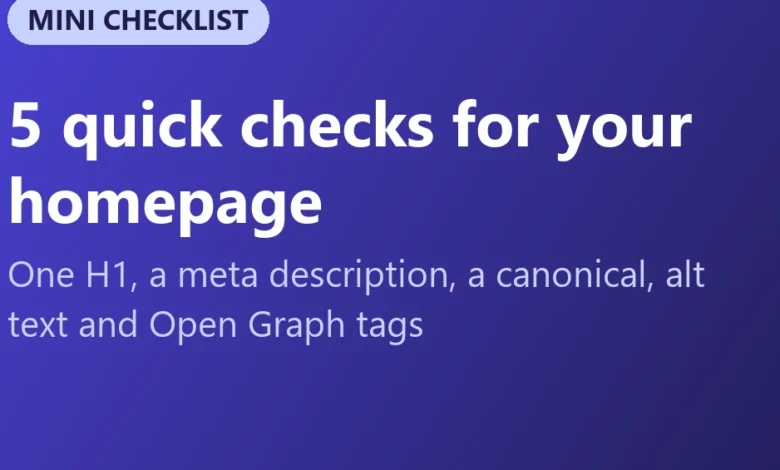
1. Strategic Deployment of Heading Tags (H1)
The H1 tag serves as the primary identifier for a webpage. According to current W3C standards and search engine best practices, every page should contain exactly one H1 tag that encapsulates the core subject matter of the site. Historically, many web designers erroneously used the H1 tag as a stylistic element for logos or navigation, leading to "keyword dilution."
When a site lacks an H1, or conversely, utilizes multiple H1 tags across a single page, search engines struggle to identify the "main topic" of the document. Industry analysis shows that properly tagged H1s are highly correlated with improved semantic relevance in search results. A best-practice H1 should be descriptive, concise, and reflective of the primary service or value proposition offered by the entity. For instance, instead of a generic "Welcome" or "Home," the H1 should read as a succinct statement of purpose.
2. The Significance of Meta Descriptions
The meta description serves as the "organic advertisement" for a page within search results. Although Google has officially stated that the meta description is not a direct ranking signal for algorithmic positioning, its impact on Click-Through Rate (CTR) is profound. A compelling, manually written meta description provides a concise summary of the page’s content, typically between 150 and 160 characters.

If a site fails to provide this tag, search engines may dynamically generate a snippet by pulling arbitrary text from the page body, which often results in disjointed or irrelevant messaging. By crafting a unique description that highlights the value proposition—such as "130+ free SEO and developer tools with no sign-up required"—site owners can significantly improve the likelihood that a searcher will choose their link over a competitor’s.
3. Canonicalization and Indexing Control
A common technical oversight in modern web development involves the improper use of canonical tags and "noindex" directives. The canonical tag (rel="canonical") is essential for preventing duplicate content issues. It informs search engines that a specific version of a URL—whether it includes "www," utilizes HTTPS, or contains tracking parameters—is the "master" version.
Simultaneously, the "noindex" directive acts as a safeguard. Often, developers implement "noindex" tags during the staging phase to prevent internal test versions of a site from appearing in search results. If this tag is accidentally migrated to a production environment, the homepage will be effectively invisible to search engines. This "silent" failure can devastate traffic metrics, as the site will not appear for even branded search queries. Beyond the HTML tag, site administrators must also check HTTP response headers, such as the X-Robots-Tag, which can exert the same restrictive influence on indexing.
4. Semantic Accessibility and Alt Text
Image optimization is frequently misunderstood as a purely visual task, yet it is a cornerstone of both SEO and digital accessibility. The alt attribute (alternative text) provides a textual description of an image for screen readers used by individuals with visual impairments. Furthermore, search engines utilize these descriptions to index images for visual search platforms.
Best practices dictate that every image conveying meaning—such as data visualizations, product shots, or infographics—must contain a descriptive alt tag. Conversely, purely decorative elements, such as dividers or background icons, should utilize an empty alt="" attribute. This signals to screen readers that the element should be ignored, improving the overall user experience. Leaving the attribute entirely absent is considered a technical failure, as it forces assistive technology to announce the file name of the image, which is rarely helpful to the user.
5. Social Media Integration via Open Graph Tags
In an era where content is distributed heavily through platforms like LinkedIn, Slack, WhatsApp, and X (formerly Twitter), the "social preview" has become a vital component of the homepage. Open Graph (OG) tags enable a website to control exactly how it appears when shared as a link. Without these tags, social platforms may display an empty preview or a low-resolution thumbnail.

By implementing og:title, og:description, and og:image tags, organizations can ensure that their brand identity remains consistent across external platforms. Research indicates that links accompanied by rich, relevant preview cards receive a significantly higher engagement rate compared to those that appear as plain, unformatted text. A standardized image size of 1200 x 630 pixels is widely considered the industry "gold standard" for ensuring compatibility across the majority of social sharing protocols.
Implications of Technical SEO Hygiene
The cumulative effect of these five checks is a baseline of digital hygiene that prevents common, avoidable errors. While SEO is often perceived as a race for high-volume keywords, the reality for most small-to-medium enterprises is that "technical debt" is the primary barrier to entry. When a homepage is optimized for both machine readability (canonical tags, meta descriptions) and human accessibility (alt text, H1 structure), the site naturally becomes more resilient to algorithm updates.
The broader implications of these practices extend to site performance and user retention. A page that is structured well for search engines is almost invariably better structured for the user. For instance, the use of proper heading tags aids in navigation for users utilizing assistive technology, while clear Open Graph tags build trust and authority through professional presentation on social media.
Broader Industry Perspectives and Tools
While the manual audit approach is effective for verifying the core components of a homepage, many organizations are increasingly turning to automated diagnostic tools to scale these checks across larger sites. The industry has seen a rise in "freemium" SEO auditing tools, such as the SEO Checker developed by specialized agencies, which allow users to identify issues ranging from HTTPS configuration and redirect chains to mobile viewport responsiveness and structured data errors.
The consensus among digital marketing professionals is that the "5-minute audit" should be the standard operating procedure for any significant site update or deployment. By integrating these checks into a continuous development cycle, webmasters can avoid the "quiet" failures that cause rankings to stagnate.
Ultimately, SEO is a function of clarity. Search engines are essentially in the business of information retrieval, and they reward sites that make the retrieval process easier. By maintaining a clean, well-indexed homepage with clear headings, descriptive meta-data, and robust social integration, site owners provide the necessary signals for search engines to prioritize their content in an increasingly crowded digital marketplace. The transition from a neglected site to a search-optimized one often begins with these fundamental technical corrections, which serve as the scaffolding for all future content and marketing efforts.