The Hunt for Extraterrestrial Intelligence Enters a New Era as Human AI Systems Listen for Alien Technology

The search for extraterrestrial intelligence has undergone a fundamental transformation, shifting from traditional human-monitored radio astronomy to a sophisticated technological paradigm driven by artificial intelligence. Rather than listening exclusively for biological signals or primitive radio broadcasts from distant civilizations, modern astrobiologists are increasingly deploying autonomous agentic AI systems to scan the cosmos. This strategic pivot is predicated on a compelling scientific hypothesis: if advanced extraterrestrial civilizations exist, they are likely millions or even billions of years older than humanity, meaning their most prominent technological footprints will not be organic, but rather synthetic. Consequently, contemporary SETI (Search for Extraterrestrial Intelligence) initiatives are now built on the premise of human-developed AI agents listening for signs of AI agents created by alien intelligence.
This transition marks a historic departure from the classic tropes of science fiction. While popular culture has long fixated on the imagery of organic entities piloting physical craft or broadcasting simple carrier waves, professional researchers are confronting the reality of deep-space communications. The vast distances involved in interstellar space, combined with the immense timescales of galactic evolution, suggest that any enduring technological civilization would have long ago transitioned to artificial intelligence systems for space exploration, signal transmission, and cosmic administration. By leveraging state-of-the-art machine learning models, research institutions are modernizing their approach to deep-space listening, positioning automated systems on the front lines of cosmic discovery.
The Technological Architecture of Modern SETI
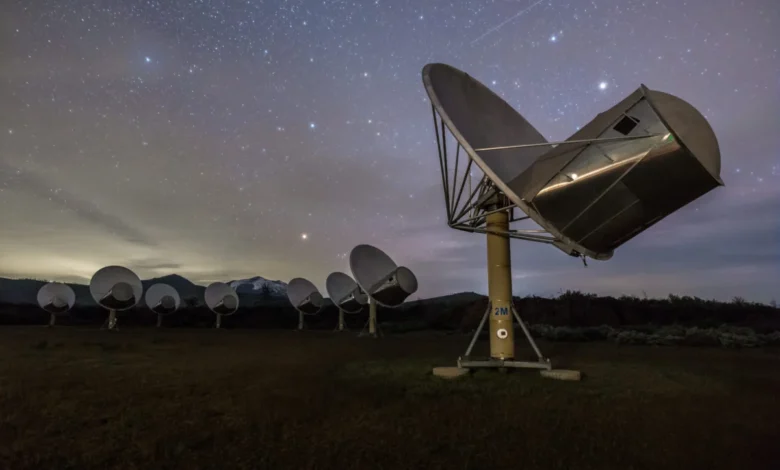
At the heart of this operational evolution is a collaborative effort involving prominent research bodies such as Breakthrough Listen and the SETI Institute. These organizations have successfully integrated agentic AI into the daily workflows of radio astronomy, fundamentally changing how ground-based observatories process incoming cosmic data. The technological proving ground for this initiative is the Allen Telescope Array, situated in Northern California. At this facility, advanced AI agents possess the unprecedented capability to actively steer the instrument, dynamically enhance and correct incoming data streams, and apply complex machine learning models directly to raw celestial observations—all initiated through simple natural language requests.
The sheer volume of data generated by modern radio telescopes has historically presented a severe operational bottleneck. Telescopes like the Allen Telescope Array capture terabits of sensor data every second, creating massive computational challenges for scientists attempting to isolate anomalous, potentially technosignature-bearing signals from the overwhelming background noise of the universe. To overcome this hurdle, researchers have implemented high-performance computing platforms, most notably the NVIDIA Holoscan edge-computing platform, which allows massive streams of sensor data to be processed in flight rather than stored on traditional hard drives.
Underpinning this hardware-software integration is a specialized ecosystem of processing libraries and orchestrators. DAQIRI, a Holoscan platform library, enables the telescope to ingest terabits per second of raw data straight into high-speed GPU memory. Meanwhile, CyberEther—a dedicated signal-processing framework developed at the SETI Institute—performs the heavy mathematical lifting using NVIDIA CUDA-X libraries, including cuFFT for fast Fourier transforms and cuBLAS for dense linear algebra operations.
To manage this intricate web of hardware and data pipelines, researchers utilize Nexus, a web-based observatory orchestrator that functions as the primary agent harness. Nexus provides autonomous agents with a unified source of truth regarding instrument states, available compute resources, and data pipelines. Through this interface, human researchers can monitor packet loss, examine live spectrograms, and rewrite signal-processing blocks simply by issuing natural language prompts. Operating on powerful hardware configurations, such as NVIDIA RTX PRO 6000 Blackwell GPUs, the system seamlessly manages data throughputs reaching 2.4 terabits per second, with inference running locally on-premises adjacent to the instrument itself.
Historical Chronology and the Evolution of SETI
The integration of artificial intelligence into the search for extraterrestrial life represents the latest milestone in a scientific journey spanning nearly a century. Understanding the magnitude of this current technological leap requires examining the chronological progression of radio astronomy and computational signal processing.
The modern era of SETI began in earnest in 1960, when astronomer Frank Drake conducted Project Ozma at the National Radio Astronomy Observatory in Green Bank, West Virginia. Using a single 85-foot radio telescope, Drake tuned into two nearby sun-like stars, Tau Ceti and Epsilon Eridani, listening across a narrow frequency band around the 1420 megahertz hydrogen line. This pioneering endeavor relied entirely on manual tuning and rudimentary analog recording equipment, yielding no artificial signals but establishing the methodological foundation for future radio searches.
Throughout the 1970s and 1980s, the field saw incremental technological improvements with the introduction of multichannel spectrum analyzers (MCSAs). These hardware devices allowed scientists to monitor thousands of frequency channels simultaneously, vastly improving the scope of observation. However, data analysis remained largely retrospective; scientists recorded analog or digital data tapes and transported them to centralized facilities for protracted offline analysis, often months after the initial observations took place.
A major institutional turning point occurred in 1984 with the establishment of the SETI Institute as a non-profit scientific research organization, followed by NASA’s formal initiation of a targeted SETI program in 1992. Although congressional funding for NASA’s program was cancelled the following year, private philanthropy stepped in to sustain the effort, leading to the creation of Project Phoenix and the eventual construction of the Allen Telescope Array in the mid-2000s.
Concurrently, distributed computing initiatives like SETI@home, launched in 1999 by the University of California, Berkeley, democratized data analysis by harnessing the idle processing power of millions of personal computers worldwide. While revolutionary for its time, SETI@home still suffered from latency issues, relying on batch processing of pre-recorded data files rather than real-time edge computing.
The 2015 launch of Breakthrough Listen—a 100 million dollar, ten-year initiative funded by technology investor Yuri Milner—infused the field with renewed financial and technological vigor. Partnering with major observatories globally, Breakthrough Listen vastly expanded the volume of collected data. This exponential growth in data acquisition ultimately outpaced traditional human-led analysis and conventional computing capabilities, necessitating the transition to modern artificial intelligence, edge computing, and agentic workflows that define contemporary SETI operations.
Practical Validation and Real-Time Discoveries
The efficacy of this newly minted AI-driven pipeline is no longer purely theoretical. The architecture has already achieved a historic operational milestone: the first real-time AI detection of a pulsar within the Crab Nebula. Pulsars are rapidly spinning neutron stars—the dense remnants of collapsed massive stars—that emit beams of electromagnetic radiation, sweeping across the cosmos with the regularity of a cosmic lighthouse. Detecting these transient phenomena in real time amidst intense stellar noise has traditionally required extensive post-processing by human astronomers.
By deploying agentic AI pipelines at the Allen Telescope Array, the research team demonstrated that autonomous systems can successfully identify, verify, and document complex astrophysical phenomena instantly as they occur. The implications of this capability extend far beyond pulsar detection; the same computational agility required to identify natural cosmic transients in real time is directly applicable to the detection of artificial technosignatures, which may appear as brief, narrow-band radio transmissions or anomalous data bursts that could easily be lost in traditional batch-processing pipelines.
Looking toward the future, the research consortium is actively evaluating advanced open foundation models, including the NVIDIA Nemotron family, to enhance data locality and response times. These models are particularly valuable for remote or isolated observatories where low-latency edge processing is critical, as well as for conceptualized future installations that may eventually operate completely offline on the far side of the Moon, shielded from Earth’s ambient radio frequency interference.
Official Perspectives and Broader Implications
The introduction of autonomous agents into the quest for cosmic companions has prompted profound reflections from leading scientists regarding the nature of intelligence, both terrestrial and extraterrestrial.
"As our new agentic observatories reach out into the universe, what they find may have much more in common with themselves than with the humans who created them," observed Andrew Siemion, the Bernard M. Oliver Chair for SETI at the SETI Institute and the principal investigator for Breakthrough Listen. Far from expressing apprehension about the rise of autonomous systems in scientific research, Siemion emphasizes the philosophical and practical advantages of this development. "This isn’t something to fear. Rather, it’s a breakthrough in translation."
This perspective addresses a long-standing challenge in astrobiology: the communication barrier between drastically different forms of intelligence. If human scientists struggle to comprehend the motivations, languages, or technologies of an extraterrestrial civilization millions of years ahead of us in evolutionary terms, human-built AI agents may serve as essential interpretive intermediaries. Unencumbered by human cognitive biases and capable of processing multidimensional data streams at unprecedented speeds, machine intelligence may be uniquely equipped to recognize subtle patterns of synthetic origin that entirely evade human observation.
Furthermore, the operational deployment of agentic AI in radio astronomy carries significant spillover benefits for terrestrial science and engineering. The frameworks developed to process 2.4 terabits of data per second in flight—such as DAQIRI, CyberEther, and Nexus—provide powerful new tools for Earth-based scientific disciplines that grapple with massive data influxes, including particle physics, climate modeling, genomics, and global satellite telemetry.
Ultimately, the convergence of artificial intelligence and astrobiology redefines humanity’s approach to the ultimate existential question: Are we alone in the universe? By upgrading our observational instruments with autonomous agents capable of matching the hypothesized technological sophistication of advanced alien civilizations, science has moved past the limitations of human sensory perception. As the Allen Telescope Array continues its continuous sweep of the skies, driven by natural language prompts and executed at GPU-accelerated speeds, the search for extraterrestrial intelligence has evolved into a high-speed, precision-engineered dialogue between advanced computing systems across the cosmos.