Bridging the Gap Between Imagination and Reality: How Frontier AI Agents and NVIDIA Omniverse Are Transforming Physical Simulation Engineering

The convergence of frontier artificial intelligence models and high-performance graphics infrastructure is fundamentally reshaping how engineers, developers, and researchers construct complex digital simulations. Traditionally, turning a conceptual simulation idea into a fully functional, interactive application required a painstaking manual assembly of disparate assets, complex physics engines, rendering pipelines, and rigorous behavioral validation routines. Today, however, developers are successfully pairing advanced large language models and autonomous AI agents—such as GPT-6 Astra and Claude Fable 5—with NVIDIA Omniverse libraries to dramatically accelerate this workflow. By issuing natural-language instructions, technical teams can now direct AI agents to construct, stress-test, and refine physical AI simulations in a fraction of the traditional time, opening new frontiers in warehouse automation, aerospace engineering, robotics, and autonomous vehicle development.
Background Context and Technological Evolution
The push toward automated simulation building stems from a critical bottleneck in modern engineering: the growing complexity of physical AI systems. Whether deploying fleets of autonomous mobile robots in a massive distribution center or training humanoid robots to operate complex machinery, developers require hyper-realistic virtual environments to safely test algorithms before deploying them to the physical world. Historically, creating these environments demanded specialized expertise in Computer-Aided Design (CAD), OpenUSD (Universal Scene Description) file structuring, and GPU-accelerated physics solvers.
NVIDIA Omniverse has long served as a foundational platform for industrial digitalization, providing GPU-accelerated physics, real-time ray-traced rendering, and precise sensor simulation capabilities. By integrating frontier AI models into this ecosystem, NVIDIA engineers have effectively democratized simulation development. Instead of writing thousands of lines of boilerplate code to configure lighting, establish collision geometries, or tune particle dynamics, developers can act as directors—guiding AI agents through conversational prompts while reviewing and refining the generated outputs.
Revolutionizing Warehouse Design and Spatial Reconstruction
One of the most immediate industrial applications of this AI-driven workflow lies in the realm of spatial computing and automated facility design. Planning modern warehouse automation requires a precise, editable digital twin of the physical building. However, existing site scans are frequently obscured by legacy shelving, machinery, and temporary inventory, complicating the extraction of clean architectural geometry.
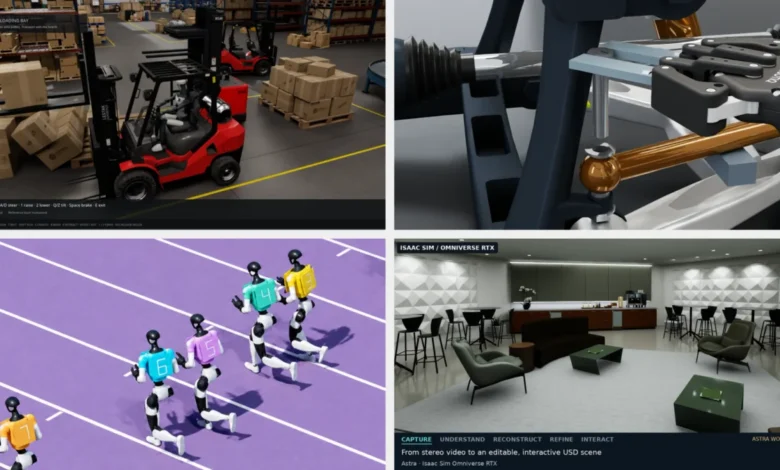
To solve this challenge, David Wehr of NVIDIA’s simulation technology team utilized the Astra AI agent to establish an innovative reconstruction pipeline. By tasking Astra with interpreting panoramic site photographs, the AI successfully isolated the core building geometry and aligned it with dense point-cloud measurements. The resulting model was stored natively in OpenUSD and rendered for real-time inspection using Omniverse’s advanced ovrtx library. This workflow yields an editable, simulation-ready environment where logistics planners can freely reposition shelving, test various automation layouts, and evaluate throughput efficiency before executing costly physical renovations.
Scaling Infrastructure and Stress-Testing Warehouse Simulations
As digital twins grow in scale and fidelity, maintaining real-time performance becomes a critical engineering hurdle. When complex simulations bog down due to excessive computational overhead, identifying the precise bottleneck can be tedious.
Bhavik Sanganee, a principal engineer at NVIDIA, recently addressed this scaling challenge by directing an AI agent to intentionally inflate the complexity of a virtual warehouse simulation. Starting with a modest layout, Sanganee progressively scaled the environment to feature 80 industrial conveyors, 40 robotic arms, and 800 individual inventory boxes. Initial tests revealed performance dips when the scene complexity doubled. However, by optimizing the concurrent execution of physics calculations, image rendering, and video stream preparation, the system successfully maintained a steady 30 frames per second at full HD resolution during intensive two-minute trials, with the robotic arms successfully executing 640 precision box placements. Subsequent performance degradation tests isolated specific friction points within the physics and robot-control pipeline, providing engineers with actionable data for targeted optimization.
Advancing Industrial Equipment Testing via Digital Twins
Beyond logistics, the integration of AI agents and Omniverse libraries is transforming how heavy industrial machinery is evaluated. Pradeep Kaushik, a member of the NVIDIA Omniverse developer relations team, spearheaded the creation of a sophisticated "what-if" analysis application centered on a simulated industrial gas turbine and generator.
By directing Astra to integrate specialized scientific solvers—such as Cantera for complex thermochemistry and SciPy for equipment dynamics—Kaushik built an interactive prototype that maps numerical solver outputs directly to animated 3D rotors, accompanied by color-coded indicators for temperature, pressure, and fluid flow velocity. Engineers utilizing the tool can dynamically adjust operational parameters such as electrical load, ambient temperature, and fuel composition, while simultaneously testing system resilience against anomalous scenarios like stuck fuel valves or failing exhaust sensors. Powered by Omniverse components including ovstage for scene updates, ovrtx for RTX rendering, and ovstream for browser-based streaming, the application enables operators to interactively scrub through simulation timelines alongside synchronized charts and virtual instrumentation.
Asset Ecosystems and the Rise of SimReady Standards
The velocity of simulation development is heavily dependent on the availability of standardized, high-fidelity 3D assets. Recognizing this industry-wide requirement, NVIDIA introduced the SimReady Central Library—showcased at GTC Berlin—which grants developers access to more than 2,000 simulation-ready USD assets contributed by leading equipment manufacturers and asset providers.
Demonstrating the power of this library, Paul Kind of NVIDIA’s documentation team directed an AI agent to assemble a complex kitchen environment entirely through natural-language conversation. The resulting scene integrated 180 individual placements drawn from 63 unique library assets, supplemented by 18 custom geometry pieces. Because SimReady assets arrive pre-embedded with essential physical properties—such as mass, friction, and collision boundaries—developers can immediately deploy them into robotics simulations and AI factory digital twins without manual remediation.
Innovations in Robotics, Cable Routing, and Humanoid Control
Robotic manipulation remains one of the most difficult challenges in industrial automation, particularly when handling flexible, non-rigid materials. Oyindamola Omotuyi, robotics technical marketing manager at NVIDIA, tackled the notoriously complex task of automated cable routing by deploying an AI agent to construct a simulation within NVIDIA Isaac Lab, utilizing the Newton physics engine and Robotiq grippers.
Astra successfully engineered a reinforcement learning system capable of fusing learned cable-bending mechanics with real-time position-and-orientation feedback, allowing a robotic arm to accurately insert a flexible USB-C cable into a recessed port. By validating insertion accuracy and grasp stability entirely within simulation, the team minimized the risk of hardware damage during early-stage physical experiments.
Similarly, Tae Kim, who leads NVIDIA Omniverse engineering and product, explored the limits of humanoid robot control through an experimental project dubbed "Robo Olympics." Leveraging sports footage and natural-language prompts, Kim directed Astra to design physics-based controllers for a simulated Unitree G1 humanoid performing dynamic athletic maneuvers. Powered by the Warp framework for accelerated calculations and Newton physics, the humanoid successfully cleared hurdles in rigorous trials, yielding invaluable telemetry data to refine robot timing, balance, and motor control policies.
Streamlining Autonomous Driving and Sensor Validation
The transportation sector is likewise reaping the benefits of agent-driven simulation workflows. Doyub Kim, a simulation technology manager at NVIDIA, tasked Astra with constructing "Zero to Alpamayo," a comprehensive, reusable simulation environment modeled after San Francisco’s bustling Market Street. The project seamlessly integrated asset generation, stochastic traffic behavior, Omniverse RTX sensor simulation, and Alpamayo autonomous driving models. By altering environmental variables such as lighting and weather conditions via Cosmos3-Nano video experiments, engineers could rigorously benchmark how automated driving models react to identical scenarios under vastly different atmospheric conditions.
To ensure that virtual testing environments reflect physical reality with absolute fidelity, sensor validation has become paramount. Ashley Reid, specializing in RTX sensor validation at NVIDIA, partnered with Astra and Claude Fable 5 agents to evaluate the accuracy of ovrtx camera outputs and raw LiDAR data against empirical recordings captured in the real world. Over a three-day iterative cycle, the AI agents autonomously detected discrepancies in geometry, material properties, and missing scene objects, successfully generating and refining digital twins that met strict key performance indicator (KPI) thresholds.
Broader Implications and Future Outlook
The integration of frontier artificial intelligence models with GPU-accelerated simulation libraries marks a definitive paradigm shift in software engineering and industrial design. By abstracting the complex mechanics of scene assembly, physics configuration, and rendering optimization behind intuitive conversational interfaces, organizations can dramatically shorten the runway from initial concept to deployment-ready application.
As these AI agents continue to evolve—demonstrated by diverse applications ranging from NASA’s International Space Station digital twins built by Nic Johns to automotive suspension disassembly pipelines engineered by Jens Jebens—the boundary between imagination and digital execution continues to dissolve. For industries spanning manufacturing, autonomous systems, aerospace, and logistics, the ability to rapidly spin up, stress-test, and refine physical AI simulations heralds a new era of unprecedented efficiency, safety, and innovation.
Related posts: