NVIDIA Launches RTX Spark and Breakthrough AI Ecosystem to Bring Personal AI Supercomputing to Laptops Worldwide

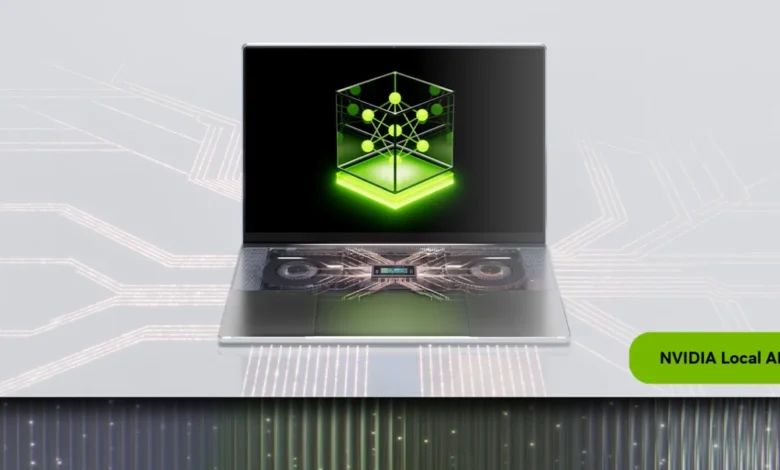
The landscape of personal computing underwent a seismic shift today with the official retail launch of NVIDIA RTX Spark, a new class of thin-and-light laptops engineered to deliver the raw computational power of an AI supercomputer directly to developers, creators, and gamers. Available immediately from major original equipment manufacturers (OEMs) including ASUS, Dell, HP, Lenovo, Microsoft, and MSI, these premium Windows laptops start at $2,599 and pack unprecedented hardware architecture into chassis as thin as 14 millimeters and weighing just three pounds.
By unifying the NVIDIA Blackwell RTX graphics processing unit (GPU) and the NVIDIA Grace central processing unit (CPU) onto a single power-efficient superchip, these devices bypass traditional mobile computing bottlenecks. The architecture supports up to 128GB of unified memory and delivers up to 1 petaflop of FP4 AI performance. This monumental leap in engineering allows creative professionals, data scientists, and power users to run complex, resource-heavy workloads locally—tasks that previously required tethering to a heavy desktop workstation or relying exclusively on cloud infrastructure—even while running entirely on battery power.
Hardware Architecture and the Rise of Local AI
The debut of RTX Spark represents the culmination of years of convergence between consumer-grade mobility and enterprise-tier artificial intelligence. For the past decade, high-performance AI model training, fine-tuning, and large-scale inference were strictly sequestered within massive cloud data centers or specialized enterprise servers. The introduction of the Blackwell RTX architecture and Grace CPU superchip changes this dynamic fundamentally.
By sharing up to 128GB of unified memory between the CPU and GPU, RTX Spark laptops eliminate the latency and capacity constraints traditionally associated with moving data back and forth across discrete memory pools. This allows massive open-weight language models, multi-modal vision systems, and complex agentic workflows to reside entirely within local hardware. Industry analysts note that this capability addresses growing enterprise concerns regarding data privacy, latency, and cloud computing costs, offering a secure, self-contained environment for proprietary AI development.
The initial rollout includes fully configured systems featuring the maximum 128GB memory tier, ensuring that developers can begin deploying demanding models straight out of the box. Major hardware partners have tailored their industrial designs to accommodate the thermal and electrical efficiency of the Grace Blackwell superchip, resulting in form factors that preserve all-day battery life while maintaining elite thermal performance under sustained loads.
Advanced Resource Management via NVIDIA App
To manage the intensive resource demands of running continuous background agents alongside foreground applications, NVIDIA has introduced a sophisticated resource management utility within the latest update of the NVIDIA App.
Modern AI-driven workflows frequently involve autonomous agents—such as digital assistants, automated coding companions, and workflow organizers—operating continuously in the background while users engage in active tasks like gaming, video editing, or software compilation. Both applications and agents draw heavily from the system’s unified GPU compute pool, creating potential friction over hardware resources.
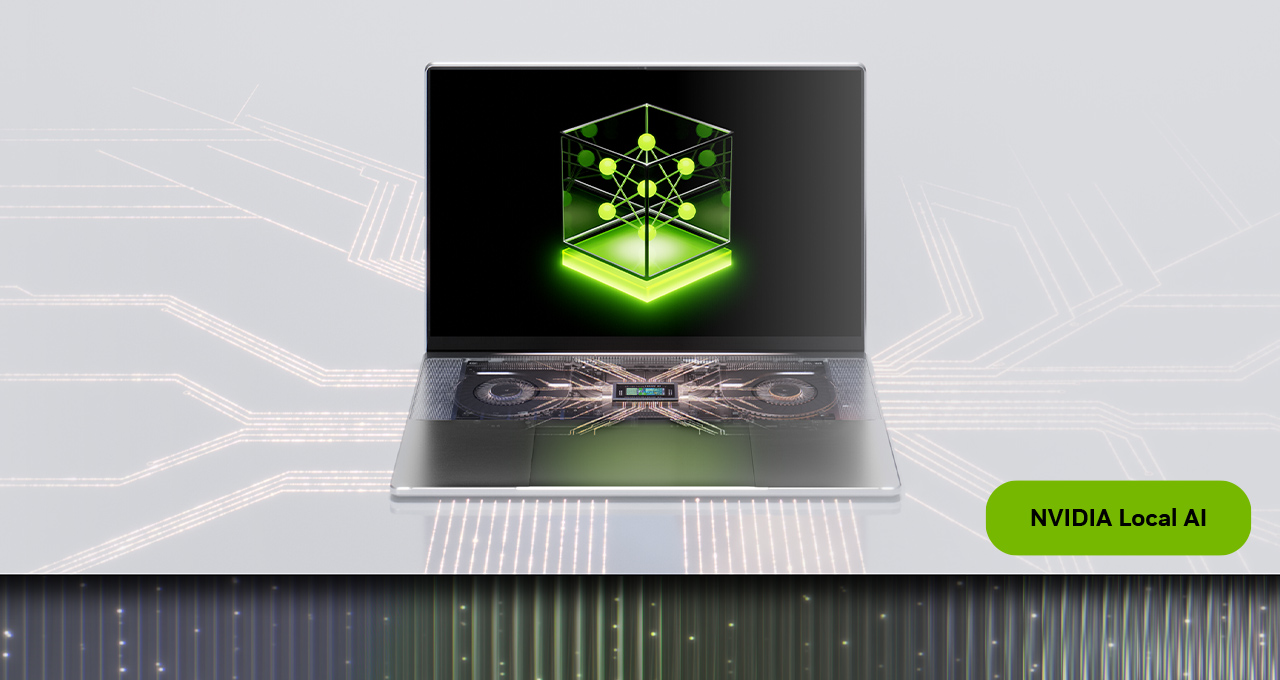
The new resource management feature, accessible through the System and Advanced menus of the NVIDIA App (provided hardware-accelerated GPU scheduling is enabled in Windows Settings), grants users granular control over resource allocation. Users can choose to prioritize their foreground application to guarantee maximum frame rates and zero input latency, or dynamically shift resources toward background agents to accelerate task completion. This level of system-level orchestration ensures that local AI integration enhances productivity rather than destabilizing system responsiveness.
NVIDIA Nemotron 3.5 Transcribe Redefines Speech Processing
Complementing the hardware rollout, NVIDIA introduced NVIDIA Nemotron 3.5 Transcribe, an advanced open-weight speech model designed to convert recorded audio into structured, actionable intelligence.
Historically, audio transcription pipelines required stitching together multiple disparate models to handle basic speech-to-text conversion, speaker diarization (labeling who is speaking), and multi-language translation. Nemotron 3.5 Transcribe streamlines this architecture into a single, promptable model capable of managing transcription, translation, and speaker identification simultaneously, while also answering complex qualitative questions about the underlying audio content.
The model natively supports 40 languages, including seven Indic languages, and demonstrates exceptional versatility through plain-language prompting. For corporate meetings, clinical dictations, or customer service logs, users can prompt the model to extract action items, summarize key decisions, or generate specialized terminology profiles. By incorporating domain-specific product names and formatting guidelines into prompts, developers can tailor the model’s accuracy for high-stakes fields such as healthcare, legal services, and financial compliance.
Ranking No. 1 on the Hugging Face Open ASR leaderboard and No. 2 among open-weight models on Artificial Analysis, Nemotron 3.5 Transcribe achieves state-of-the-art accuracy with approximately 4.3 billion active parameters—roughly 80% fewer parameters than competing top-tier open-weight models. This lean efficiency makes sophisticated speech intelligence remarkably practical to run locally on RTX Spark systems, Jetson AGX Thor devices, and desktop workstations, or to scale massively across Blackwell data center GPUs. The model is available immediately on Hugging Face, with quantized and NVFP4 deployment versions forthcoming via NeMo-Speech.cpp and vLLM.
Liquid AI LFM3 and Expanded Open-Weight Offerings
The software ecosystem surrounding RTX Spark is further bolstered by the integration of Liquid AI’s LFM3 family of Liquid Foundation Models. Spanning text, vision, audio, omni, and decision-making architectures on a shared backbone, the LFM3 lineup provides developers with compact, high-speed models optimized for specialized local workflows.
Notably, Liquid AI’s new 1.7-billion-parameter base model outperforms its predecessor, a 2.6-billion-parameter model, demonstrating rapid algorithmic advancements in model efficiency. These models integrate natively with RTX Spark via llama.cpp and vLLM, empowering local AI agents—such as those operating within Hermes Agent, Pi, and OpenClaw frameworks—to autonomously triage email inboxes, manage calendars, analyze screen contents, and route customer support tickets with minimal latency.
In addition to Liquid AI, NVIDIA highlighted the availability of the Nemotron 3.5 Bolt E4B 4GB model, which enables natural conversational interfaces and multi-step agent execution on hardware with as little as 4GB of memory. For heavier enterprise workloads, the Nemotron 3.5 Bolt 74B-A9B 24GB model provides robust local agent capabilities tailored for RTX Spark. Furthermore, Black Forest Labs’ FLUX 3 Image Klein—a 5.6-billion-parameter open-weight image generation and editing model—has been optimized to run on RTX GPUs with just 8GB of VRAM, with fine-tuning recipes available through NVIDIA NeMo AutoModel.
Gaming and Creative Workflows Enhanced by DLSS 4.5 and RTX Remix 1.6
While enterprise developers leverage RTX Spark for AI development, the gaming and digital content creation sectors are receiving monumental upgrades through the simultaneous launch of S-GAME’s Phantom Blade Zero and the release of NVIDIA RTX Remix 1.6.
Phantom Blade Zero, launching globally on Steam and the Epic Games Store, serves as a premier showcase for NVIDIA’s latest graphics technologies. Utilizing ray-traced path tracing, the game delivers physically accurate bounced lighting, intricate environmental reflections, and realistic shadows across complex terrain and character models. Crucially, the integration of NVIDIA DLSS Dynamic Multi Frame Generation enables up to a 6x frame-rate multiplier, dynamically adjusting generation parameters on the fly to ensure seamless visual fidelity and responsive performance across both desktop GeForce RTX rigs and mobile RTX Spark systems.
Simultaneously, the deployment of RTX Remix version 1.6 brings advanced path-tracing and AI-driven remastering capabilities to some of the world’s most enduring gaming titles. The update officially extends RTX Remix support to Minecraft Java Edition 1.21.1, opening the door for creators to overhaul the iconic sandbox game with DLSS-accelerated path-tracing. Furthermore, Portal with RTX and the Half-Life 2 RTX demo have been updated to support RTX Spark, incorporating DLSS 3D-Guided Neural Rendering for lifelike materials, a new Performance Mode for Frame Generation, and optimized path-tracing algorithms.
The update also streamlines the modding pipeline by integrating a redesigned ComfyUI workflow, allowing creators to generate physically based materials directly within RTX Remix without complex API setups, while supporting AI agent integration to automate repetitive remastering tasks.
Enterprise and Research Expansion with DGX Spark
For research institutions and enterprise developers requiring dedicated stationary infrastructure, NVIDIA also announced the immediate commercial availability of the NVIDIA DGX Spark 64GB. Powered by the GB10 Grace Blackwell Superchip, the DGX Spark system pairs 64GB of unified memory with the enterprise-grade DGX OS and the complete NVIDIA AI software stack.
Designed for local agent development, high-throughput inference, and model fine-tuning, the DGX Spark bridges the gap between portable client devices and massive cloud server clusters, offering a dedicated, secure on-premises appliance for advanced AI research.
Industry Implications and Future Outlook
The simultaneous deployment of RTX Spark laptops, the Nemotron 3.5 Transcribe model, upgraded DLSS gaming pipelines, and localized agent orchestration frameworks marks a definitive turning point in the technology sector. By shifting foundational AI capabilities from centralized data centers to local, client-side hardware, NVIDIA is addressing long-standing industry demands for data sovereignty, reduced operational latency, and offline operational resilience.
As enterprises, creative studios, and software developers begin deploying these systems at scale, the boundaries between consumer hardware and enterprise-grade supercomputing will continue to blur. With robust OEM backing, a rapidly expanding open-weight model ecosystem, and deep integration across creative and professional software suites, RTX Spark establishes a new baseline for what personal computing can achieve in the era of artificial intelligence.
Related posts: