The Evolution of Document Processing
The rise of large language models (LLMs) initially focused on the semantic understanding of plain text. However, the nature of corporate documentation is inherently multimodal. Data from industry analysts suggests that nearly 60% of critical information in professional documents is contained within non-textual elements, such as financial charts, engineering schematics, and comparative data tables.
Traditional RAG architectures function by chunking text and embedding it into vector databases. When a parser encounters a table, it often treats the rows and columns as disjointed, nonsensical lines of text, destroying the relationships between data points. Similarly, images are typically ignored entirely, resulting in "blind" retrieval systems that provide incomplete, and sometimes misleading, answers. The current industry shift toward multimodal RAG represents a maturation of AI, moving from simple text-in-text-out models to holistic reasoning systems that treat visual and textual data as complementary parts of a single truth.
The Technical Architecture: A Four-Stage Workflow
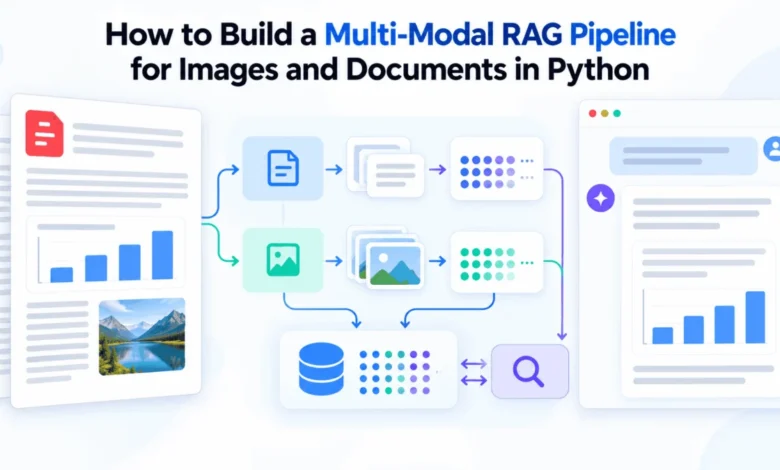
To address these limitations, engineers are adopting a multi-vector retrieval architecture. This approach requires a sophisticated pipeline consisting of four distinct phases: structural parsing, visual summarization, multi-vector indexing, and multimodal inference.
Stage 1: Structural Parsing and Semantic Segmentation
The process begins with the unstructured library, an open-source tool that has become an industry standard for data ingestion. Unlike basic text extractors, unstructured utilizes heuristic analysis to classify document elements into specific categories—paragraphs, headers, tables, and images. By setting infer_table_structure=True and employing "by_title" chunking strategies, developers can preserve the spatial integrity of a document. This prevents the "shattering" of data, ensuring that when an image or table is identified, it remains logically tethered to the surrounding context.
Stage 2: Bridging the Semantic Gap via Visual Summarization
One of the primary challenges in building a multimodal system is the inherent incompatibility between image pixels and vector embeddings. Vector databases are designed for text; they cannot directly "index" an image. To solve this, developers use a technique known as "image-to-text proxy indexing."
In this stage, every extracted image is passed to a multimodal model, such as GPT-4o. The model generates a highly descriptive, search-optimized summary of the image. For example, a bar chart detailing Q3 revenue growth is summarized with specific labels, trends, and data points. This summary is then stored in the vector database. When a user asks a question, the system searches these text-based summaries. If the summary matches the query, the system retrieves the raw image file for the final generation step, effectively using the summary as a signpost for the visual data.
Stage 3: The Multi-Vector Store Infrastructure
The architecture requires a split-storage strategy. A MultiVectorRetriever manages two distinct components:
- The Vector Store: A searchable index (using tools like Chroma or Pinecone) that contains the text chunks and the image summaries.
- The Document Store: An object storage system (or
InMemoryStorefor smaller projects) that holds the actual content—the original text and the raw image files.
Each element is assigned a unique identifier (UUID). When the vector store identifies a match, the docstore retrieves the corresponding raw asset. This separation of concerns is vital for scalability; it allows the system to perform fast similarity searches on lightweight text summaries while keeping the "heavy" visual data stored and accessible only when needed.
Stage 4: Multimodal Synthesis and Inference
The final stage is the retrieval-and-generation loop. When a query is submitted, the retriever pulls the top-k relevant documents, which may include both text snippets and image files. These are then aggregated into a single prompt for a multimodal LLM. By injecting both the textual context and the visual evidence into the model’s context window, the AI can perform cross-modal reasoning. For instance, it can look at a text paragraph discussing a company’s performance and simultaneously analyze a chart showing that performance, providing a comprehensive answer that a text-only system could never generate.
Implementation Requirements
For teams looking to deploy this, the setup requires specific dependencies. Developers must install the langchain, unstructured, chromadb, and openai libraries. Additionally, system-level dependencies such as poppler-utils are necessary to facilitate PDF image rendering.
# Essential installation command for the pipeline
pip install langchain langchain-openai unstructured[pdf] chromadb pillow
apt-get install -y poppler-utils
Setting the environment variables and initializing the OpenAI client completes the baseline configuration. From an operational standpoint, cost management is a factor. Every image processed by the LLM for summarization incurs an API cost. Consequently, developers are advised to implement filtering logic—ignoring small icons or decorative graphics—to ensure the pipeline remains cost-effective for large-scale document repositories.
Broader Implications for Industry
The move toward multimodal RAG has profound implications for industries such as finance, healthcare, and engineering. In the financial sector, analysts often manage thousands of pages of quarterly filings. A multimodal RAG system can instantaneously pull data from a PDF chart in a 200-page report, compare it with text from the CEO’s commentary, and provide a synthesized outlook. In healthcare, the technology can assist clinicians in referencing medical imaging reports alongside diagnostic literature.
From a development perspective, the trend is moving toward even more specialized architectures. Emerging frameworks like ColPali are beginning to challenge the need for separate parsing steps, instead embedding whole document pages as images. These advancements suggest that the "parsing" phase of the pipeline will eventually be automated and abstracted away, allowing developers to focus entirely on the reasoning and retrieval logic.
Challenges and Future Considerations
Despite its power, the pipeline is not without challenges. High-resolution technical drawings can sometimes cause hallucinations in smaller vision models if the summary is not sufficiently detailed. Furthermore, the latency involved in encoding images and querying multiple stores can be higher than traditional text-only systems. To optimize for production, companies are increasingly looking into re-ranking models, which refine the initial search results to ensure only the most relevant visual and textual evidence is passed to the final LLM call.
As AI continues to integrate into the workflow of the modern enterprise, the ability to process documents in their native, multimodal format will likely become the standard requirement for all RAG implementations. By treating images as first-class citizens in the data retrieval process, organizations can finally unlock the hidden insights trapped within their most complex documents.