Speculative Decoding Explained: Achieving 3x Faster LLM Inference through Parallel Verification

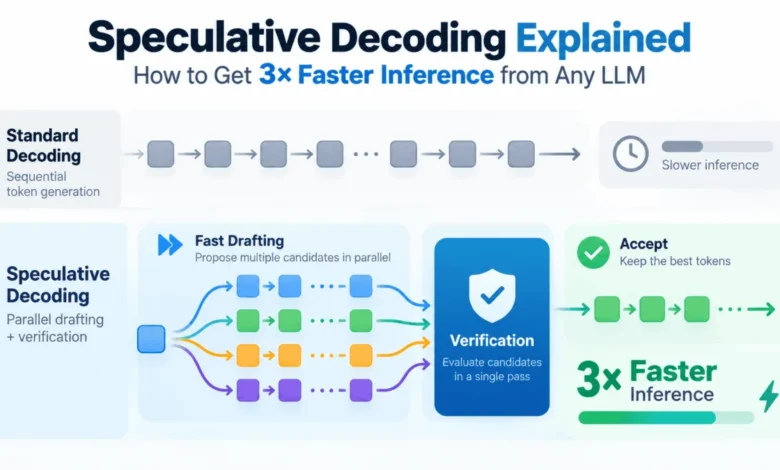
The deployment of Large Language Models (LLMs) has transformed the landscape of artificial intelligence, yet a persistent structural limitation continues to hinder their real-time utility. While models like GPT-4, Llama 3, and Claude have achieved unprecedented reasoning capabilities, they remain constrained by the autoregressive nature of their architecture. In this paradigm, models generate output one token at a time, creating a significant latency bottleneck. Speculative decoding has emerged as the industry-standard solution to this latency, offering a method to increase inference speeds by 2x to 3x without sacrificing the mathematical integrity of the model’s output.
The Architecture of the Autoregressive Bottleneck
To understand why speculative decoding is necessary, one must first examine the mechanics of standard LLM inference. Modern LLMs operate through an autoregressive process, meaning each new token is dependent on the entire sequence of tokens that preceded it. During the generation phase, the model must load its multi-billion parameter weight matrix into the GPU’s VRAM for every single token produced.
This process renders LLM inference "memory-bandwidth bound." In contemporary hardware, such as the NVIDIA H100 or A100 Tensor Core GPUs, the compute units—the portions of the chip responsible for floating-point arithmetic—are significantly faster than the speed at which data can be moved from High Bandwidth Memory (HBM) to the processor. Consequently, the GPU spends the vast majority of its time idling, waiting for the weights to be fetched from memory, rather than performing the actual matrix multiplication required to predict the next word. Because this fetch-and-compute cycle must be repeated for every token, the latency scales linearly with the length of the output, creating a sluggish user experience in applications requiring instant feedback, such as coding assistants or real-time customer service agents.
The Evolution of Speculative Decoding: A Chronology
The conceptual foundation for speculative decoding gained significant traction in early 2023, following research papers from Google DeepMind and independent researchers at Stanford. The core premise—that one could use a small "draft" model to guess the outputs of a larger "target" model—was initially met with skepticism regarding accuracy. However, by mid-2023, empirical evidence confirmed that the technique could provide a mathematical guarantee of equivalence to the target model.
In early 2024, the field saw a pivot toward "model-less" speculative decoding. Innovations such as Medusa and Eagle, developed by researchers aiming to eliminate the overhead of managing two separate models, demonstrated that the target model could be modified or prompted in ways that facilitate self-verification. By the second half of 2024, frameworks such as vLLM and llama.cpp began integrating these features into their core libraries, effectively moving speculative decoding from a research curiosity into a standard production feature for enterprises.
How Speculative Decoding Works: The Two-Model Loop
Speculative decoding functions through a synchronized loop consisting of two distinct stages: the drafting stage and the verification stage.
In the drafting stage, a lightweight, "draft" model—often a distilled version of the target model or a much smaller architecture—generates a sequence of $K$ tokens. Because this draft model has fewer parameters, it can complete this sequence in a fraction of the time it would take the primary model.
In the verification stage, the larger target model takes the entire $K$-token sequence and processes it in a single forward pass. During this pass, the target model calculates the probabilities for each token in the sequence simultaneously. If the target model’s own internal confidence aligns with the draft model’s choices, the tokens are accepted. If there is a discrepancy, the target model rejects the incorrect tokens and samples a corrected sequence.
A critical aspect of this process is the "rejection sampling" mechanism. This statistical procedure ensures that the final output distribution is identical to what the target model would have produced on its own. The user receives the high-quality, nuanced output of the larger model, but the computation is distributed in a way that minimizes the number of memory-intensive passes required.
Supporting Data and Performance Metrics
The efficacy of speculative decoding is heavily dependent on the "acceptance rate"—the percentage of drafted tokens that the target model deems correct. Data from recent benchmarks indicates that when a well-calibrated draft model is paired with a target model, acceptance rates frequently reach 70% to 80%.
- Latency Reduction: In environments with low batch sizes, speculative decoding frequently yields a 2.5x to 3x increase in tokens per second.
- Hardware Efficiency: By reducing the number of times the model weights are accessed from memory, the system reduces the pressure on GPU memory bandwidth, allowing the hardware to operate closer to its theoretical peak throughput.
- Cost Implications: For enterprise providers, this improvement translates directly to cost savings. By increasing the throughput of a single GPU, companies can handle more concurrent requests or reduce the number of instances required to maintain a specific latency SLA (Service Level Agreement).
Limitations and Strategic Considerations
While the benefits are clear, speculative decoding is not a universal panacea for all deployment scenarios. Industry experts and engineers have identified specific constraints:
- High-Throughput Batching: In scenarios where a server is handling hundreds of concurrent requests, speculative decoding can sometimes degrade performance. The additional compute power required to verify draft tokens may compete for resources that could otherwise be used to process more requests in parallel.
- Draft Model Overhead: Maintaining a separate draft model increases the complexity of the deployment pipeline. It requires additional memory for the draft model’s weights and complicates the containerization of the inference service.
- Task Sensitivity: The method is highly effective for tasks with predictable structures, such as coding, legal document drafting, or SQL generation. However, in highly creative or "high-entropy" writing tasks, the draft model may struggle to guess the target model’s next tokens, leading to frequent rejections that add overhead without providing speed gains.
Future Implications and Industry Adoption
The integration of speculative decoding into mainstream libraries like Hugging Face’s text-generation-inference marks a turning point in LLM deployment. We are witnessing a shift where efficiency is no longer achieved solely through model compression or quantization, but through smarter orchestration of inference cycles.
Looking forward, the industry is trending toward "Self-Speculative" methods. By training models with multiple "heads" (as seen in the Medusa architecture), developers are creating systems that are natively optimized for fast verification. This effectively bypasses the need for a secondary model entirely, simplifying the infrastructure while maintaining the performance gains.
As the demand for real-time AI agents grows, the ability to deliver sub-100ms response times will become the primary differentiator for AI-driven products. Speculative decoding serves as the bridge between the high-compute requirements of large models and the real-world expectations of human users. By moving away from the "one-token-at-a-time" bottleneck, developers are unlocking a more responsive, efficient, and scalable future for generative AI. For the practitioner, the immediate takeaway is clear: speculative decoding is no longer an optional optimization but a necessary configuration for any high-performance LLM application.
Related posts: