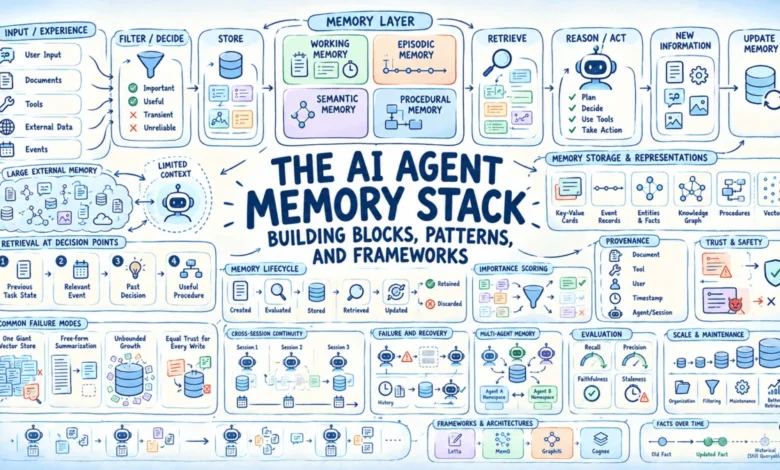
In the rapidly evolving landscape of artificial intelligence, the transition from simple chatbot interfaces to autonomous agents hinges on one critical development: the mastery of machine memory. Traditional large language models (LLMs) operate on a stateless architecture; each interaction is treated as an isolated event, with the model possessing no inherent recollection of previous inputs or outputs once the context window is cleared. While this stateless design is sufficient for basic querying, it represents a significant bottleneck for complex, multi-step workflows. As AI agents move into corporate environments, scientific research, and automated administrative tasks, the ability to store, retrieve, and manage information across extended sessions has become the primary differentiator between experimental scripts and production-grade autonomous systems.
The Evolution of Stateless Computing to Agentic Memory
The concept of "memory" in AI represents a fundamental shift in how developers architect software. In the early stages of generative AI development, the primary focus was on expanding the context window—the "working memory" of a model. However, brute-forcing larger context windows is increasingly seen as an unsustainable strategy. Beyond the technical limitations of computational cost and latency, excessive context can lead to "lost in the middle" phenomena, where models struggle to attend to relevant information buried within a massive prompt.
The modern industry approach has pivoted toward memory externalization. By treating the LLM as a stateless processing engine and moving the storage layer to dedicated database architectures, developers can now build systems that simulate human-like recall. This architectural evolution began in earnest around 2023, as early implementations of retrieval-augmented generation (RAG) proved that connecting models to external vector databases could significantly improve accuracy. By 2026, the focus shifted from simple retrieval to sophisticated "memory stacks," which manage long-term storage, semantic relationships, and procedural logic.
Defining the Agentic Memory Stack
To understand how these systems function, it is necessary to categorize the types of memory an agent requires. Industry standards now generally group these into four distinct tiers, each serving a unique functional role in the agent’s decision-making process:
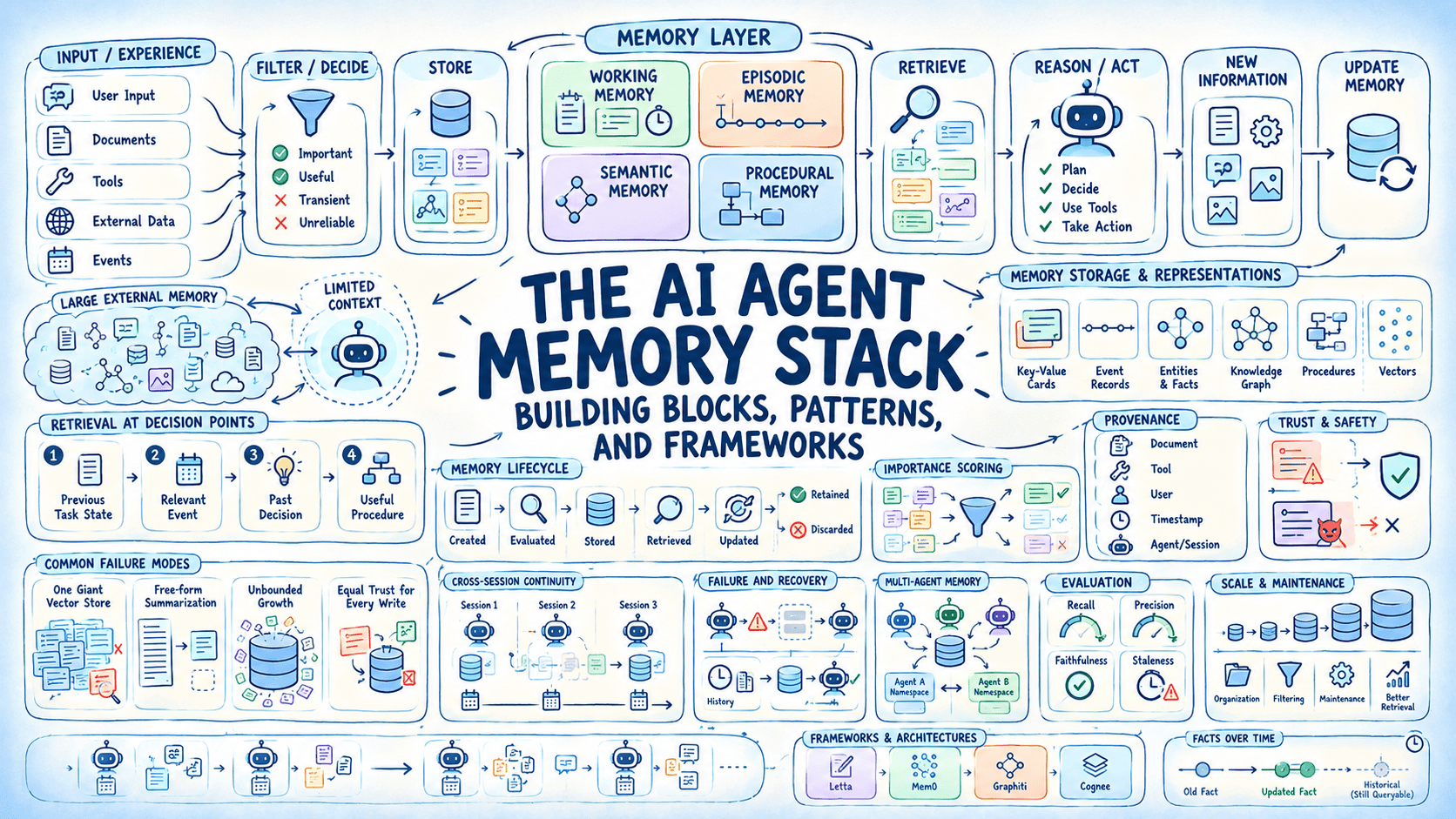
- Working Memory: This is the volatile, immediate state of the agent. It holds the variables, intermediate calculations, and current task status. It is typically stored in high-speed, short-lived buffers or key-value stores.
- Episodic Memory: This functions as the agent’s diary. It records a chronological log of past interactions, specific decisions made during a workflow, and the outcomes of those decisions. This data is essential for "reflection" and debugging.
- Semantic Memory: This is the agent’s knowledge base. It stores facts, user preferences, and entity relationships. Unlike episodic memory, which is appended to over time, semantic memory is updated, refined, and corrected as the agent discovers new information.
- Procedural Memory: This represents the "how-to" layer. It encodes successful strategies, optimized prompts, or learned heuristics that the agent uses to execute tasks.
Strategic Implementation and Performance Metrics
The architectural challenge lies in the "lifecycle management" of these memory stores. A common failure point in early agent design is the "everything in a vector store" approach. Empirical data from recent deployments suggests that simply embedding all history into a single, massive vector database leads to significant retrieval degradation. As the volume of data grows, the signal-to-noise ratio drops, and the agent becomes prone to retrieving semantically similar but contextually irrelevant information.
Instead, robust systems employ tiered architectures. Research indicates that systems utilizing a combination of graph-based relationships for structured data and vector search for unstructured text consistently outperform flat-file architectures. Furthermore, "memory hygiene"—the process of pruning stale, contradictory, or redundant information—is critical. Without an automated maintenance policy, memory stores become bloated, leading to increased latency and "hallucination-by-proxy," where an agent retrieves an outdated or incorrect fact from its own logs.
A Chronology of Memory Framework Development
The development of dedicated memory frameworks has moved at a rapid pace over the last 24 months:
- Phase 1 (2023): Basic RAG Implementation. Developers began using simple vector databases (such as Pinecone or Milvus) to provide agents with static knowledge.
- Phase 2 (2024): The Rise of State-Management. Frameworks like LangChain and LlamaIndex introduced primitives for handling chat history and session state, allowing for primitive conversational memory.
- Phase 3 (2025): Entity-Aware Memory. The industry moved toward frameworks like Mem0 and Letta, which introduced the ability to track specific entities and update information dynamically as the agent interacted with the world.
- Phase 4 (2026-Present): Graph-Based and Multi-Temporal Architectures. Current state-of-the-art systems, such as Graphiti and Cognee, have moved toward bi-temporal knowledge graphs. These systems do not just store information; they track the evolution of facts over time, allowing agents to understand not just "what is true," but "what was true at the time the decision was made."
Implications for Multi-Agent Systems
The shift toward sophisticated memory is particularly visible in multi-agent orchestration. When multiple agents collaborate on a complex project, the memory layer acts as the "source of truth." In this environment, memory engineering becomes a coordination problem. If Agent A updates a piece of semantic memory based on a new finding, Agent B must be able to retrieve that update in real-time.
This necessitates "atomic writes" and strict concurrency controls. Furthermore, evaluation metrics have moved beyond simple accuracy scores. Today, developers monitor "retrieval precision," "memory latency," and "truth-retention rates." According to recent industry benchmarks from AI research groups, agents with managed, tiered memory systems demonstrate a 40% reduction in task-completion time compared to agents that rely on raw, unfiltered context windows.
Challenges and Future Trajectories
Despite these advancements, significant hurdles remain. The issue of "memory poisoning"—where an agent accidentally stores malicious or incorrect information that it later trusts as a fact—remains a major security concern. Additionally, the computational overhead of maintaining a complex graph-based memory structure can be prohibitive for smaller, latency-sensitive applications.
Looking ahead, the industry is trending toward "autonomous memory pruning," where the agent itself is responsible for evaluating which memories are worth keeping based on a cost-benefit analysis. The goal is to move toward a system where memory is not merely a passive storage bin, but an active, curated asset that evolves alongside the agent’s capabilities.
As these technologies mature, the definition of an AI agent will continue to drift away from "a tool that answers questions" toward "a persistent digital assistant that understands the context of its history." For enterprises, the investment in memory architecture is no longer an optional optimization; it is the foundation upon which reliable, autonomous digital workforces will be built. As organizations continue to integrate these systems, the ability to manage the complexity of this memory stack will likely become the primary metric by which AI effectiveness is judged.