Building a Robust JSON Serialization Pipeline in Python for Complex Machine Learning Workflows

The architectural complexity of modern machine learning systems often masks a fundamental engineering bottleneck: the persistent challenge of data interchange. While significant intellectual capital is routinely invested in neural network design, hyperparameter tuning, and gradient descent optimization, a disproportionate amount of production-level engineering time is consumed by the "plumbing" of data. This entails the rigorous, error-prone process of serializing and deserializing complex objects as they transit between local files, distributed databases, containerized microservices, and high-latency APIs. As machine learning environments move from static notebooks to dynamic production pipelines, the limitations of standard JSON—a format designed for simple key-value structures—become an increasingly critical point of failure.
The Limits of Standard Serialization in Production
The JSON standard (RFC 8259) provides a universal language for data interchange, yet it is natively limited to primitive types: strings, numbers, booleans, arrays, and objects. In the domain of machine learning engineering, data is rarely so simple. A standard experiment configuration might involve datetime objects for tracking run durations, pathlib.Path objects for file system abstraction, set structures for unique feature selection, and Enum classes for strict typing of model architectures.
When a standard Python dictionary containing these types is passed to the native json.dumps() function, the process immediately halts with a TypeError. This is not merely an inconvenience; in an automated CI/CD pipeline, such a failure can trigger a cascading outage, stalling training jobs and causing significant resource wastage. To build a robust system, engineers must move beyond basic serialization and implement a custom, type-aware pipeline that anticipates the nuances of modern data structures.
The Architecture of a Custom Serialization Layer
The first line of defense in building a reliable data pipeline is the implementation of a custom encoder. By subclassing the json.JSONEncoder provided in the standard library, developers can intercept objects before they hit the serialization barrier. The strategy here is to override the default() method, which serves as the fallback mechanism for the encoder when it encounters an unfamiliar type.
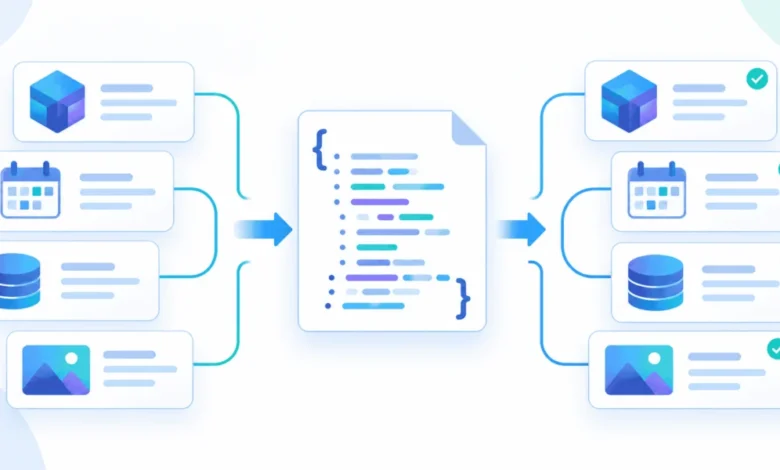
This approach effectively implements a "type-tagging" pattern. For instance, when the encoder identifies a datetime object, it does not attempt to serialize it directly. Instead, it creates a structured JSON object containing a metadata field—commonly __type__—and the serialized string representation of the object. This ensures that the original type information is preserved during the transit phase. By explicitly handling set, Path, and Enum types through this method, developers create a predictable schema that can be reliably parsed by any downstream consumer, whether that consumer is written in Python, Go, or Node.js.
The Reconstructive Power of Custom Decoders
If serialization is the process of flattening objects into a serial stream, deserialization is the process of reconstruction. A naive approach to deserialization simply maps JSON keys to dictionary keys, losing the original class context. To achieve a truly robust pipeline, one must utilize the object_hook parameter in the json.loads() function.
The object_hook acts as a middleware layer that inspects every nested dictionary parsed from the JSON stream. If the hook detects the __type__ marker, it triggers a recovery function that casts the "value" back into its intended class. For example, a serialized Path object is passed through the Path() constructor, and a datetime string is processed via datetime.fromisoformat().
Critically, this layer provides a centralized location for error handling. In production environments, data can become corrupted or malformed. By wrapping the reconstruction logic in a try-except block, the decoder can gracefully handle unexpected input, logging the anomaly and potentially providing a fallback value rather than allowing the entire application to crash. This degree of resilience is essential for maintaining the stability of data pipelines in distributed systems.
Addressing Schema Evolution and Data Drift
A frequently overlooked aspect of machine learning engineering is the challenge of schema migration. As projects mature, the underlying configuration schema inevitably drifts. Parameters are added, renamed, or deprecated as models evolve from simple baselines to sophisticated architectures. Loading a JSON file generated by an older version of the codebase into a newer, more strict system often results in "missing key" errors or unexpected runtime exceptions.
To solve this, developers should adopt a factory pattern for loading configurations. Rather than calling json.loads() directly in the business logic, the application should route all incoming data through a dedicated configuration loader. This loader functions as a validation and migration layer, applying default values for newly introduced hyperparameters—such as a learning_rate or dropout_rate—that may not exist in legacy configuration files. Furthermore, this layer can explicitly prune deprecated keys, ensuring that the internal state of the application remains clean and aligned with the current production requirements.
Quantitative and Qualitative Impacts
The implementation of these patterns provides three primary benefits to engineering teams:
- System Stability: By removing the risk of serialization-based crashes, teams reduce the frequency of "hot-fix" deployments and emergency patches.
- Type Safety and Consistency: Preserving complex types like
Pathanddatetimeeliminates the ambiguity that arises when developers have to guess the format of a date string or the nature of a directory path. - Operational Transparency: The explicit tagging of custom types allows for easier debugging. When a configuration file is inspected, it is immediately clear what the intended data structure was, even if the application logic has changed.
Industry Implications and Best Practices
The transition toward robust serialization is reflective of a broader shift in the machine learning industry toward MLOps—the application of DevOps principles to machine learning. As models are increasingly deployed in high-stakes environments, the reliability of the "data plumbing" becomes a primary indicator of system maturity.
Industry leaders emphasize that while libraries like Pydantic or Marshmallow offer sophisticated validation, understanding the fundamental mechanics of Python’s json module is a prerequisite for any senior engineer. These custom hooks provide a lightweight, dependency-free solution that can be deployed across various environments without the overhead of external libraries.
Future-Proofing the Data Pipeline
Looking ahead, the integration of these techniques into existing pipelines should be viewed as an iterative process. As schemas grow in complexity, developers might consider moving toward schema-driven development, where JSON structures are validated against a schema definition (such as JSON Schema). However, even in those cases, the core logic of encoding and decoding remains the bedrock upon which validation rests.
In conclusion, the effort required to build a robust serialization pipeline is a long-term investment. By moving from simple, fragile scripts to a structured, type-aware serialization layer, organizations can ensure that their data pipelines are not only capable of handling today’s requirements but are also resilient enough to withstand the inevitable shifts in model architecture, schema requirements, and production environments. Through consistent use of custom encoders, reconstructive decoders, and schema migration factories, engineers can focus their efforts on what truly matters: the efficacy and performance of their machine learning models.