Tulungagung Onion Farmers Forced Into Early Harvests as Heavy Rains Threaten Crops with Rot and Market Collapse

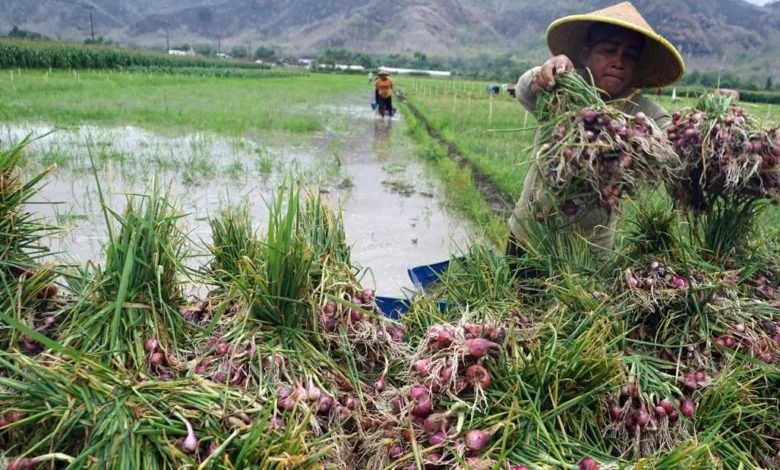
The relentless intensification of seasonal rainfall across East Java has triggered an agricultural emergency in Tulungagung, where local shallot farmers find themselves compelled to execute premature harvests. Faced with rapidly waterlogged fields and mounting humidity, producers have had to abandon their standard cultivation timelines to salvage whatever yield remains viable. This desperate measure is designed to forestall complete crop failure, mitigate severe fungal infections, and prevent a catastrophic plunge in market value that typically accompanies rain-damaged produce.
The decision to pull crops from the earth before they reach optimal maturity highlights the profound vulnerability of domestic horticulture to shifting weather patterns. As climate anomalies become more frequent and severe, traditional agricultural calendars are increasingly disrupted, threatening both the livelihoods of rural farming communities and the stability of regional supply chains.
The Anatomy of an Agricultural Crisis
Shallots, locally known as bawang merah, are notoriously sensitive to excessive moisture. Unlike staple grains such as rice, which can endure prolonged flooding to varying degrees, Allium cepa var. ascalonicum demands well-drained soils and consistent sunshine during its bulb-bulking phase—the critical window when the underground storage organs expand and accumulate dry matter.
When torrential downpours inundate shallot fields, the repercussions are immediate and multifaceted. Standing water suffocates the root system, cutting off vital oxygen supplies and inducing root rot. Simultaneously, the saturated environment creates a breeding ground for pathogenic fungi and bacterial agents, most notably Fusarium wilt, purple blotch, and anthracnose. Left unchecked, these pathogens can decimate an entire field within a matter of days, turning firm, marketable bulbs into a mushy, unmarketable waste.
Furthermore, excessive moisture late in the growing cycle prevents the outer tunics of the shallot from curing properly. Even if the bulb survives the initial inundation, high humidity levels hinder the drying process, leaving the produce highly susceptible to post-harvest decay during storage and transit. By initiating an early harvest, Tulungagung farmers aim to extract the crop from the hostile aquatic environment before these destructive processes render the harvest entirely worthless.
Chronology of the Weather-Induced Pivot
The current crisis did not emerge in a vacuum; it is the culmination of weeks of erratic meteorological conditions that caught many agrarian communities off guard.
In the initial weeks of the planting season, weather patterns appeared relatively stable, allowing farmers to sow their shallot seeds with reasonable confidence. However, as the crops entered their mid-vegetative and early bulb-development stages, the regional atmospheric conditions shifted dramatically.
By late last month, localized thunderstorms began pelting Tulungagung with high-intensity rainfall, overwhelming local drainage infrastructures in various farming sub-districts. Initially, farmers attempted standard mitigation efforts, manually digging drainage trenches, pumping standing water out of furrows, and applying prophylactic fungicides to ward off anticipated blights.
Despite these laborious interventions, subsequent weather forecasts predicted no immediate relief, signaling days of continuous precipitation. Recognizing that further delay would result in total crop rot, local farming cooperatives and independent growers convened informally to reassess their strategies. By the middle of this week, the consensus shifted decisively toward emergency early harvesting. Tractors and manual laborers were mobilized overnight to strip the fields, transforming a routine agricultural cycle into a frantic salvage operation.
Economic Fallout and Pricing Pressures
Opting for an early harvest is far from an ideal solution for farmers; rather, it represents a calculated minimization of losses. Shallots harvested prematurely suffer from distinct economic disadvantages. Because the bulbs have not reached their full biological potential, the overall yield per hectare drops significantly compared to a standard, full-term harvest. Farmers harvest smaller bulbs, which command lower prices in the wholesale marketplace.
In the Indonesian agricultural market, shallot grading is rigorous. Large, well-cured bulbs fetch premium prices, while undersized, moisture-laden shallots are heavily discounted by traders and middlemen. Consequently, even though Tulungagung farmers manage to save a portion of their crop from total destruction, their gross revenue per harvest cycle is projected to decline precipitously.
This localized supply shock also introduces complex dynamics into the broader regional economy. From a consumer perspective, an influx of prematurely harvested shallots can create a temporary distortion in market supply. Initially, the sudden surge of harvested produce hitting local markets may cause a slight, short-term dip in consumer prices due to the immediate availability of goods that cannot be stored long-term. However, because these shallots lack durability and are prone to rapid spoilage, this supply bubble is expected to dissipate quickly.
As the damaged or prematurely sold stock clears, a severe supply deficit is likely to materialize in the subsequent weeks. Without the anticipated volume from Tulungagung—historically one of East Java’s reliable agricultural buffers—regional markets may experience sharp inflationary spikes in shallot prices. This volatility not only strains household budgets across Java but also complicates national efforts to maintain food price stability, a core objective for macroeconomic planners.
Official Responses and Institutional Support
In the wake of the emergency harvests, agricultural extension officers and local government agencies in Tulungagung have stepped up to assess the damage and provide guidance to affected farming communities. Regional agricultural offices have deployed teams to conduct field surveys, quantifying the exact acreage affected by waterlogging and compiling data on total anticipated losses.
Preliminary assessments from agricultural extension personnel emphasize the urgency of implementing post-harvest management strategies tailored to wet conditions. Because early-harvested shallots contain higher moisture content, traditional sun-drying methods are frequently ineffective under overcast skies. Agricultural authorities are advising farmers to utilize makeshift or communal artificial drying facilities, such as thermal driers, where available, to reduce moisture levels and prevent rapid fungal proliferation.
Furthermore, discussions are underway among local policymakers regarding potential relief mechanisms. While direct cash subsidies for weather-related crop failures remain constrained by bureaucratic and budgetary limitations, agricultural departments are exploring avenues to distribute subsidized antifungal treatments, high-quality seeds for the subsequent planting cycle, and technical assistance on climate-resilient farming techniques.
Agricultural economists and regional planners have also reiterated the necessity of expanding participation in government-backed agricultural insurance programs, such as the Autas Usaha Tani Padi (AUTP) framework and its equivalents for horticulture, known as Asuransi Usaha Tanaman Hortikultura (AUTH). These financial instruments are designed to buffer farmers against the total loss of capital investment caused by extreme weather events, though uptake among smallholder shallot farmers remains variable due to administrative hurdles and premium costs.
Broader Implications for Indonesian Agriculture
The plight of the Tulungagung shallot farmers serves as a microcosm of the broader challenges confronting Indonesian agriculture in an era of climate change. Horticultural commodities, by virtue of their short growth cycles and biological sensitivities, act as early indicators of environmental stress.
As shifting monsoon patterns, prolonged La Niña phases, and unseasonal rainfall events become the new normal, traditional farming wisdom is increasingly insufficient to guarantee food security. The situation in East Java underscores an urgent structural imperative: the modernization of agricultural infrastructure.
Key areas requiring immediate capital investment and policy prioritization include:
- Advanced Drainage Systems: Upgrading rural irrigation networks to feature bidirectional capabilities—allowing rapid drainage during excessive rainfall just as efficiently as they deliver water during droughts.
- Protected Agriculture: Expanding the adoption of rain shelters, net houses, and greenhouse technologies for high-value horticultural crops to decouple production from immediate meteorological volatility.
- Cold Chain and Processing Infrastructure: Developing decentralized drying, storage, and processing facilities to absorb prematurely harvested or surplus produce, converting raw crops into shelf-stable pastes, flakes, or powders to insulate farmers from raw market price collapses.
- Climate Forecasting Integration: Enhancing the granularity and accessibility of meteorological data for rural farming communities, enabling proactive rather than reactive decision-making.
Until these structural transformations are fully realized at the grassroots level, rural producers will remain precariously exposed to the whims of the skies. For the shallot farmers of Tulungagung, the immediate priority remains weathering the current deluge, salvaging what livelihoods remain, and bracing for a turbulent transition into the next agricultural cycle.
Related posts: