
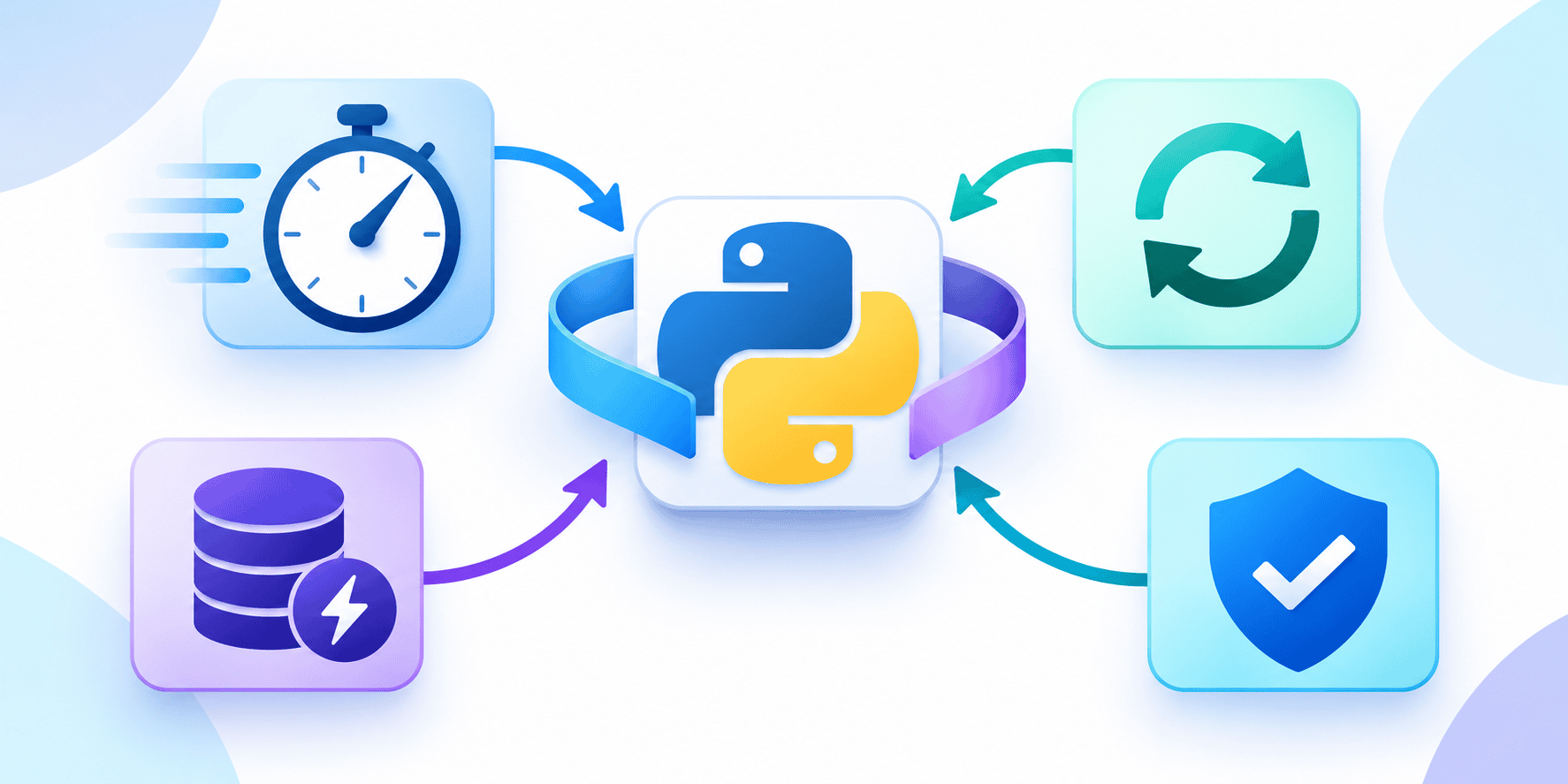
The evolution of modern software architecture, particularly in data-intensive environments like machine learning pipelines, has necessitated a cleaner approach to handling cross-cutting concerns. Developers frequently encounter "boundary code bloat," where the core logic of a function becomes obscured by secondary tasks such as performance monitoring, transient error handling, input verification, and memoization. This accumulation of peripheral code not only increases the cognitive load for maintainers but also introduces subtle, inconsistent bugs across a codebase. Python decorators offer a sophisticated mechanism to abstract these concerns into reusable, modular wrappers, ensuring that the primary business logic remains pristine and focused.
The Problem of Boundary Bloat
In a typical development cycle, a feature pipeline might begin with concise, purpose-driven functions. For instance, a function designed to load_embeddings from a disk might start as a ten-line script. However, within a few months, the necessity for robust production systems introduces requirements: the function must now verify the existence of file paths, ensure batch sizes are within acceptable bounds, and log execution times for telemetry. Simultaneously, external service calls, such as fetch_vocab, require retry logic to mitigate transient network instability.
By manually embedding these requirements into each function, developers inadvertently create "boundary bloat." The logic becomes fragmented, and because each implementation is often written ad-hoc, the retry logic in one function may differ slightly from another, leading to unpredictable system behavior. Research into codebase maintainability suggests that duplicated boundary logic is a primary contributor to technical debt. When the same logic is pasted into dozens of locations, a single bug in the implementation—such as an improper exception swallow—requires a widespread, error-prone refactor.
Anatomy of a Decorator: Function Reassignment
At its core, a Python decorator is a higher-order function that facilitates the reassignment of a function object. When a developer uses the @decorator_name syntax, they are invoking syntactic sugar for a reassignment operation: func = decorator(func). This process occurs at import time, meaning the decorator logic executes once when the module is loaded.
Understanding this lifecycle is critical for high-performance applications. Because decorators run at definition time, they are ideal for registering functions in global tables or initializing resources. However, if a decorator fails to return a callable—or worse, returns None—the original function name becomes unbound or redefined, causing runtime failures. Stacked decorators, such as @f1 above @f2, function as nested wrappers (f1(f2(func))), a hierarchy that dictates the order of execution. Proper ordering is essential, particularly when combining caching (which should be innermost to minimize overhead) with validation (which should be outermost to block bad calls early).
Closures and the Preservation of Identity
The efficacy of a decorator relies on the closure—the ability of an inner wrapper function to "remember" the original function variable even after the outer decorator has finished executing. By utilizing *args and **kwargs, decorators can forward arguments dynamically, ensuring they remain agnostic to the signature of the function they are wrapping.
However, this abstraction comes with a cost: the loss of metadata. A decorated function will report its name as wrapper and lose its original docstring. To maintain professional standards, it is imperative to use functools.wraps. This utility copies the original function’s identity, including its docstring, annotations, and module name, onto the wrapper. Furthermore, it creates a __wrapped__ attribute, which provides a critical escape hatch for unit testing. Without __wrapped__, tools like inspect.signature or automated documentation generators would fail to reflect the reality of the underlying code, leading to significant confusion during debugging sessions.
Implementation: Building Robust Boundary Behaviors
1. Performance Monitoring (Timing)
Performance monitoring is essential for identifying bottlenecks. Using time.perf_counter() within a try/finally block ensures that timing data is captured regardless of whether the function succeeds or raises an exception. This is vital for diagnostic purposes; knowing that a function took 5 seconds before crashing is significantly more useful than simply knowing it crashed.
2. Resilience (Retry Logic)
Retry decorators serve as a buffer against intermittent failures. By accepting parameters like max_attempts and exceptions, developers can create highly configurable policies. A critical design rule here is to restrict retries to idempotent operations—tasks that can be repeated safely, such as fetching data. Implementing a retry on a non-idempotent operation, such as a database write or a financial transaction, can result in duplicate operations and inconsistent system states.
3. Efficiency (Memoization)
The standard library’s functools.lru_cache serves as the gold standard for memoization. By storing the results of expensive function calls, it significantly reduces computation time for repetitive inputs. However, its usage requires caution. Because it stores references in a dictionary, it can lead to memory leaks if used with an infinite maxsize in a long-running process, or it may produce incorrect results if the cached function relies on mutable objects.
4. Input Validation
Validation decorators represent the most advanced use of the pattern. By leveraging the inspect.signature module, a decorator can bind arguments to a function’s signature and apply validation rules before the function ever executes. This "fail-fast" approach prevents invalid data from entering the business logic layer, simplifying the function’s internal error handling.
Analysis of Implications and Best Practices
The transition from manual boundary handling to decorator-based design marks a shift toward more professional, enterprise-grade software engineering. By isolating concerns, teams can ensure that:
- Consistency is enforced: All functions share the same retry policy, preventing divergent behaviors across the codebase.
- Testing is simplified: Logic is separated, allowing for unit tests to verify the decorator and the function independently.
- Readability is preserved: Developers can scan the code and immediately identify the "extra" behaviors of a function via the decorators present at the top of the definition.
Despite their power, decorators should not be used indiscriminately. A common pitfall is over-engineering; if a decorator requires more than a few lines of state management, it is often better to implement a class-based approach. A class with a __call__ method offers superior introspection, as the state is held in attributes rather than hidden in a closure.
Furthermore, the "order of operations" in stacked decorators must be managed with extreme care. If a cache is placed outside of a retry decorator, the cache will store the exception if the first attempt fails, potentially causing subsequent calls to fail immediately without retrying. The standard practice dictates that retries should be placed outside the cache to ensure that failures are handled before results are memoized.
Conclusion: The Future of Pythonic Architecture
As Python continues to dominate the machine learning and data science landscapes, the reliance on clean, modular architectures becomes increasingly paramount. Decorators are not merely a convenience; they are a fundamental tool for managing the complexity of modern, distributed applications. By adopting these patterns, engineers move closer to a declarative style of programming, where the intent of the code is clearly separated from the mechanical requirements of the runtime environment.
While the provided patterns—timing, retrying, caching, and validating—cover the most frequent use cases, the ultimate measure of success is the simplicity of the resulting codebase. When used correctly, decorators make the boundary of a function clearer, not more complex. If the implementation of a decorator makes the function harder to understand, the developer should revert to simple, explicit code. The goal remains constant: building software that is as maintainable as it is performant.