In the rapidly evolving landscape of enterprise data architecture, organizations worldwide are increasingly turning to decentralized paradigms to break down monolithic data silos. At the vanguard of this movement is the Data Mesh framework, designed to shift data ownership directly to domain teams. However, as enterprises attempt to implement decentralized data ownership, a critical operational bottleneck has emerged: the absence of integrated, frictionless self-service infrastructure. Industry analysts and platform engineering experts emphasize that without a robust, purpose-built self-service data platform, the foundational promise of Data Mesh—domain autonomy and operational agility—collapses under the weight of cognitive overload and technological fragmentation.
The Anatomy of the Platform Gap
To construct a fully functional data product, development teams must orchestrate a complex array of modern technologies. These include distributed compute engines for data transformations, scalable cloud storage layers, data ingestion frameworks, enterprise data catalogs, distributed query engines, and rigorous data quality validation tools. When examining these discrete technologies in isolation, enterprise architects frequently encounter a profound structural disconnect known as the "platform gap."
This gap exists because legacy and modern individual technologies alike typically lack native abstractions for high-level Data Mesh constructs such as data contracts and data products. A single data product does not function as an isolated database or a standalone pipeline; rather, it represents an integrated, cohesive unit of productized data. Because no single foundational technology covers the entire lifecycle of a data product, developers are forced to manually bridge the divide. The absence of built-in abstractions leads to widespread organizational confusion regarding what a data product actually is, how it manifests within an enterprise technology stack, and how teams should interact with it. Consequently, direct utilization of disparate data technologies hinders enterprise-wide adoption of Data Mesh principles.
Platform Engineering and the CNCF Maturity Model
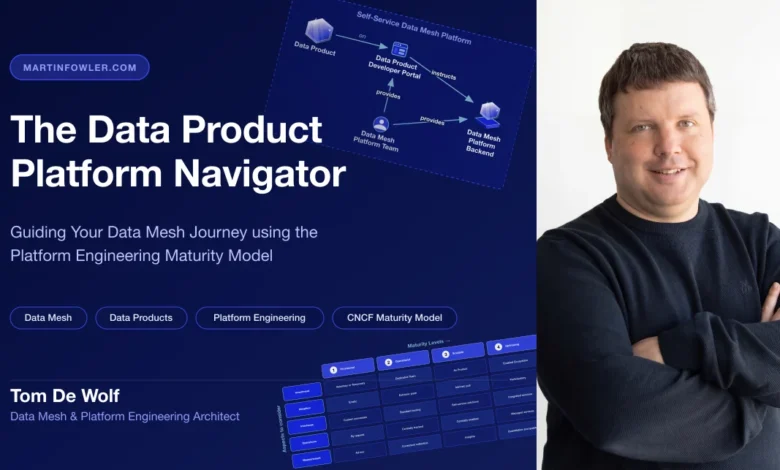
To bridge the platform gap, forward-thinking organizations are turning to platform engineering. By constructing an abstraction layer that sits atop existing infrastructure technologies, platform teams can successfully shield developers from underlying infrastructure complexity. This abstraction layer provides a user experience centered squarely on data contracts and data products, transforming fragmented tools into a unified self-service ecosystem.
Despite the clear benefits, building an enterprise-grade data platform presents severe organizational hurdles. Platform teams frequently struggle to articulate their development progress, prioritize incoming requests, and mathematically demonstrate the return on investment (ROI) to executive stakeholders. To navigate these strategic challenges, industry leaders are increasingly adopting the Cloud Native Computing Foundation (CNCF) Platform Engineering Maturity Model.
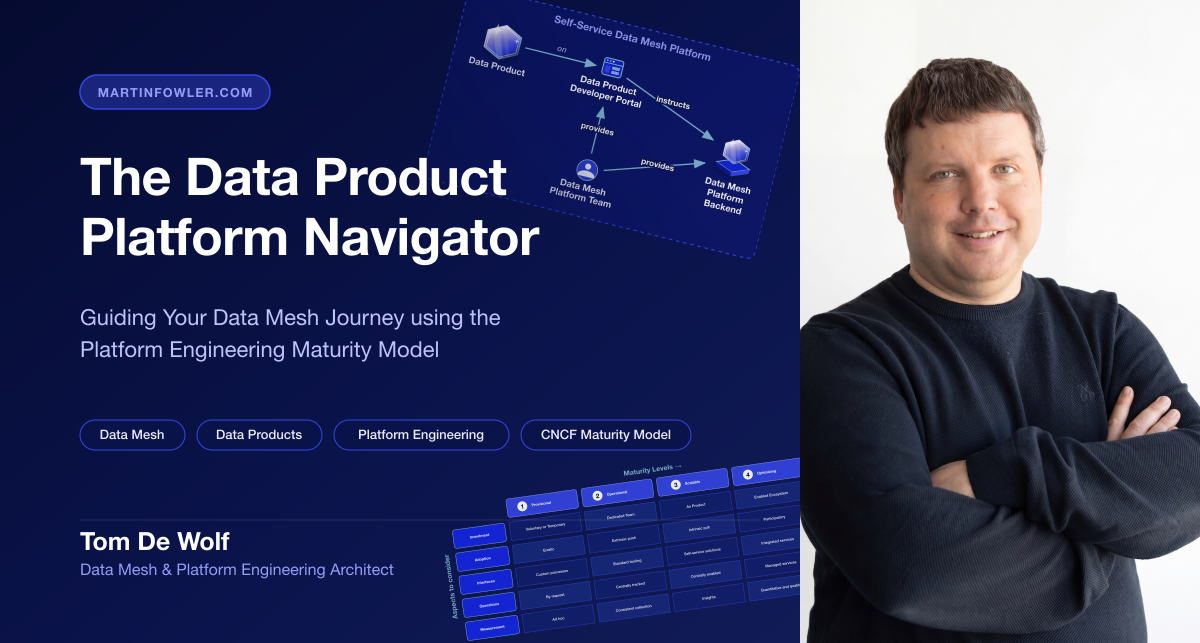
Published by the CNCF app-delivery community, this maturity model establishes a comprehensive framework for assessing and advancing platform capabilities. The model evaluates platforms across four distinct maturity levels—Provisional, Operational, Scalable, and Optimizing—and measures progress across five core operational aspects: Investment, Adoption, Interfaces, Operations, and Measurement.
By mapping their current capabilities onto the CNCF grid, platform engineering teams can accurately diagnose high-friction bottlenecks. Rather than over-investing blindly in raw technology, organizations can strategically balance people, policies, and processes. For instance, establishing a dedicated product team and gathering qualitative developer feedback must precede heavy investments in automated self-service tooling. This balanced approach prevents lopsided resource allocation and provides executives with transparent metrics.
The Four Stages of Platform Evolution
The evolution of data platforms typically progresses through four distinct maturity tiers, each characterized by markedly different developer experiences and organizational outcomes.
At Level 1, the Provisional Platform represents the "No Platform" era. Characterized by ad-hoc provisioning and chaotic workflows, developers rely entirely on informal personal networks to cobble together infrastructure. A data product developer must negotiate individually with disparate engineers to secure a Git repository, a CI/CD pipeline, and cloud storage buckets, before manually configuring processing clusters. Subsequent developers looking to build their own products find no documentation, leading them to copy disparate technology stacks—such as shifting from Apache Spark to Google BigQuery and dbt—without architectural consistency. This provisional approach results in rampant shadow IT, excessive cognitive load, and deep technological fragmentation.
At Level 2, the Operational Platform introduces centralized structure through ticketing systems like Jira and specialized infrastructure teams. While requests are tracked and underlying technologies are standardized, the developer experience remains severely fragmented. Developers submit separate tickets for version control, pipelines, and data storage, enduring frustrating operational queues. Even with the introduction of Infrastructure-as-Code (IaC) scripts, developers are left entirely alone to manually glue these components together. Exhausted by integration friction, engineers frequently bypass the official toolchain to establish their own local shadow platforms.
Level 3 marks a pivotal paradigm shift: the Scalable Platform, where the platform is treated as a product. The interface transitions from individual technical components to a unified Data Product Developer Portal. Developers define architectural specifications—such as data contracts, input ports, and output ports—within a self-service portal. The underlying platform backend automatically orchestrates and wires together the necessary Git repositories, CI pipelines, cloud storage, and query engines. This abstraction removes knowledge bottlenecks, enforces organizational standards, prevents the creation of architectural "Frankenstein" products, and establishes the foundation for automated governance and policy enforcement.
At Level 4, the Optimizing Platform embeds the platform deeply into the developer’s native workflow, integrating directly into Integrated Development Environments (IDEs) and command-line interfaces (CLIs). Furthermore, the platform evolves into a collaborative ecosystem where various domain and specialized teams contribute platform capabilities back to the central backend. This level enables seamless lifecycle management, allowing organizations to execute enterprise-wide technology upgrades—such as migrating Iceberg or Spark versions—without disrupting individual domain teams.
Minimum Maturity for Sustainable Data Mesh Success
Industry analyses of enterprise transformation initiatives reveal a stark dichotomy in adoption rates. Organizations operating at the provisional and operational levels routinely experience low adoption, forcing leadership to mandate platform usage through heavy-handed policies. Engineers inevitably route around painful workflows, perpetuating shadow IT.
True adoption takes off only when a platform achieves the Scalable maturity level. At this stage, usage is driven by "Intrinsic Pull"—it is simply easier and faster for developers to use the platform than to build solutions independently. Consequently, platform engineering experts and Data Mesh pioneers designate the Scalable level as the absolute minimum requirement for sustainable Data Mesh success. Without a self-service platform that abstracts underlying complexities and empowers domain autonomy, decentralized data architectures cannot scale across large enterprises.
Strategic Implications and Conclusion
The journey toward a mature data platform demands a targeted, iterative investment strategy. Organizations must continuously assess their standing against frameworks like the CNCF maturity model, identify areas of maximum friction, and apply resources judiciously.
By bridging the platform gap, enterprises can successfully transition from fragmented, mandated toolchains to user-centric, data-product-driven ecosystems. Ultimately, empowering domain teams with frictionless self-service capabilities unlocks the true operational and analytical potential of decentralized data, ensuring long-term resilience and innovation in modern data-driven enterprises.