How SmileID Revolutionized African Digital Identity Verification by Migrating its Android SDKs to CameraX


In the rapidly expanding digital economy of Africa, establishing secure and trustworthy identity verification is a foundational requirement for financial inclusion, mobile banking, and digital governance. For platforms like SmileID, a leading identity verification and Know Your Customer (KYC) software development kit (SDK) provider operating across the continent, this mission historically encountered profound technical friction. Capturing high-resolution facial imagery capable of defeating sophisticated spoofing attacks and deepfakes—while simultaneously preventing catastrophic out-of-memory crashes on low-end hardware—presented a formidable engineering paradox.
This challenge was magnified by the sheer fragmentation of the African mobile hardware landscape. Android devices account for approximately 85 percent of SmileID’s target market share. Within this vast ecosystem, users access banking and telecommunication services on an eclectic mix of hardware: ultra-low-cost entry-level smartphones equipped with severely constrained processors, obscure regional models with non-standard camera stacks, and specialized, ruggedized Point of Sale (POS) terminals deployed by merchant agents in remote locations. Prior to overhauling their architecture, the engineering team at SmileID struggled against a familiar gauntlet of Android camera development hurdles, including stretched preview feeds, unpredictably rotated sensor orientations, erratic OEM-specific bugs, and persistent memory exhaustion crashes.
The consequences of these technical hurdles directly impacted business growth and operational efficiency. Year-over-year SDK adoption was artificially throttled to modest 2x to 3x growth rates. Furthermore, the technical inability to reliably run real-time, on-device liveness checks across all target hardware forced the system to frequently fall back on high-latency REST APIs that required uploading static photographs over unstable cellular connections. Recognizing that traditional legacy Camera1 and low-level Camera2 API implementations were no longer viable for scaling operations, SmileID undertook a comprehensive architectural migration, rewriting their core Android mobile SDKs to leverage Google’s CameraX library. This strategic pivot fundamentally transformed their technical bottlenecks into a massive competitive advantage, enabling the company to scale past 160 million successful identity verifications.
The Technical Hurdles of Fragmented Hardware and Legacy APIs
To confirm that a user is genuinely present during an onboarding session—and to thwart increasingly sophisticated biometric spoofing attempts involving printed photographs, video playbacks, or generative artificial intelligence deepfakes—digital verification systems require exceptionally sharp, high-density face captures. Under legacy camera frameworks, achieving this consistency across thousands of disparate Android models proved nearly impossible.

Developers working with low-level camera APIs must manually manage camera lifecycles, configure complex preview surfaces, handle continuous frame analysis, and write extensive boilerplate code just to maintain a stable video feed. On the fragmented Android ecosystem, minor discrepancies in how original equipment manufacturers (OEMs) implemented the Camera2 API resulted in fragmented behaviors. A configuration that produced a crystal-clear preview on a flagship device would frequently cause memory leaks, severe frame drops, or upside-down orientations on an entry-level smartphone or a custom POS terminal.
These engineering roadblocks created a bottleneck for financial institutions and telecommunications operators relying on SmileID. When verification attempts failed due to camera crashes or unreadable image captures, legitimate customers abandoned the onboarding process in frustration. For banks, fintechs, and mobile money providers operating in high-growth markets, every dropped user represented lost revenue and financial exclusion for citizens attempting to access essential services.
Strategic Migration to CameraX: Building a Unified Pipeline
To eliminate device-specific camera bugs and standardize their capture pipeline, SmileID re-engineered their mobile SDK architecture from the ground up using CameraX. As an Android Jetpack support library, CameraX is specifically designed to abstract away the labyrinthine complexities of underlying device hardware. It provides a consistent, natively lifecycle-aware developer interface that automatically coordinates camera operations with the application’s lifecycle states, preventing resource leaks and background processing anomalies.
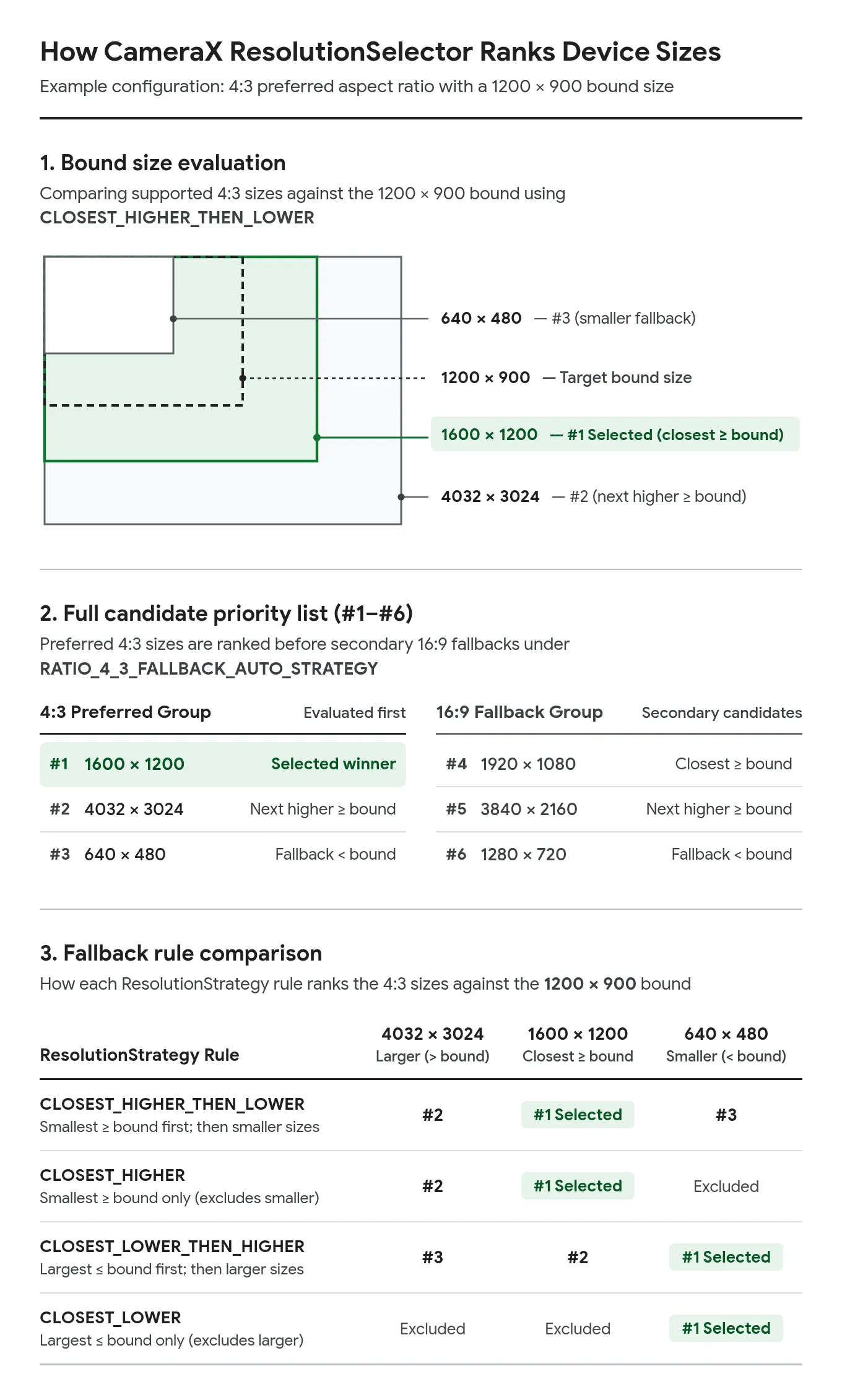
By leveraging CameraX’s core use cases—specifically Preview and ImageAnalysis—the engineering team constructed a robust, dual-purpose camera pipeline that simultaneously renders a smooth user interface preview while feeding real-time frames into on-device machine learning models. A critical breakthrough in this migration was the adoption of CameraX’s advanced ResolutionSelector API, integrated directly into the ImageAnalysis configuration.
The ResolutionSelector API allows developers to define precise target resolutions while establishing intelligent fallback rules for hardware that lacks native support for those exact dimensions. By pairing this selection mechanism with STRATEGY_KEEP_ONLY_LATEST backpressure strategies, SmileID ensured that slower processors on entry-level devices would simply drop older, unprocessed frames rather than accumulating memory queues that lead to out-of-memory crashes.

Through this optimized pipeline, SmileID achieved a remarkable fourfold increase in captured selfie and liveness pixels without imposing any additional network overhead. The SDK intelligently crops and compresses the face region locally on the device, ensuring that the data payload sent to cloud-based servers remains identical in size to legacy implementations. This architectural elegance provided their machine learning models with hyper-detailed biometric data while preserving user cellular data allowances.
The Role of Automated Hardware Testing and Quirk Management
The success of SmileID’s migration highlights a broader truth about Android development: building resilient applications for a fragmented device market requires robust infrastructure support from platform providers. CameraX achieves its unprecedented device compatibility through two foundational mechanisms maintained by Google: extensive physical laboratory testing and automated quirk management.
First, CameraX’s stability is continuously verified through Google’s dedicated Camera and Media Test Lab. In this facility, automated test suites execute daily across a rotating, exhaustive matrix of more than 190 physical Android device models, encompassing diverse chipsets, varying operating system iterations, and specialized form factors. This rigorous continuous integration testing catches library regressions before they can impact production deployments.
Second, CameraX incorporates an intelligent internal system of device quirk classes—such as DeviceQuirks and CameraQuirks within the camera-camera2 library. When the library detects an incoming runtime environment running on a device known to exhibit specific hardware flaws, such as inverted sensor orientations or broken exposure controls, it automatically injects tailored software workarounds. For SmileID, this meant their engineering team was spared the grueling task of writing and maintaining thousands of conditional code blocks for individual device models. Consequently, their SDK achieved native compatibility across more than 18,000 distinct Android device types.
Quantifiable Business Impact and Scale
The decision to migrate SmileID’s mobile infrastructure to CameraX yielded immediate, measurable improvements across all core business and technical metrics. Most notably, the elimination of aspect ratio distortions, preview lag, and memory-related crashes drove a 20 percent increase in verification pass rates for client applications utilizing SmileID SDKs. In the context of African financial services, where digital onboarding represents the primary gateway to banking, loans, and mobile wallets, a 20 percent rise in successful verifications translates to hundreds of thousands of legitimate users seamlessly gaining access to the formal economy rather than abandoning the process due to technical friction.
The dramatic improvement in reliability and integration simplicity did not go unnoticed by the developer community. In the first year following the CameraX integration, SmileID experienced a fifteenfold surge in SDK adoption, which expanded to a twentyfold increase by the second year. To date, the platform has successfully processed more than 160 million identity verifications globally, establishing a new benchmark for biometric security and reliability in emerging markets.
Industry analysts reviewing the partnership emphasize that SmileID’s trajectory underscores the vital importance of modern Jetpack libraries in solving perennial mobile development challenges. By delegating low-level hardware abstraction and device-specific bug management to CameraX, enterprise SDK providers can redirect their engineering talent toward core product innovation—such as enhancing anti-spoofing algorithms and expanding machine learning detection capabilities—rather than spending countless hours debugging OEM camera implementations.
Future Outlook and Developer Tooling
As digital identity verification becomes increasingly critical in safeguarding financial systems against synthetic identity fraud and deepfake injections, the demand for robust, high-performance camera pipelines will only accelerate. To help engineering teams replicate SmileID’s success without reinventing the wheel, the Android ecosystem continues to expand its developer support frameworks.
Recently, Android introduced the CameraX Skill for AI coding agents. By integrating this specialized skill into modern development environments, developers utilizing AI assistants like Gemini can automatically generate production-ready code adhering to current CameraX best practices. Whether development teams are migrating legacy implementations, configuring complex multi-camera bindings with ConcurrentCamera, or integrating real-time machine learning pipelines via MlKitAnalyzer, these intelligent tooling additions ensure that writing reliable, cross-compatible camera software is more accessible than ever.
Ultimately, the collaboration between SmileID and the Android CameraX team serves as a definitive case study in modern mobile engineering. By prioritizing architectural consistency, leveraging advanced hardware abstraction layers, and embracing automated ecosystem compatibility, enterprises can successfully scale across the most fractured hardware landscapes in the world, delivering secure, frictionless digital experiences to hundreds of millions of users.