A Chronology of Cross-Platform Expansion
The journey toward this announcement began nearly a decade ago, but the specific trajectory toward Meta Quest can be traced back to the 2021 "Many Platform Vision" blog post. At that time, the React Native core team committed to a future where the framework would be agnostic to the underlying hardware. Since then, the ecosystem has matured to support not only iOS and Android but also desktop environments like macOS and Windows, Apple TV, and, more recently, the web via technologies such as react-strict-dom.
The integration with Meta Quest represents a logical, albeit technically complex, progression. Meta Horizon OS is fundamentally an Android-based operating system, a design choice that facilitates a smoother transition for the vast community of React Native developers. Because the underlying architecture shares DNA with the Android Open Source Project (AOSP), the majority of existing build systems, debugging workflows, and native tooling remain compatible with minimal modifications. This ensures that a developer proficient in building a standard mobile application can pivot to VR development with a relatively low barrier to entry.
Technical Foundations and Developer Workflow
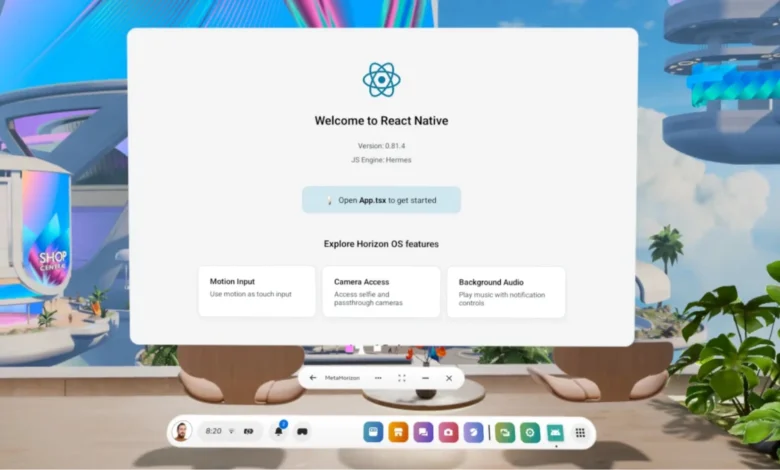
For the developer, the transition to Meta Quest is largely defined by familiarity. Because Meta Horizon OS functions within the Android ecosystem, the familiar suite of Expo tools—specifically Expo Go—serves as the primary gateway for rapid prototyping. Developers can launch their development servers and render their React Native applications directly on the headset, mirroring the workflow they utilize for smartphone apps.
When projects graduate from the UI prototyping phase to more complex, native-integrated applications, the "development build" workflow becomes the standard. This methodology allows developers to include custom native modules, which is essential for accessing the unique hardware sensors and input systems inherent to VR. To simplify this, the community has introduced the expo-horizon-core plugin. This tool automates the necessary configuration for Meta Horizon OS, handling requirements like product flavors, specific application metadata, and manifest configurations that are required for successful deployment on the Meta Quest store.
Navigating the AOSP Environment
A critical distinction in this transition is the absence of Google Mobile Services (GMS) on Meta Horizon OS. Because the platform is built on AOSP, it does not support Google’s proprietary services, such as the Play Store, Google Maps, or Firebase Cloud Messaging. This carries significant implications for developers accustomed to relying on these services.
"Developers must shift their mindset regarding dependencies," notes a lead engineer close to the project. "While the framework is the same, the service layer is fundamentally different." Applications that rely heavily on Google Play Services must either be refactored to use platform-agnostic alternatives or replaced with native solutions provided by the Meta Horizon SDK. This includes critical areas like push notifications and location services, for which specialized libraries are now available to bridge the gap.

Design Principles for Spatial Computing
Beyond the technical setup, the move to Meta Quest forces a necessary reckoning with user experience (UX) design. Mobile apps are built for touch interfaces, compact screens, and variable lighting. VR apps, by contrast, are consumed in a three-dimensional space where the interface is rendered at a distance.
The design guidelines for this new integration emphasize several key factors:
- Input Agnosticism: While mobile development relies on touch, Quest development must account for controller-based pointing, hand tracking, and potential keyboard/mouse inputs.
- Readability at Scale: UI elements require larger hit targets and high-contrast typography to remain legible in a virtual environment.
- Responsive Layouts: Just as developers adapted to the rise of foldable devices, they must now embrace "spatial responsiveness," where the application window can be resized or positioned dynamically in 3D space.
Implications for the Ecosystem
The implications of this announcement extend far beyond the convenience of existing developers. By lowering the cost of entry for building VR applications, Meta and the React Native team are essentially inviting a wave of web-first developers into the XR (Extended Reality) space. Historically, VR development was gated behind specialized game engines like Unity or Unreal, which require a steep learning curve in C# or C++. React Native’s entry provides a viable, high-performance alternative for enterprise, productivity, and utility applications that do not necessarily require the heavy-duty physics engines of gaming platforms.
Industry analysts observe that this move aligns with a broader industry trend of "convergence." As headsets become more sophisticated and lightweight, the distinction between a desktop application, a mobile application, and a spatial application is narrowing. By enabling React Native on Meta Quest, the framework is positioning itself as the "glue" that will hold this fragmented landscape together.
Future Outlook and Support
The support for Meta Quest is not merely a one-time release but an ongoing commitment to the platform. The documentation provided by the React Native team is robust, offering clear pathways for handling permissions, identifying hardware-specific capabilities, and utilizing runtime utilities to detect whether an app is running on a Quest device.
For those looking to get started, the community has provided reference projects that demonstrate how to manage the lifecycle of a Quest application. As the platform matures, we can expect to see an increase in third-party library support, as maintainers begin to test and optimize their packages for the unique constraints of Horizon OS.
The collaboration between the React Native core team and the engineers at Meta underscores a shared belief: that the next generation of computing should be built on accessible, open standards. By building on the established success of Android, the React Native community has ensured that the leap into virtual reality is not a leap into the unknown, but a natural evolution of a proven, robust development cycle. As more developers begin to ship their first VR projects, the framework will continue to refine its abstractions, ensuring that the "Many Platform Vision" remains a reality for years to come.
Related posts: