Strumming the Quantum Chord: ETH Zurich Physicists Harness Microscopic Vibrations to Revolutionize Computer Memory

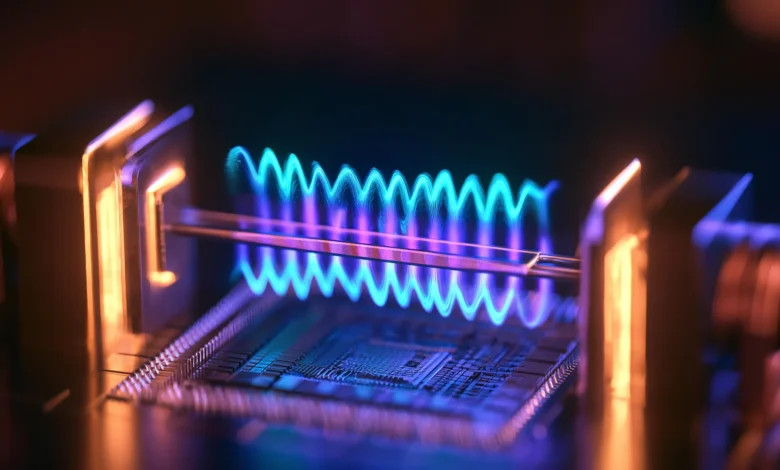
The intersection of classical musical theory and bleeding-edge quantum physics may seem unlikely, yet researchers at the prestigious ETH Zurich have successfully bridged these disparate worlds. Led by physicist Yiwen Chu, a dedicated research team has engineered a pioneering system that utilizes microscopic mechanical vibrations to store and manipulate delicate quantum information, mirroring the acoustic principles of vibrating guitar strings. While these high-frequency oscillations operate entirely beyond the threshold of human hearing, they take place within a specialized quantum chip, effectively establishing a novel and highly efficient paradigm for quantum computer memory.
This breakthrough, recently detailed in the peer-reviewed journal Science, marks a significant departure from traditional quantum computer designs. By introducing a modular architecture that separates the processing unit from the working memory—much like a conventional digital computer splits tasks between a central processing unit (CPU) and random access memory (RAM)—the ETH Zurich team has addressed one of the most persistent bottlenecks in modern quantum engineering. As the scientific community races to build scalable, fault-tolerant quantum machines capable of outperforming classical supercomputers, this acoustic approach offers a compelling pathway toward overcoming physical scaling limits.
The Architectural Evolution: Mimicking Classical Computing
For decades, the standard approach in quantum computing hardware has involved tightly integrating information processing and storage components. Superconducting circuits, which serve as the primary processing units in many modern quantum computers, have traditionally relied on electromagnetic memory elements to retain data. While these electromagnetic systems offer high fidelity and are deeply understood by physicists, they suffer from a major structural drawback: physical bulk. Electromagnetic resonators require substantial space on a chip, creating severe spatial constraints when researchers attempt to integrate hundreds or thousands of qubits into a unified architecture.
Dr. Chu’s team drew direct inspiration from the macroscopic architecture of everyday digital computers to solve this spatial dilemma. In a standard laptop or desktop computer, the CPU executes heavy computational logic, while data is temporarily housed in RAM chips situated separately on the motherboard. This modular design maximizes efficiency and prevents resource contention.
In the newly developed ETH Zurich system, a superconducting qubit takes on the role of the CPU, executing core calculations and control operations. Meanwhile, a distinct mechanical resonator acts as the quantum equivalent of RAM. Instead of storing information electromagnetically, this quantum working memory encodes data into precise mechanical vibrations—phonons—trapped within microscopic structures. When the superconducting qubit requires specific data points, it accesses the stored vibrational state, performs the necessary logical operations, and subsequently returns the modified information back to the mechanical memory bank.
Chronology of the Breakthrough and Experimental Validation
The road to integrating mechanical resonators with superconducting qubits has been a gradual evolution spanning over a decade of global research in circuit quantum electrodynamics (cQED) and optomechanics. Initial academic explorations focused primarily on coupling light with mechanical motion, eventually shifting toward microwave frequencies to interface directly with superconducting qubits.
The recent publication in Science represents the culmination of years of rigorous experimental design by Chu and doctoral student Igor Kladaric. Prior to this milestone, the scientific community questioned whether mechanical systems could maintain quantum coherence long enough to execute meaningful algorithms without suffering from excessive decoherence—the loss of quantum information due to environmental interference.
To evaluate the operational viability of their vibration-based architecture, the ETH Zurich researchers subjected their system to rigorous computational stress tests. Specifically, they implemented two foundational algorithms: the quantum Fourier transform and a period-finding protocol. Both procedures are considered gold standards in quantum benchmarking because they demand precise, simultaneous coordination across multiple quantum states.
The quantum Fourier transform, in particular, is an essential subroutine underpinning numerous complex algorithms, including Shor’s algorithm for integer factorization, which poses a theoretical threat to modern cryptographic systems. By successfully executing these routines, the team demonstrated that their mechanical memory architecture is not merely a passive storage device capable of holding static data, but a dynamic, fully integrated component capable of supporting active, programmable quantum computations.
Advantages of Acoustic Quantum Memory
The pivot from electromagnetic storage to mechanical vibration yields several distinct physical advantages that could accelerate the timeline for commercial quantum hardware development.
First and foremost is spatial efficiency. Microscopic mechanical resonators possess a significantly smaller physical footprint than their electromagnetic counterparts. This miniaturization is crucial for scalability, as it allows engineers to pack significantly more memory units onto a single quantum processor without expanding the overall physical dimensions of the cryogenic hardware housing the system.
Furthermore, mechanical resonators exhibit remarkable versatility. They are capable of supporting a diverse array of vibrational modes—different spatial patterns of oscillation—within a single microscopic structure. This multi-mode capability opens the door to multiplexing, enabling the system to store and process multiple streams of quantum information simultaneously within the same physical volume.
Perhaps most critically, mechanical resonators often boast exceptionally long coherence times compared to certain electromagnetic alternatives. By preserving quantum states for extended periods before thermal or environmental noise causes the information to degrade, the system provides a wider operational window. This extended persistence is vital for executing deep, multi-step quantum algorithms that require data to remain stable throughout complex computational sequences.
Expert Analysis and Industry Implications
The broader implications of the ETH Zurich study extend far beyond academic curiosity. Quantum computing experts note that hardware scaling remains the single greatest hurdle facing technology giants and academic laboratories alike. Current systems require elaborate cryogenic refrigeration units and complex wiring harnesses, making large-scale expansion exceptionally difficult.
By introducing a compact, vibration-based memory system that integrates seamlessly with superconducting processors, the research team has provided the industry with a viable alternative to purely electromagnetic scaling. If successfully scaled, this architecture could drastically reduce the physical complexity of quantum processor units.
However, independent analysts emphasize that translating laboratory-scale demonstrations into commercial, fault-tolerant machines remains a formidable engineering challenge. While the ETH Zurich chip successfully executed fundamental algorithms, scaling the technology to thousands or millions of interconnected qubits while maintaining low error rates will require overcoming complex materials science and fabrication hurdles. The mechanical properties of the resonators must remain uniform across large arrays, and stray thermal noise must be meticulously managed at millikelvin temperatures.
Outlook and Future Horizons
As Yiwen Chu and her colleagues look toward the future, their immediate research agenda focuses on addressing these scaling challenges. The primary objective is to determine whether mechanical quantum memory can maintain its high fidelity and coherence as additional components, more complex control electronics, and larger arrays of qubits are integrated into subsequent generations of the chip.
While practical, fault-tolerant quantum computers capable of solving industry-scale problems are still estimated to be years away from widespread deployment, foundational innovations continue to reshape the trajectory of the field. By demonstrating that the microscopic physics of vibration can be harnessed to store and manipulate quantum information with high precision, the ETH Zurich research team has opened an exciting new acoustic chapter in the ongoing quest to build the ultimate computing machine.