PCloud Pass Security Breach Triggers Global User Alarms and Puts Password Management Industry Under Scrutiny


The landscape of digital security was rattled once again as pCloud Pass, the dedicated password manager developed by cloud storage provider pCloud, suffered a targeted cyberattack. The security incident, which began unfolding late last week, sent automated security alerts to users worldwide, informing them that unknown devices had successfully established connections with their password management accounts. For many customers, the alarm was compounded by the fact that these unauthorized access attempts appeared to bypass or occur despite the active implementation of two-factor authentication (2FA).
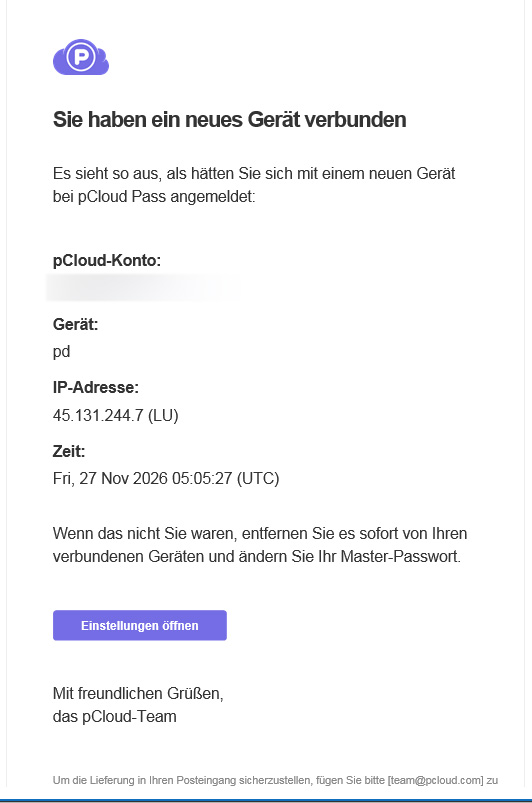
The initial wave of panic was registered across various online communities and customer support channels. Users took to digital forums, most notably Reddit, to share alarming screenshots and details of security notifications they had received from the company. According to these widespread customer reports, the alerts warned that an unfamiliar, generic device identified simply as "pd" had connected to their pCloud Pass accounts. Digital forensics conducted by observant users traced the originating IP address of these connections to 45.131.244.7, a network block located in Luxembourg that customers quickly identified as belonging to pCloud’s own corporate and server infrastructure.
Complicating matters further, several affected users reported receiving these security warnings even though they had rigorously maintained multi-layered security protocols, including robust two-factor authentication frameworks. However, when these concerned individuals logged into their dashboards to audit their account security and inspect active device sessions, some found no trace of unfamiliar hardware or unauthorized client apps listed. The anomalies did not stop there; bizarrely, other individuals reported receiving identical warning notifications despite never having used pCloud Pass in their lives. Among these anomalous reports was an individual who received the security alert on an email address tied to a legacy pCloud storage account that had been formally requested for deletion nearly a year prior.
Official Response and Containment Measures
In the wake of mounting public concern and bewildered inquiries across social media platforms, pCloud’s executive and engineering teams moved to address the situation publicly. The company officially confirmed that its password manager infrastructure had indeed been subjected to a malicious cyberattack. However, pCloud representatives emphasized that the hostile activity was swiftly identified, isolated, and contained by their internal incident response units.
In a formal statement published on Reddit, a pCloud representative outlined the preliminary findings of the security event. "A cyberattack targeting pCloud Pass occurred, which was promptly contained by the pCloud team," the statement read. The company elaborated on the nature of the intrusion, explaining that a limited segment of pCloud Pass user email addresses was exposed during the breach, prompting threat actors to initiate automated login attempts against those specific vectors. pCloud noted that the security warning emails received by customers were, in fact, a byproduct of their automated defensive systems reacting to these unauthorized login probes.

Crucially, pCloud management sought to reassure its user base by drawing a strict boundary between its various service offerings. The company asserted that the cyberattack was strictly isolated to the pCloud Pass password manager ecosystem and that its core cloud storage infrastructure remained entirely unaffected by the breach. Furthermore, pCloud stated that sensitive user data—including stored passwords, secure notes, and other confidential credentials housed within pCloud Pass—remained uncompromised. The organization explained that because pCloud Pass employs a zero-knowledge architecture where data is encrypted locally on the customer’s device, the underlying vaults can theoretically only be decrypted using the individual user’s unique master password.
Unresolved Questions and Technical Irregularities
Despite pCloud’s assurances regarding the safety of stored vaults, critical questions and red flags raised by cybersecurity researchers and observant customers remain unaddressed by the company. Most notably, pCloud has not explicitly clarified whether threat actors managed to successfully access or exfiltrate encrypted password vaults during the course of the attack.
In the realm of modern cryptography and credential management, the unauthorized theft of an encrypted password vault is an event of grave concern. While zero-knowledge encryption ensures that data remains unreadable without the master password, the possession of an encrypted vault allows malicious actors to launch offline brute-force attacks against the cryptographic hashes. Unlike active online logins, offline cracking attempts are not throttled by service rate limits, nor are they hindered by two-factor authentication protections. Attackers can leverage massive computing power, specialized hardware arrays, and artificial intelligence to systematically guess weak or reused master passwords at their own leisure.
This exact scenario manifested in the infamous 2022 LastPass security breach, where threat actors stole backup files containing encrypted password vaults. Months and years later, security researchers successfully traced those stolen vaults to coordinated cryptocurrency theft campaigns, where victims who utilized weak or reused master passwords saw their digital wallet private keys and seed phrases compromised.
Adding to the technical confusion surrounding the pCloud Pass incident, security-conscious users who analyzed the incident pointed out a glaring anomaly within the warning notifications themselves. Multiple readers and technology publications, including BleepingComputer, verified that the "Open settings" hyperlink embedded within the official pCloud security email directed recipients to passqa1.pcloud.com. This specific hostname strongly indicates a quality assurance (QA) or pre-production testing environment rather than the secure, live production environment normally utilized by the password manager service. The presence of QA links in production-bound security emails has led to speculation regarding potential misconfigurations or internal staging exposures during the timeline of the attack.
Broader Industry Implications and the November Wave of Breaches

The pCloud Pass incident does not occur in a vacuum; rather, it represents the latest in a troubling cascade of high-profile security events impacting the password management sector within a remarkably short timeframe. The cybersecurity community has observed an unprecedented concentration of attacks targeting credential-storing entities throughout the month of November, sending shockwaves through an industry built on the premise of absolute digital trust.
Earlier in the month, mSeven Software issued an urgent security advisory urging mSecure password manager customers to immediately change all stored passwords, reset their two-factor authentication parameters, and purge vulnerable passkeys from their systems. That advisory followed a sophisticated intrusion in which a hacker successfully exfiltrated an encrypted customer database.
Just days before the pCloud incident came to light, 1Password—one of the most widely trusted names in the password management industry—disclosed a significant data breach. The incident at 1Password unfolded after a persistent threat actor successfully compromised an internal employee’s GitHub account. Leveraging the compromised credentials, the attacker deployed unauthorized malicious code directly into the company’s backend service pipeline in an effort to scrape and steal customer data. Fortunately, similar to pCloud’s defense mechanisms, 1Password maintained that core customer password vaults and the critical encryption keys protecting them were safeguarded and remained uncompromised.
These consecutive security events highlight an evolving threat landscape where malicious actors increasingly view password managers and credential vaults as high-value, centralized honeypots. By compromising a single password management infrastructure, attackers gain the potential leverage to access vast networks of secondary accounts belonging to thousands of individuals and enterprises.
Artificial Intelligence and Emerging Threat Vectors
In its post-incident communications, pCloud touched upon the broader macro-environmental factors influencing modern cybersecurity, noting that rapid advancements in artificial intelligence are drastically accelerating the discovery and exploitation of software vulnerabilities. While the company did not explicitly categorize the attack against pCloud Pass as an AI-driven assault, security analysts widely agree that threat actors are increasingly weaponizing machine learning models to automate reconnaissance, map out attack surfaces, and discover zero-day flaws at speeds that traditional defensive teams struggle to match.
The integration of generative and analytical AI into cybercriminal toolkits means that defensive perimeters are being probed continuously, requiring password management vendors to adopt equally sophisticated AI-driven defense mechanisms. Adaptive security protocols, behavioral anomaly detection, and automated threat intelligence sharing are rapidly transitioning from optional enterprise upgrades to essential baseline requirements for any service handling sensitive personal data.
Recommendations and Best Practices for Affected Users
In response to the unfolding situation, pCloud has issued explicit guidelines to its user base, strongly urging customers to remain vigilant against opportunistic secondary attacks, particularly phishing campaigns that frequently piggyback on major security incidents. The company reiterated a foundational security rule: pCloud representatives will never, under any circumstances, ask users for their master passwords, account recovery words, or sensitive personal credentials over email, telephone, or live chat support channels.
Cybersecurity experts recommend that all pCloud Pass users—and individuals utilizing password managers in general—take proactive steps to secure their digital footprints in the wake of such incidents:
- Master Password Hygiene: Ensure that the master password protecting the vault is exceptionally strong, entirely unique, and never reused across any other online service or platform.
- Vault Auditing: Regularly review stored credentials within the password manager to identify and update weak, old, or duplicated passwords.
- Enhanced Authentication: Verify that multi-factor authentication is active on all accounts associated with the password manager, prioritizing hardware-based security keys (FIDO2/WebAuthn) over SMS-based or app-based one-time passwords where supported.
- Phishing Vigilance: Exercise extreme caution regarding incoming communications, notifications, or emails referencing the pCloud incident, verifying all links and avoiding the disclosure of sensitive credentials to unverified sources.
As the digital ecosystem continues to grapple with sophisticated, automated, and AI-accelerated threats, the pCloud Pass incident serves as a stark reminder that even the guardians of our digital keys are prime targets for malicious actors. The ability of companies to maintain transparent communication, rapid containment, and airtight cryptographic isolation will ultimately determine user trust in the security-critical password management industry moving forward.
Related posts: