Combining LLM Embeddings with Tabular Features in a Unified Scikit-learn Pipeline

The Evolution of Hybrid Data Architectures
For over a decade, machine learning pipelines were largely bifurcated. Text data required specialized natural language processing (NLP) libraries, often involving bag-of-words or TF-IDF vectorization, while tabular data relied on standard feature engineering, such as one-hot encoding for categorical variables and Min-Max scaling for numerical attributes. This separation often led to "siloed" modeling, where insights extracted from text were treated as secondary features rather than being deeply integrated into the core predictive engine.
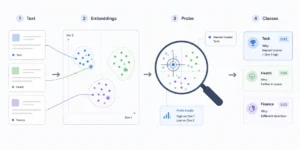
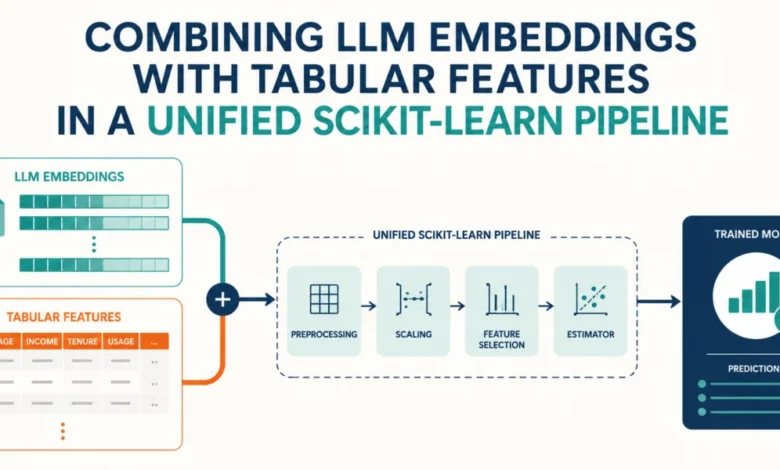
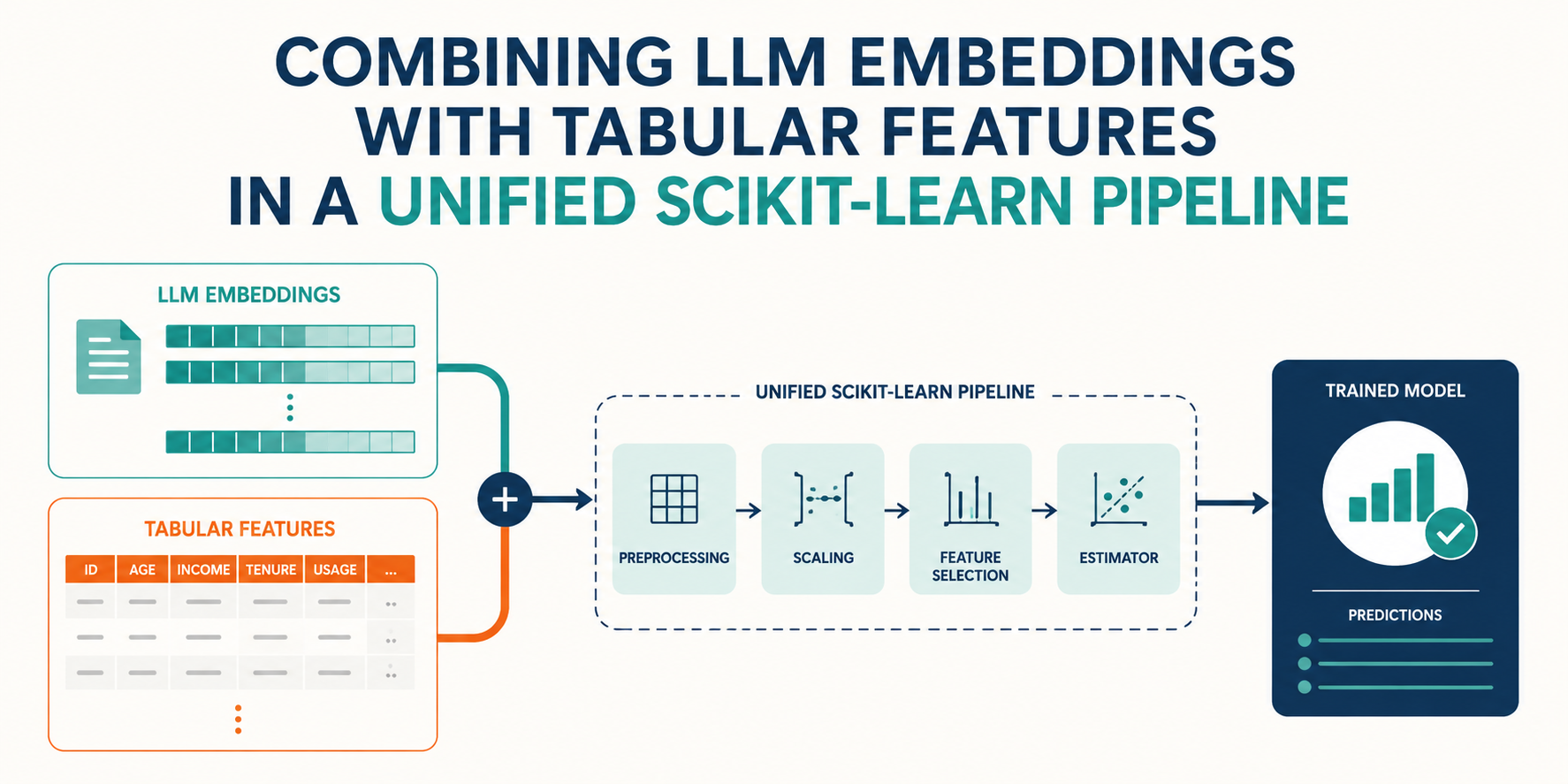
The emergence of transformer-based architectures and lightweight language models has fundamentally altered this landscape. However, the operational challenge remains: how to integrate high-dimensional semantic embeddings from large language models (LLMs) into standard machine learning workflows without sacrificing performance or scalability. The adoption of the ColumnTransformer within the scikit-learn ecosystem provides a standardized methodology to bridge this gap, allowing for the parallel processing of mixed data types before concatenating them into a single feature vector for downstream classifiers.
A Chronology of Pipeline Integration
The shift toward unified pipelines can be traced back to the introduction of scikit-learn’s Pipeline and ColumnTransformer classes. These tools were designed to combat the "data leakage" that occurs when preprocessing steps are applied inconsistently across training and testing sets.
- Pre-2020: Data scientists relied heavily on manual data munging, often writing custom scripts to bridge the gap between text-processing libraries like NLTK or Spacy and scikit-learn estimators.
- 2020–2023: The rise of Hugging Face’s
sentence-transformerslibrary democratized access to state-of-the-art embedding models. During this period, the industry saw a trend toward utilizing pre-trained BERT and RoBERTa models to generate static embeddings for text classification. - 2024–Present: The current industry standard emphasizes "deployment-ready" pipelines. The focus has shifted from mere feature extraction to building modular, object-oriented transformers that can be pickled and deployed as a single unit in production environments.
Technical Implementation and Design Principles
The core of a modern hybrid pipeline rests on the custom transformer class. By inheriting from BaseEstimator and TransformerMixin, developers can encapsulate the initialization and inference logic of a language model within a standard scikit-learn interface. This design ensures that the model is portable—it can be saved as a single object and loaded into a web API (such as FastAPI or Flask) for real-time inference without the need for additional preprocessing orchestration.
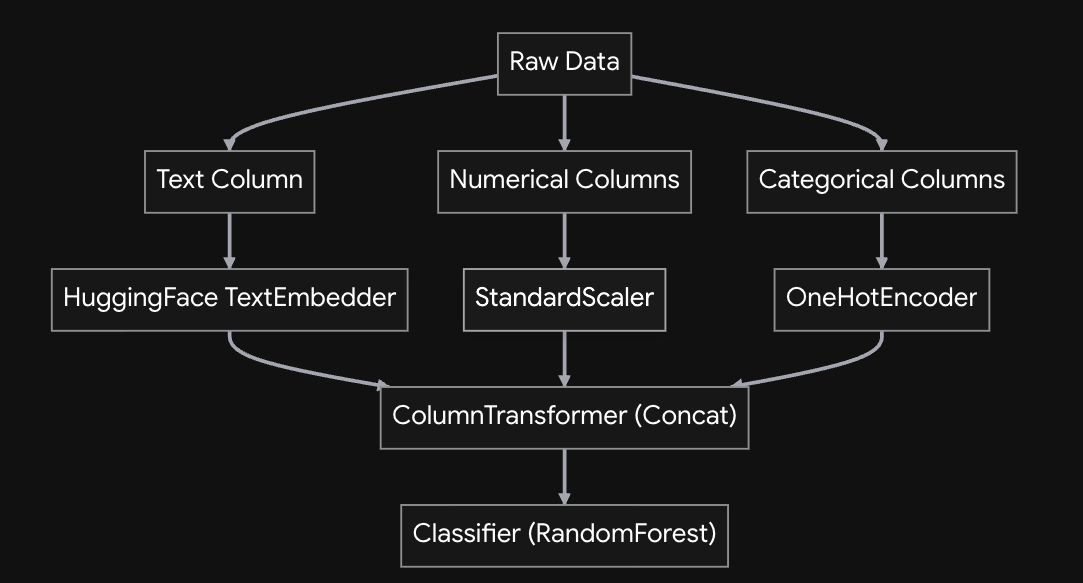
In a typical scenario—such as detecting malicious users—the pipeline architecture functions in three distinct streams:
- The Semantic Stream: The custom
TextEmbedderconsumes raw strings, passing them through a lightweight model (e.g.,all-MiniLM-L6-v2). This transforms variable-length text into fixed-length, 384-dimensional vectors that capture the intent and context of the user message. - The Numerical Stream: Standard scalar transformations normalize variables such as "account age" or "interaction frequency," ensuring that high-magnitude features do not disproportionately influence the model’s objective function.
- The Categorical Stream: One-hot encoding transforms nominal data, such as membership tiers or geographic regions, into a binary matrix format suitable for tree-based models like Random Forests or Gradient Boosting Machines.
Data Integrity and the Role of Noise
A common oversight in synthetic dataset construction is the creation of "perfect" data. In real-world applications, features are often noisy and overlapping. For instance, in a churn prediction model, a high-value customer might share behavioral traits with a churn risk. When designing a test-bed for these pipelines, it is essential to inject synthetic noise—such as overlapping distributions for priority scores—to ensure that the model learns to rely on a combination of text and tabular features rather than a single "silver bullet" variable.
The inclusion of these overlapping features provides a more realistic performance metric. If a pipeline achieves 99% accuracy on a dataset where the classes are perfectly separable, the model is likely overfitting or the data is trivial. By simulating realistic edge cases, engineers can better evaluate how the language model embeddings interact with traditional features to resolve ambiguities.
Official Perspectives on Modular AI
Leading machine learning practitioners advocate for this modular approach because it simplifies the "Model-as-a-Service" (MaaS) deployment model. When a pipeline is unified, the versioning of the preprocessing steps is inextricably linked to the versioning of the model weights. This minimizes the risk of feature drift—a common issue where the data seen by the model during inference differs slightly from the data used during training.
Industry leaders at organizations like Hugging Face and the scikit-learn development team have highlighted that the bottleneck for AI adoption is rarely the lack of model power; it is the complexity of the data plumbing. By abstracting away the complexity of embedding generation, the ColumnTransformer allows engineers to experiment with different LLMs—switching from a MiniLM to a more complex architecture—simply by changing a single parameter in the pipeline configuration.
Implications for Enterprise Predictive Analytics
The business implications of adopting unified pipelines are significant. First, the reduction in development time allows for more rapid iteration. When data scientists can swap models or features with minimal code changes, they can perform A/B testing on different embedding strategies more frequently.
Second, the maintainability of these systems is superior. Traditional "spaghetti code" pipelines are notoriously difficult to debug, particularly when an error occurs during the transformation phase. In a unified pipeline, every stage is transparent and traceable, facilitating better model auditing and compliance with emerging AI governance regulations.
Third, there is an inherent efficiency in using lightweight, CPU-friendly embeddings. While large-scale LLMs provide superior semantic depth, the latency and cost of running them for high-throughput classification tasks are often prohibitive. Utilizing smaller models via the sentence-transformers library offers a "sweet spot" of performance that is suitable for the majority of enterprise classification use cases, from sentiment analysis to automated regulatory compliance monitoring.
Conclusion
The integration of LLM-derived text embeddings with structured tabular data marks a maturation of the field. By moving away from fragmented, multi-step processes toward unified, object-oriented pipelines, organizations can build more resilient, scalable, and interpretable machine learning systems. As the data landscape continues to grow in complexity, the ability to treat text and numbers as a singular, cohesive input will remain a defining skill for effective data engineering. The use of scikit-learn’s native architecture ensures that these innovations remain accessible, reproducible, and ready for the demands of the modern, data-driven enterprise.
Related posts: