Cutting AI Operational Costs: How Markdown Formatting is Revolutionizing Token Efficiency for Intelligent Agents

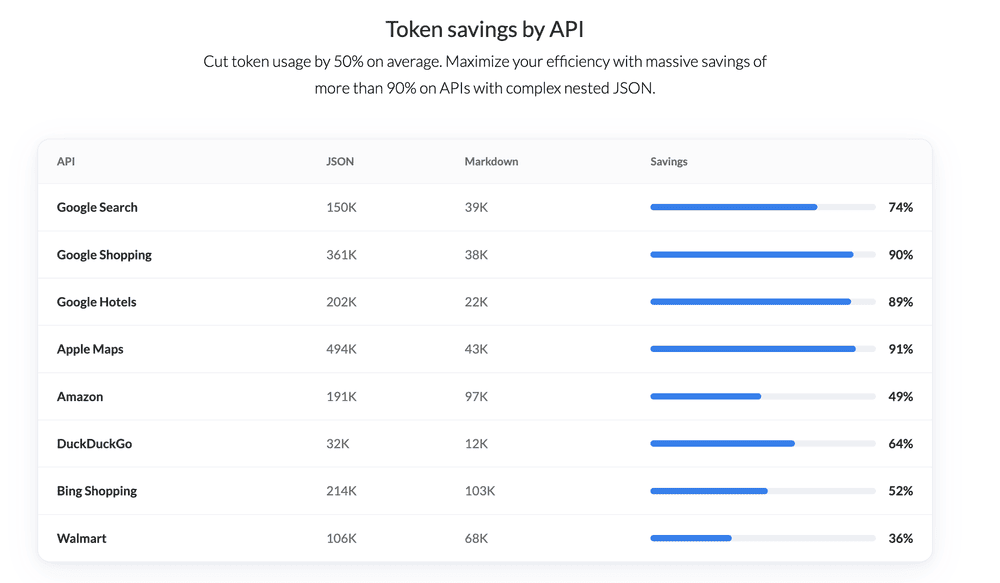
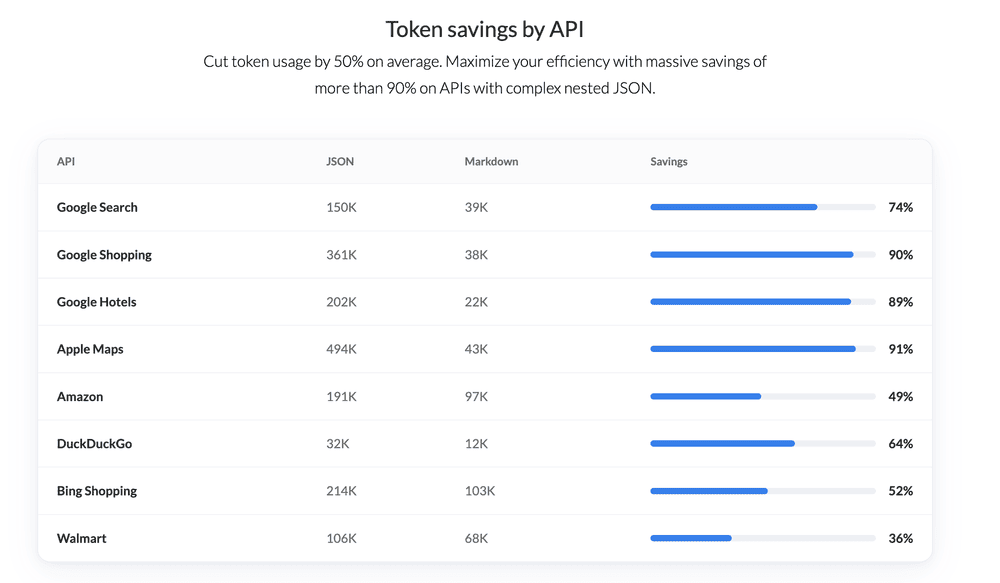
The rapid proliferation of autonomous AI agents has brought a significant, often overlooked challenge to the forefront of software engineering: the "token tax." As developers build increasingly complex agentic systems designed to browse the web, parse long-form documentation, and synthesize real-time data, the financial and computational costs of these operations are ballooning. Every time an agent initiates a search, it consumes a massive quantity of tokens to process logs, comment blocks, and nested metadata—much of which is redundant for the model’s actual reasoning process. Recent industry data indicates that shifting from traditional data formats like JSON to optimized Markdown output can reduce token consumption by as much as 74 percent, offering a critical path toward sustainable AI scaling.
The Anatomy of the Token Crisis
In the current landscape of Large Language Model (LLM) integration, developers typically rely on JSON (JavaScript Object Notation) as the industry standard for data exchange. While JSON is structurally superior for programmatic tasks—such as updating a database or performing arithmetic on a product’s price—it is inherently verbose. For an AI agent, a standard search query often returns hundreds of lines of code, including internal tracking identifiers, server metadata, and deeply nested objects that the model is forced to "read" and pay for, even if the information is entirely irrelevant to the user’s request.
For example, when an agent searches for "coffee shops," a standard JSON payload includes structural elements like brackets, key-value pairs, and long-form metadata keys. When this data is fed into a context window, the LLM consumes tokens to process these syntactic markers. Because LLMs operate on a pay-per-token model, the "noise" in a standard JSON response translates directly into a higher monthly infrastructure bill. Furthermore, because these agents often utilize recursive loops—where the agent repeats a search or digs deeper into a site—this bloat compounds exponentially, often leading to performance bottlenecks and shortened context windows that limit the agent’s ability to retain long-term memory of a session.
The Emergence of Markdown as an LLM-Native Format
Recognizing this inefficiency, platforms like SerpApi have introduced native Markdown output, which is designed specifically for machine reasoning rather than programmatic parsing. Markdown is a lightweight markup language that relies on simplified syntax—tables, bullet points, and headers—to convey structure. By stripping away the programmatic "cruft" found in JSON, Markdown allows the model to receive only the information that contributes to its understanding of the environment.
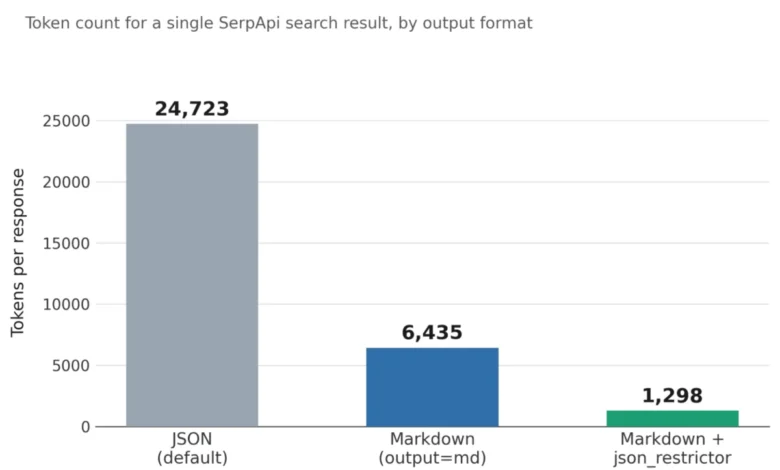
The transition from JSON to Markdown is not merely a stylistic change; it is a fundamental shift in data representation. When comparing a search for "coffee" in both formats, the token requirements drop from 24,723 tokens in JSON to just 6,435 in Markdown—a reduction of over 70 percent. This is achieved by removing redundant fields, collapsing arrays into human-readable tables, and eliminating internal tracking noise. For developers managing high-volume applications, this reduction serves two purposes: it lowers the direct cost of API calls and expands the effective capacity of the model’s context window, allowing the agent to analyze more search results within a single request cycle.
A Chronology of Data Optimization in AI
The evolution of data handling in AI can be traced through three distinct stages of development:
- The Raw Data Era (2020–2022): Early implementations of AI-driven web search relied on raw HTML or standard JSON feeds. Developers accepted the high token cost as a necessity, prioritizing the preservation of every data point over efficiency.
- The Prompt Engineering Era (2023): As costs rose, developers turned to "system prompts" to instruct models to ignore specific parts of a JSON response. While this reduced the model’s distraction, it did not solve the underlying cost problem, as the tokens were still consumed by the input layer before the model ever had a chance to "ignore" them.
- The Structural Optimization Era (2024–Present): With the introduction of server-side formatting like SerpApi’s Markdown output, the industry has moved toward pre-processing data to match the specific consumption habits of LLMs. This era marks a shift where the data provider takes responsibility for trimming the payload before it ever reaches the AI agent.
Technical Implications and Use-Case Segmentation
While Markdown is highly efficient for summarization, synthesis, and retrieval tasks, industry experts emphasize that it is not a universal replacement for JSON. The choice of format must be dictated by the downstream requirements of the agentic pipeline.
- When to use Markdown: Markdown is ideal for "Agentic Research," where the AI is tasked with gathering context, summarizing news, or performing comparative analysis. Its ability to represent data in tabular form allows models to easily compare features, prices, and ratings without the overhead of complex JSON nesting.
- When to maintain JSON: JSON remains the superior choice for systems that require high-fidelity data integrity. If an agent is designed to execute a financial transaction, update a database record, or perform precise floating-point math on product ratings, JSON’s rigid structure is necessary to ensure that the data is parsed correctly by the downstream backend systems.
The strategy currently favored by enterprise developers is to implement a hybrid approach: utilizing a "routing" mechanism where the agent requests Markdown for exploratory search queries and switches to JSON for transactional or data-heavy operations. This nuanced approach allows for maximum cost savings without sacrificing system reliability.
Economic and Operational Impact
The financial implications of token reduction are substantial. For a startup or an enterprise-level deployment running thousands of agentic queries per day, a 74 percent reduction in token volume can translate to thousands of dollars in monthly savings. Furthermore, this efficiency contributes to lower latency. Fewer tokens mean faster inference times, as the model spends less time processing input strings and more time generating tokens for the output.
There is also the matter of "Context Window Real Estate." In many modern models, the context window is a limited resource. By reducing the size of search result payloads, developers can "fit" more information into the agent’s memory. This allows an agent to process a higher volume of documents, logs, or search results in a single prompt, significantly increasing the agent’s intelligence and problem-solving capability without requiring a more expensive, larger-capacity model.
Future Outlook: Toward Smarter Data Payloads
The shift toward optimized formats like Markdown signifies a maturation of the AI industry. As the novelty of autonomous agents wears off, the focus is shifting toward the "unit economics" of AI—how to make agents profitable, scalable, and efficient.
Industry analysts suggest that we are moving toward a future where "LLM-Optimized" becomes a standard requirement for all data APIs. Future developments may include dynamic payload shaping, where an API intelligently detects the model’s requirements and adjusts the data structure in real-time. Whether through the use of Markdown, YAML, or specialized binary formats, the goal remains the same: ensuring that every token sent to an AI is essential for its reasoning.
For developers currently deploying agentic systems, the advice from the field is clear: perform a granular audit of your token usage. By testing current workflows with optimized output parameters and measuring the delta in token consumption, organizations can identify immediate opportunities for cost containment. As the data shows, the most effective way to improve an AI agent’s performance is often not to build a more complex agent, but to feed it a more efficient, relevant, and structured dataset.