The Evolution of RAG and the Chunking Challenge
The history of RAG systems is relatively brief but marked by rapid technical refinement. Early iterations of RAG relied heavily on naive, fixed-size chunking. Developers would simply split documents into 512-token segments with a small overlap. While this provided a baseline for functionality, it frequently resulted in "context fragmentation," where vital information was severed mid-sentence, leaving the LLM without the necessary semantic context to synthesize an accurate answer.
Recent advancements in embedding models, which now support significantly larger input vectors, have not negated the need for chunking; rather, they have increased the importance of precision. Today, the industry recognizes that a one-size-fits-all approach is insufficient for complex data environments. The transition from simple character-based splits to sophisticated, context-aware strategies represents a maturity milestone for enterprise AI engineering.
Understanding the Taxonomy of Chunking Strategies
To navigate the landscape of modern data ingestion, it is essential to understand the underlying assumptions of each strategy. Selecting the wrong approach is not merely a technical error; it is a resource drain that increases latency and costs without yielding improvements in retrieval accuracy.
- Fixed-size chunking: The legacy standard, assuming that overlap will mitigate the impact of arbitrary boundaries. This is increasingly viewed as an insufficient method for high-stakes information retrieval.
- Recursive chunking: A middle-ground approach that prioritizes natural language boundaries (paragraphs, sentences) over character counts.
- Document-based chunking: Leverages the native structure of the source file, such as Markdown headers, JSON fields, or Python function definitions.
- Semantic chunking: A more advanced method that monitors the vector distance between sentences, creating a "break" only when the topic shift exceeds a specific threshold.
- Late chunking: A technique designed for long-context models, where the document is encoded in its entirety before the system is partitioned, ensuring each chunk retains a global semantic footprint.
- Adaptive and Agentic chunking: The current frontier of the field, utilizing LLM-driven logic to dynamically adjust chunk sizes based on the density and nature of the content.
A Decision-Tree Framework for Implementation
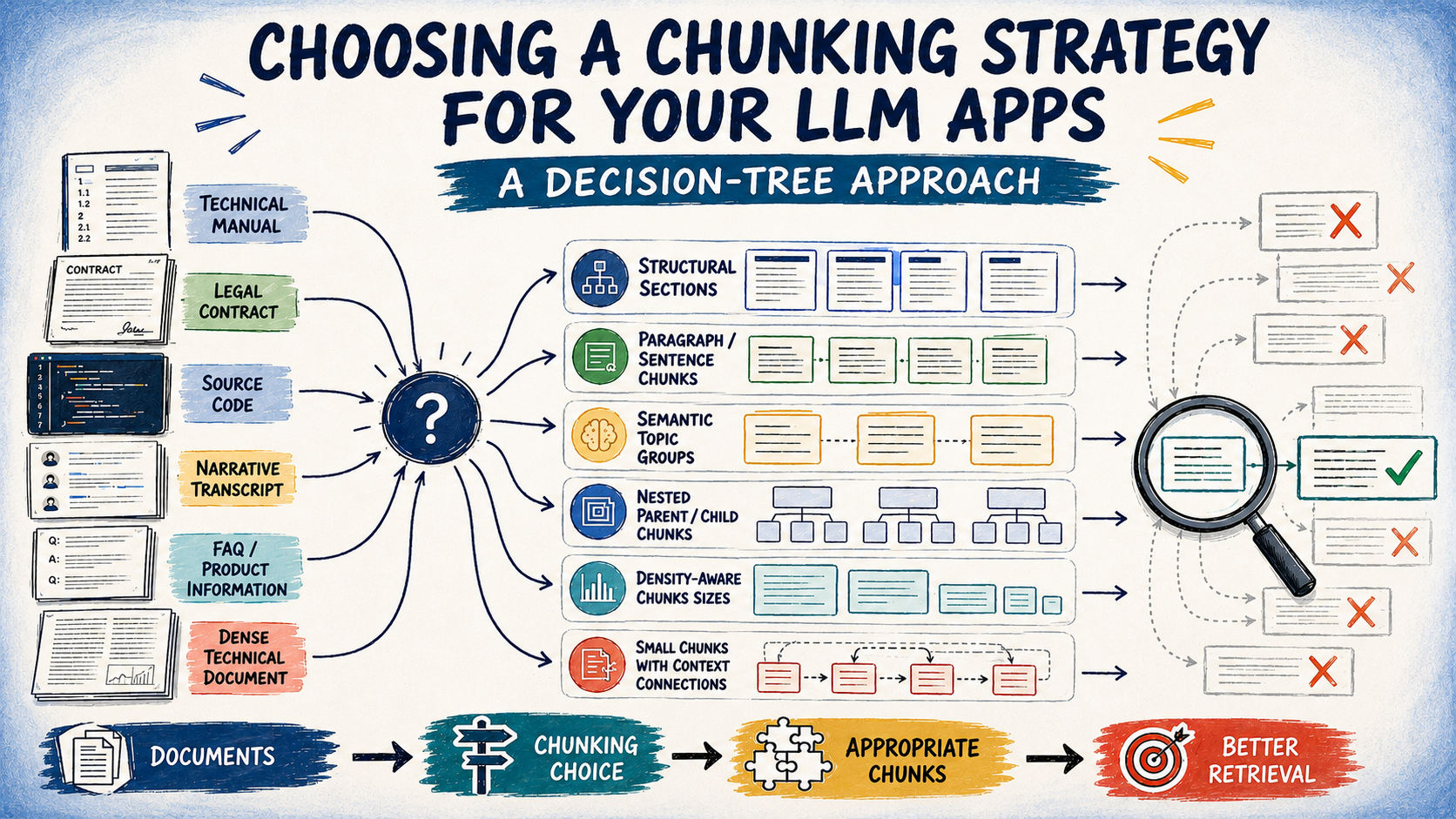
For development teams, the path to an optimal strategy is best visualized as a structured decision tree. By answering six critical questions, architects can systematically filter out ineffective methods and identify the strategy that aligns with their specific data corpus.
1. The Necessity of Partitioning
The primary question is whether the document requires chunking at all. In environments dominated by short-form data—such as FAQ databases, individual product specifications, or singular configuration snippets—chunking is often counterproductive. If a document fits within the embedding model’s context window and maintains a unified subject, it should be indexed as a single unit. Fragmentation in these instances creates noise rather than clarity.
2. Identifying Internal Structural Logic
If the document is too large for a single embedding, the next step is to analyze its structure. Documents with clear hierarchies—such as technical manuals with standardized headers, legal documents with numbered clauses, or codebases with defined functions—should be processed via document-based chunking. By aligning the chunk boundaries with the inherent logic of the document, the system maintains the semantic cohesion of the original author’s intent.
3. Contextual Dependency and Global Relationships
A common pitfall occurs when a chunk contains a reference that requires context from a previous section. For example, a "defined term" in a legal contract may be utilized across several pages. In these scenarios, late chunking is the superior choice. By encoding the full document first, the embedding reflects the global context, allowing individual chunks to be "aware" of the broader document narrative even after they are separated.
4. Managing Information Density and Granularity
Information density is rarely uniform. Technical specifications may contain high-density data alongside low-density filler text. Adaptive chunking addresses this by varying the chunk size based on the density of the information, while hierarchical chunking offers a solution for systems that must answer both broad, thematic questions and narrow, fact-specific queries simultaneously.
5. The Performance-Cost Tradeoff
Quality necessitates investment. LLM-based chunking, which uses an AI model to determine the most logical breakpoints, provides the highest level of accuracy but imposes a significant compute cost. Conversely, semantic chunking offers a balance, utilizing vector distance to detect topic shifts at a lower price point than full LLM analysis. Organizations must weigh their budget against the required retrieval precision to determine which tier is appropriate.
6. Handling Heterogeneous Collections
When a corpus consists of diverse data types—ranging from narrative transcripts to structured reports—agentic chunking is the most robust solution. An autonomous agent can classify each document and apply the appropriate strategy on a per-file basis. For more uniform datasets, recursive chunking remains the most reliable and efficient default.
Diagnostic Analysis: Identifying and Fixing Pitfalls
Even with a well-designed pipeline, technical issues are inevitable. Data science teams should monitor for specific symptoms that indicate a mismatch between the strategy and the data:
- Fragmentation: If chunks frequently cut off mid-sentence, the system is likely utilizing a structure-blind method on a structured document. The immediate correction is to pivot toward recursive or document-based strategies.
- Inconsistent Results: If semantic chunking yields erratic results across similar files, the similarity threshold is likely miscalibrated. Refining this parameter is standard procedure, though some documents may require a transition to LLM-based boundaries.
- Latency Spikes: If advanced methods like hierarchical chunking fail to improve answer accuracy, it suggests that the complexity is unnecessary for the scale of the data. Simplification is the recommended course of action in these cases.
Broader Implications for RAG Architectures
The shift toward more precise chunking is part of a larger trend toward "data-centric AI." The industry is moving away from the belief that model architecture and prompt engineering are the only levers for improving RAG performance. Instead, there is a growing consensus that the quality of the data pipeline—specifically the preprocessing of text—is the primary determinant of system success.
As LLM context windows continue to expand, the definition of a "chunk" may eventually evolve, but the fundamental requirement to maintain semantic integrity will persist. Organizations that prioritize robust, context-aware chunking strategies today are building the infrastructure necessary for the next generation of AI applications. By systematically evaluating their data structure and applying the appropriate partitioning logic, engineers can ensure that their RAG systems are not only efficient but also highly accurate in their retrieval, ultimately providing the reliability required for enterprise-grade deployment.