Vercel Integrates Amazon S3 Directly into Development Workflow to Streamline Cloud Storage Provisioning

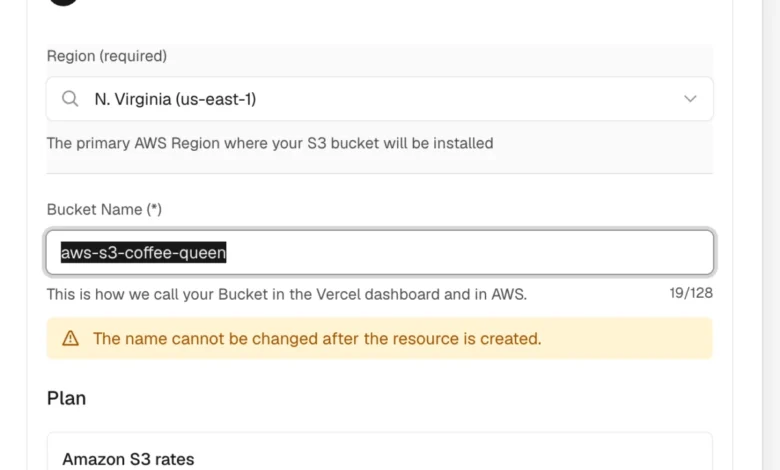
The landscape of modern web development underwent a significant shift today as Vercel, the platform for frontend developers, announced a deep, native integration of Amazon Simple Storage Service (Amazon S3) into its marketplace and v0 generative AI interface. This development marks a transition in cloud architecture, moving away from the manual, often fragmented process of provisioning infrastructure toward an automated, developer-centric experience that bridges the gap between high-level web frameworks and low-level cloud storage. By allowing developers to provision S3 buckets, S3 Tables, and S3 Vectors directly from the Vercel dashboard, the integration simplifies the deployment of complex, data-heavy applications.
A New Paradigm in Cloud Provisioning
Historically, the workflow for a developer building a full-stack application on Vercel involved a significant "context switch" when moving from code to infrastructure. Developers would write their application logic in Next.js or other frameworks, only to be forced to exit their development environment to navigate the AWS Management Console. This involved creating Identity and Access Management (IAM) policies, managing complex bucket permissions, and manually injecting environment variables—a process prone to security misconfigurations and human error.
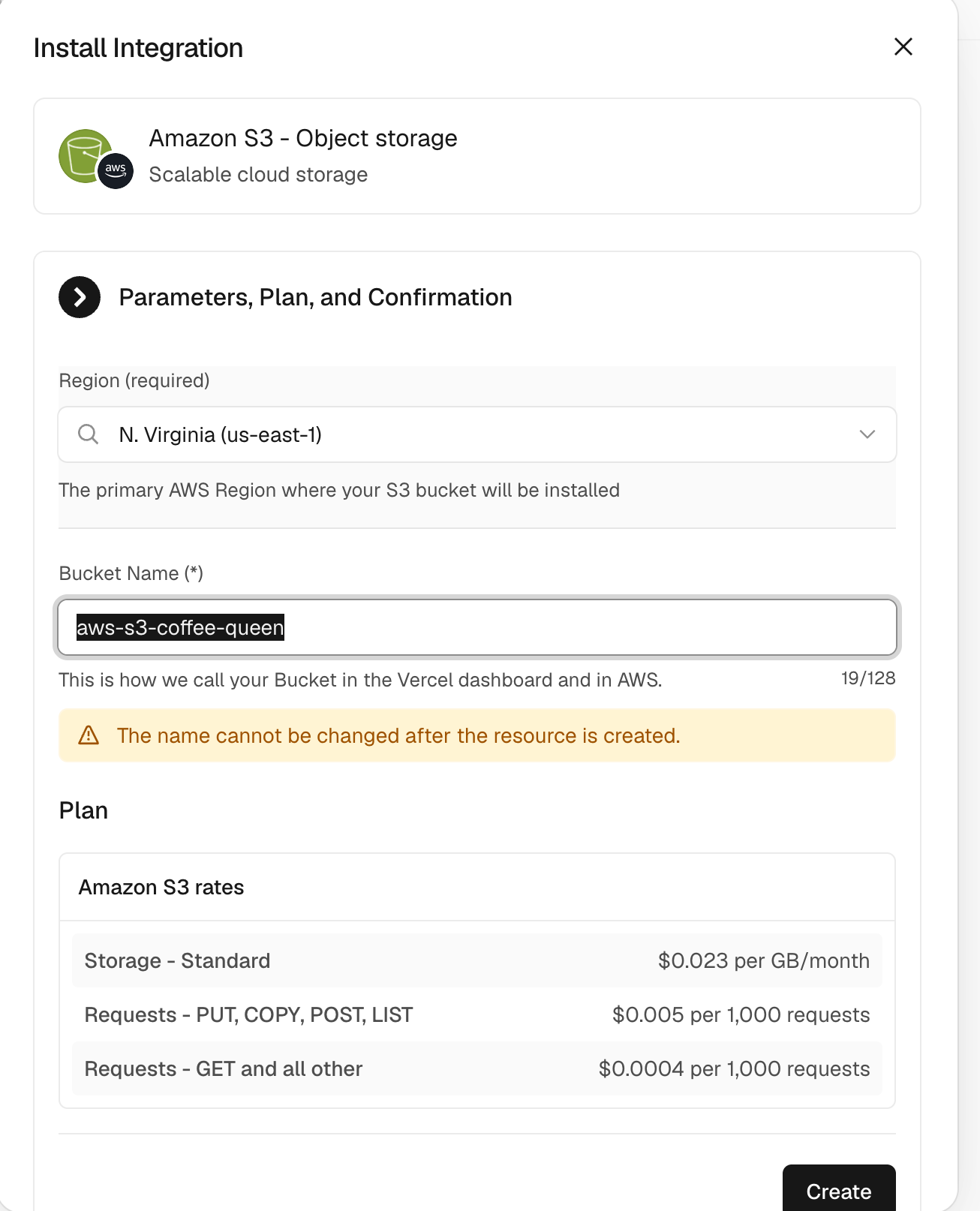
With the new integration, this friction is largely eliminated. By leveraging OIDC (OpenID Connect) for authentication, Vercel now enables the automatic generation of short-lived, secure credentials. When a developer triggers a resource creation from the Vercel Marketplace, the platform handles the handshake with AWS, injecting necessary variables like AWS_ROLE_ARN and S3_BUCKET_NAME into the project environment. This ensures that developers can focus on application features—such as image uploading, data analytics, or AI-driven semantic search—without becoming experts in AWS cloud infrastructure management.
Chronology of Infrastructure Evolution
The collaboration between Vercel and AWS has been maturing over the past several years, reflecting a broader industry trend of "Infrastructure as Code" (IaC) becoming invisible to the end-user.
- Early Stages: Vercel focused on frontend performance and serverless functions, leaving storage and database management to external manual configurations.
- The Database Shift: In previous updates, Vercel introduced native integrations for Amazon Aurora (relational), Amazon DynamoDB (NoSQL), and Amazon OpenSearch (search), establishing a pattern of bringing AWS-powered backend services directly into the Vercel control plane.
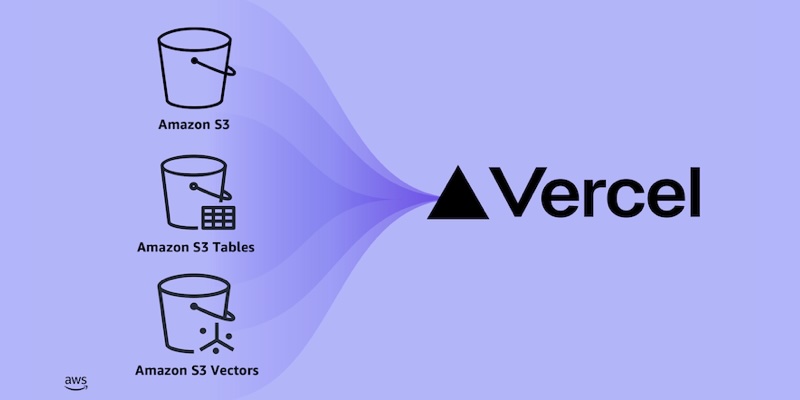
- The Current Milestone: The inclusion of Amazon S3, S3 Tables, and S3 Vectors marks the "final piece" of the puzzle, providing a comprehensive storage layer that spans traditional object storage, structured analytical tables, and high-performance vector indices for AI applications.
This progression reflects the changing nature of the web. Applications are no longer just static sites; they are now intelligent systems that require persistent object storage for media, large-scale data processing for insights, and specialized storage for Retrieval-Augmented Generation (RAG) pipelines in AI agents.
Technical Depth: Object, Analytics, and AI Storage
The integration provides access to three distinct tiers of S3 functionality, each serving a specific workload requirement.
General-purpose S3 storage remains the backbone for standard object storage needs. Whether it is storing user-generated content, static assets, or binary data, the integration allows for seamless integration via the AWS SDK. The use of the @vercel/functions/oidc module ensures that security remains a priority, as no static secret keys are ever exposed or stored in plain text.

The inclusion of S3 Tables represents a more sophisticated approach to data management. By providing fully managed Apache Iceberg tables, Vercel enables developers to perform complex analytical queries directly within their serverless functions. Utilizing tools like DuckDB, developers can query petabytes of data without the overhead of maintaining a traditional data warehouse. This capability is particularly useful for building real-time dashboards or performing ad-hoc data analysis on clickstream data.
Perhaps most timely is the support for S3 Vectors. As the industry pivots toward generative AI, the requirement for vector storage—where data is stored as high-dimensional numerical embeddings—has become standard. By offering native access to S3 Vectors, Vercel allows developers to build "intelligent" applications that can perform semantic search or power AI agents without the complexity of managing a dedicated vector database service. This enables a unified storage architecture where documents and their corresponding vector embeddings reside within the same AWS ecosystem.
Impact on the Developer Ecosystem
Industry analysts observe that this integration serves to democratize access to enterprise-grade cloud capabilities. By lowering the barrier to entry for S3, Vercel is effectively allowing smaller development teams and startups to leverage the same durability, scalability, and performance that global enterprises rely on.
Furthermore, the integration with "v0," Vercel’s generative AI tool, creates a feedback loop for developers. When a user asks v0 to build a feature—such as a PDF-based support bot—the AI now understands how to provision the required S3 Vector storage, wire up the connection, and generate the corresponding code in real-time. This reduces the "time-to-first-commit" for new projects from hours to minutes.
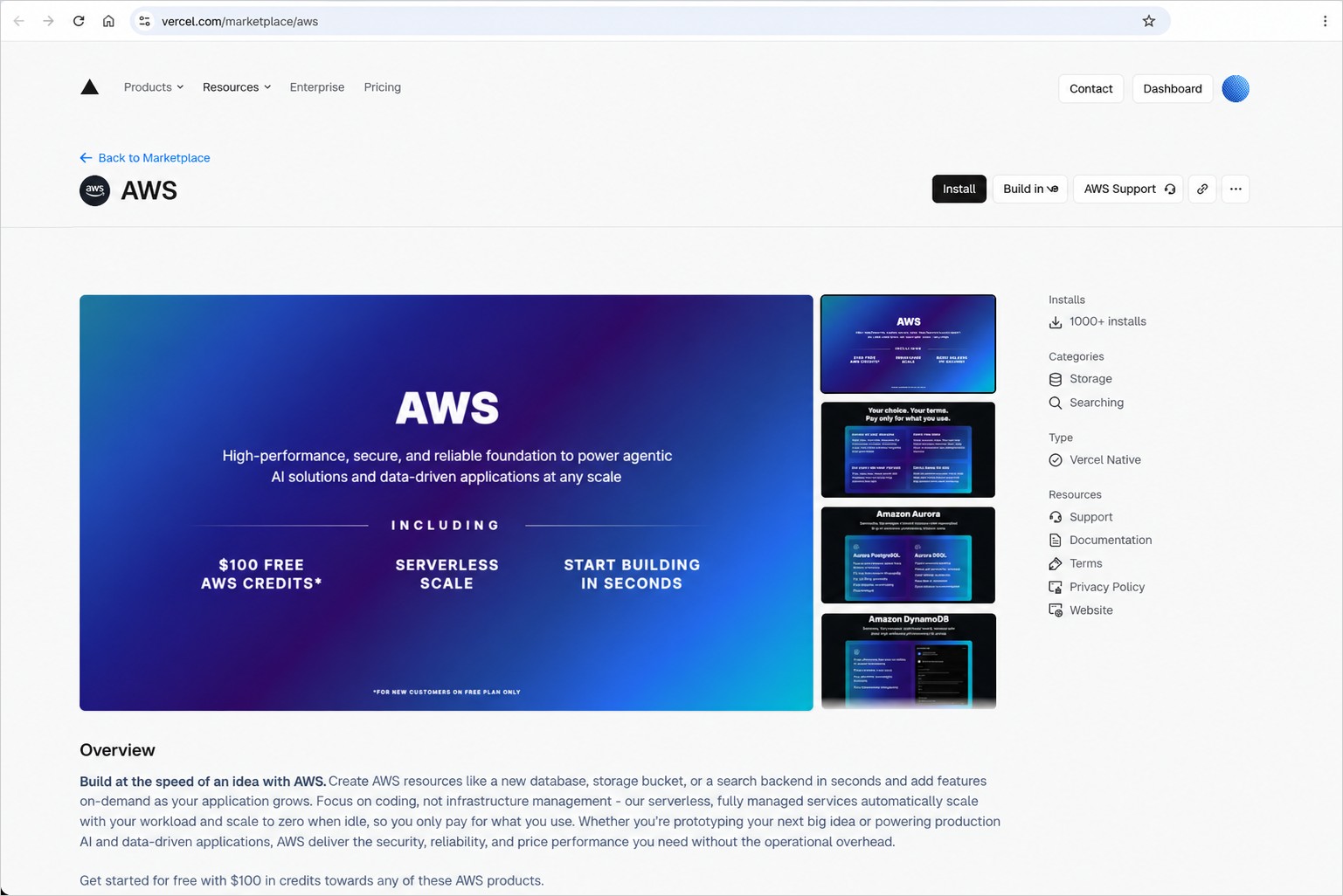
From a financial perspective, the integration maintains transparency. Vercel does not introduce a markup on the storage itself; rather, developers pay standard AWS rates for their S3 usage. This ensures that as an application scales, the cost model remains predictable and tied directly to the resource consumption rather than being obfuscated by third-party billing layers. The inclusion of $100 in AWS credits for new accounts further incentivizes developers to experiment with these services without immediate financial risk.
Strategic Implications for Vercel and AWS
This move is strategically significant for both companies. For AWS, the integration deepens the "stickiness" of the AWS ecosystem. By making S3 accessible within the Vercel dashboard, AWS captures developers who might otherwise have chosen easier-to-use, but less robust, storage alternatives. It reinforces the idea that while Vercel provides the frontend experience, AWS remains the engine room of the internet.
For Vercel, the move solidifies its position as an all-in-one platform for the modern web. By consolidating the application stack—from the frontend framework to the database and now to the object and vector storage—Vercel is positioning itself as a "Cloud Operating System" for the frontend.
Broader Industry Context
The shift toward integrated cloud services comes at a time when the "Serverless" movement is maturing. As developers continue to move away from managing servers, the focus has shifted to managing data and services. The ability to abstract away the complexity of cloud storage is not just a convenience; it is a necessity for maintaining development velocity in a competitive landscape.
However, this convenience comes with a caveat: platform lock-in. While the use of standardized protocols like Apache Iceberg and AWS SDKs provides some portability, the tight integration with Vercel’s provisioning workflow means that migrating away from the Vercel-AWS ecosystem may require more effort than a traditional multi-cloud setup. Despite this, the consensus among the developer community, as seen on platforms like AWS re:Post, is that the trade-off in productivity is well worth the cost.
Looking Forward
The integration is available immediately in all commercial AWS Regions where Vercel operates. As the company continues to refine its marketplace, developers can expect further expansions, potentially including more specialized AWS services. The current offering already covers the most critical needs of modern web applications, providing a stable foundation for the next generation of AI-enabled, data-driven software.
As developers continue to adopt these tools, the industry will likely see a reduction in the "overhead" of software development. The focus is shifting back to what matters most: the end-user experience and the functionality of the application itself, rather than the intricate plumbing required to make it run. For the millions of developers who rely on Vercel for their deployment pipelines, this integration is a welcome evolution in the quest for a more seamless and efficient development lifecycle.